Yamaha Keyboard Prices in 2026: What to Expect
Explore Yamaha keyboard prices across entry, mid-range, and premium models. Learn what drives cost, how to budget, and where to focus when shopping in 2026.


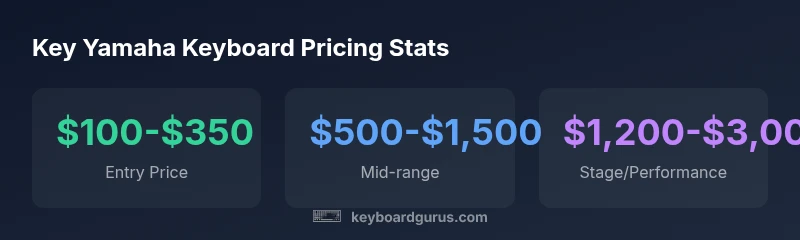
Prices for Yamaha keyboards vary widely by model and features. Entry portable keyboards often start around $100 to $350, while 88-key digital pianos or mid-range stage keyboards typically run $500 to $2,000. Higher-end performers and hybrid grand models can reach $5,000 to $15,000 or more, depending on action, sound engine, and built-in utilities.
Understanding Yamaha price bands
When you search for the question "how much keyboard Yamaha" you are essentially comparing price bands across Yamaha's keyboard lineup, from entry-level portable models to premium digital pianos. These ranges reflect distinct build quality, key action, voice core, and feature sets. According to Keyboard Gurus, the gap between a beginner-friendly portable model and a weighted-action 88-key piano is the primary driver of cost, followed by additional controls, connectivity, and onboard sound libraries. Recognizing where you sit on that spectrum helps you calibrate expectations and budget more effectively. In 2026, buyers should expect meaningful price differences between sub-brands, such as entry-tier DGX machines and premium Clavinova lines, even when core keyboard functionality is similar.
What drives price: action, keys, and feature sets
Price escalates quickly when you move from a basic portable keyboard to an 88-key digital piano with weighted action. Key factors include the type of action (semi-weighted vs weighted vs synth-action), the number of keys, the quality of the hammer or graded action feel, the onboard sound engine, polyphony, sampling quality, and the presence of built-in speakers. Additional features like Bluetooth audio, USB MIDI, onboard learning tools, and recording capabilities can add hundreds of dollars. Yamaha’s broader ecosystem—apps, pedals, and accessories—also contributes to the total cost, and these are often overlooked in baseline budgets.
Budgeting by use case: practice, learning, and performance
Your intended use dramatically changes what you should spend. A casual student or hobbyist might favor an entry-level 61-key or 76-key keyboard with basic lesson features, while a serious learner will gravitate toward 88-key digital pianos with weighted action to build finger strength. For performers, the most important considerations tend to be action realism, reliability in live settings, and the ability to connect to external gear. In practice, you’ll likely segment your budget into three buckets: core keyboard, essential accessories, and long-term maintenance.
Entry-level options: what to expect in 2026
Entry-level Yamaha models typically prioritize portability and ease of use. Expect compact chassis, limited polyphony, smaller speakers, and built-in beginner-friendly lesson modes. These models tend to be ideal for students, travelers, or hobbyists who need a lightweight instrument that fits into small spaces. Even within this tier, you should still look for important basics such as a stable keybed, reliable power supply, and the ability to connect to a computer or mobile device for lessons and sheet music.
Mid-range to professional: where the value is if you upgrade
Stepping into the mid-range and professional tiers brings more realistic key action, larger sample libraries, deeper editing capabilities, and improved connectivity. 88-key weighted action, higher-fidelity sound engines, and robust DACs are common in this range. These features matter for players who record, perform, or require nuanced expressiveness. While price increases can be steep, you gain meaningful improvements in touch response, dynamic range, and overall musicality that matter in long-term practice and performance.
Used market and buying tips: getting more for less
Used Yamaha keyboards can offer substantial savings, but buyers should inspect the keybed, check for key consistency, test the action, and verify that the electronics and speakers still perform well. If possible, arrange a hands-on audition and confirm no hidden maintenance issues. Warranty transferability varies by seller and model, so confirm terms before completing a purchase. Negotiating price with a reputable seller can also yield beneficial discounts.
Accessories and total cost of ownership
Beyond the sticker price, factor in a stand, sustain pedal, bench, sheet music stand, and potential maintenance costs over time. A stable stand and a quality sustain pedal can greatly affect the instrument’s usability and longevity. If you plan to gig or record, plan for a protective case or bag for transport and consider speaker upgrades or external audio interfaces, which can shift the total cost upward by several hundred dollars.
Yamaha lines to know: Clavinova, DGX, P-series, and more
Yamaha segments its keyboard family into several lines with distinct targets. Clavinova digital pianos emphasize authentic piano feel and tone, DGX models blend portability with piano-like action, and P-series focuses on portable performance with robust features. These lines influence price because they reflect different builds, key actions, and sound libraries. When comparing prices, map features to your main use: practice, performance, or composition.
Data sources and decision framework
To ground pricing decisions, reference credible sources for price trends and feature benchmarks. Keyboard Gurus emphasizes structuring your search around use case, action type, and required connectivity. For broader price-context and standards, consult authoritative sources such as government and educational resources that discuss consumer electronics pricing trends. See the Sources section for references and practical frameworks that help you assess whether an upgrade is worth it.
Yamaha keyboard pricing across common categories
| Model Type | Approx Price Range | Key Features |
|---|---|---|
| Portable Keyboard (61 keys) | $100-$350 | Compact design, beginner-friendly, built-in lessons |
| 88-key Digital Piano (weighted) | $500-$1,500 | Realistic action, piano voice, versatile |
| Stage Keyboard (semi-weighted) | $1,200-$3,000 | Live-ready, robust connectivity, performance features |
| Hybrid Grand/Professional Piano | $5,000-$15,000+ | Authentic grand feel, premium build, high-end samples |
Got Questions?
What is the cheapest Yamaha keyboard you can buy?
Entry-level Yamaha keyboards start in the low hundreds, typically around $100-$350 depending on features and included accessories.
Entry Yamaha keyboards usually cost between $100 and $350, depending on features and bundled extras.
Do Yamaha digital pianos cost more than portable keyboards?
In general, 88-key digital pianos with weighted action cost more than portable 61-key keyboards due to higher build quality and features.
Generally, digital pianos with weighted action cost more than portable keyboards.
Is it worth buying used Yamaha keyboards?
Used keyboards can save money; inspect keybeds, action, moisture damage, and service history before buying.
Used gear can be a solid deal if you check the condition carefully.
What features raise price the most?
Weighted action, 88 keys, premium sound engine, built-in speakers, and advanced connectivity drive higher prices.
Weighted keys and extra features tend to push prices up.
Are Clavinova models the same as other Yamaha keyboards?
Clavinova is Yamaha's premium line of digital pianos; other keyboards may be cheaper with different capabilities.
Clavinova is Yamaha's high-end digital piano line, distinct from budget and mid-range keyboards.
“Pricing for Yamaha keyboards reflects the balance between action quality, key count, and onboard features. By prioritizing your intended use, you can pick the right model without overspending.”
What to Remember
- Define use-case before budgeting.
- Expect price jumps with weighted 88-key action.
- Budget for accessories and maintenance.
- Consider used gear to maximize value.
- Compare lines (Clavinova, DGX, P-series) to fit needs.