keyboard 61 vs 88 keys: A practical comparison for players and producers
Compare 61-key and 88-key keyboards to choose the right setup for portability, playability, and production. This Keyboard Gurus guide analyzes key differences, use cases, and practical tips to help you decide.


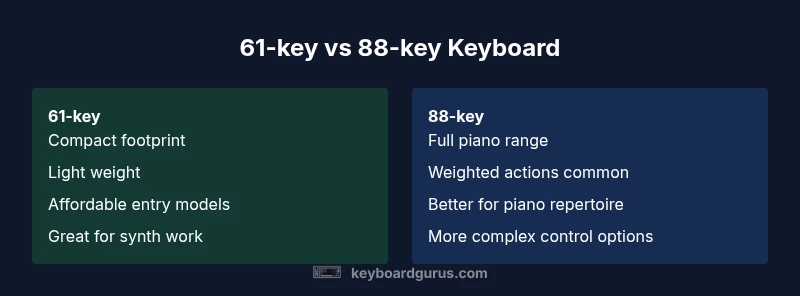
Choosing between a keyboard 61 vs 88 keys hinges on portability, piano feel, and intended use. For keyboard 61 vs 88 keys, a 61-key board shines for travel, compact desks, and synth-heavy work, while an 88-key keyboard delivers a full piano range and more natural chord shapes for piano pieces and live performance. This guide from Keyboard Gurus breaks down the differences and helps you decide.
What the terms mean and who tends to use them
The keyboard landscape is defined by the number of keys and the intended workflow. A 61-key keyboard is a compact, portable option popular with bedroom producers, live-loopers, and travelers who need to fit gear into tight spaces. An 88-key keyboard offers a full piano range, letting performers and composers access standard octaves without transposing. According to Keyboard Gurus, most learners and hobbyists start with 61 keys for cost and portability, then graduate to 88 keys as piano goals mature. This section sets the stage for practical comparisons between the two formats.
Range, octaves, and musical repertoire
An 88-key keyboard covers the standard piano range from A0 to C8, enabling performances of classical repertoire and modern piano pieces without awkward transpositions. A 61-key layout covers fewer octaves, which is adequate for many synth lines, bass parts, and chord progressions typical in electronic genres. When you study keyboard 61 vs 88 keys, the critical question is how often you need full-range piano pieces versus synth-focused parts. If your music leans on piano repertoire, 88 keys are typically preferable. For synths, pads, and riffs, 61 keys can be perfectly sufficient.
Portability and desk footprint
Desk space and transportability are major decision drivers. A 61-key model is notably lighter and narrower, making it easier to carry to gigs or set up on small desks. By contrast, 88-key boards require more space and often weigh more, which may matter for rig management and stage setup. Portability is not only about the keyboard’s mass but also about the feel of the grip and how easily you can set up in tight venues. Keyboard Gurus emphasizes testing balance and fit with your actual workspace.
Key action: synth-action vs weighted keys
Key feel is a central differentiator. 61-key keyboards frequently use synth-action or light semi-weighted actions, which feel quick for lead lines, programming, and fast playing in electronic genres. 88-key boards commonly offer weighted or semi-weighted action to emulate acoustic pianos, improving realism for pianists and players transitioning from acoustic keyboards. The choice affects dynamics, aftertouch usage, and expressiveness, particularly in legato passages and nuanced chords. Consider your playing style and preferred touch when evaluating actions.
Use-case profiles: when to pick 61 keys
If you travel often, perform in small venues, or focus on MIDI sequencing, a 61-key keyboard is often the pragmatic choice. It’s usually more affordable and fits a minimal desktop setup. Students and hobbyists experimenting with multiple software synths also appreciate the compact footprint. In system design or education environments where space is at a premium, 61 keys can enable broader exposure to ideas without the asset overhead of a full 88-key system.
Use-case profiles: when to pick 88 keys
For players who want authentic piano repertoire, or who frequently perform classical or jazz standards, 88 keys provide a natural range that mirrors a real piano. The extra octave space improves sight-reading fluency across common pieces and reduces the need for frequent octave transpositions. In production environments requiring expressive piano passages, layered textures, and live performance with real-time dynamics, 88-key boards become a robust centerpiece. Keyboard Gurus notes that 88-key keyboards also often support advanced MIDI features that enhance live playability.
Connectivity, MIDI, and software integration
Both formats typically offer USB-MIDI, standard USB connections, and traditional MIDI outputs on some models. The 88-key variants tend to include more comprehensive control options—such as aftertouch and more pedal capability—because some players pair them with more demanding software and piano libraries. For producers, ensure the interface and DAW track routing align with your workflow; the extra keys can influence the keyboard’s usability in multi-take sessions and live loops.
Budget and value considerations
Price generally scales with the number of keys, action quality, and onboard features. Entry-level 61-key models tend to be more affordable, making them attractive for learners, casual producers, and minimal setups. 88-key boards span a wider price range, with higher-end models offering weighted actions, premium keybeds, and additional controls. When evaluating keyboard 61 vs 88 keys, consider total cost of ownership, including maintenance, keybed reliability, and compatibility with your existing gear.
Practical audition tips: try before you buy
Whenever possible, audition both formats side by side. Pay attention to keybed weight, bounce, and the transition between keys, especially around the middle C region. Test octave stretches for familiar passages and compare the piano feel to your acoustic or preferred MIDI controller. For beginners, a short audition can reveal whether the 61-key layout supports your learning path, while experienced players can quickly gauge whether 88 keys provide the needed range without sacrificing portability.
Myths and realities about 61 vs 88 keys
A common myth is that 61 keys are inherently inferior for all users. In reality, the right choice depends on your goals. Some players will never need the extra range, while others will benefit from the expanded octave space. Likewise, a weighted 61-key keyboard can feel substantial for piano work, but many producers prefer the nimbleness of a lighter action for fast synth lines. Understanding your use-case and testing in context is the best way to decide.
Comparison
| Feature | 61-key keyboard | 88-key keyboard |
|---|---|---|
| Key count and range | 61 keys, limited octave span | 88 keys, full piano range |
| Portability and desk footprint | Smaller footprint, lighter weight | Larger footprint, heavier, more space required |
| Key action options | Often synth-action or light semi-weighted | Often weighted or semi-weighted to mimic piano |
| Best use case | Synthesis, portability, travel setups | Piano repertoire, studio work, live piano-style playing |
| Playability for chords | Easier to reach with one hand for compact chords | More comfortable for complex piano chords across octaves |
| Price range (general guidance) | Typically lower-cost entry models | Typically higher-cost across the board due to build and action |
| MIDI/DAW integration | Excellent for compact DAW control | Robust for piano libraries and keyboard-triggered performances |
| Other hardware features | Fewer keys, simpler feature sets | More keys often accompanied by more controls and aftertouch |
Advantages
- Compact form factor supports portable rigs and small desks
- Lower weight simplifies transport and setup
- Often more affordable entry models for beginners
- Encourages creative workflows in limited space
- Good for travel musicians and students
Drawbacks
- Limited octave range can limit repertoire and transposition flexibility
- Fewer keys may hinder advanced piano techniques
- Smaller keys can feel cramped for some players
- Weighted actions are less common on entry 61-key models compared to 88-key desks
61-key boards for portability and budget; 88-key boards for piano range and realism
Choose 61-key if you need compact travel-friendly gear or cost efficiency. Choose 88-key if your focus is piano repertoire, dynamic expression, and full octave access in performance or production.
Got Questions?
What is the main difference between 61-key and 88-key keyboards?
The main difference is the number of keys and playable range: 61-key keyboards are compact with limited octaves, suitable for synth work and travel, while 88-key keyboards offer a full piano range and a more piano-like playing experience.
The key difference is the number of keys and range: 61 keys for portability, 88 keys for a piano-like feel.
Is a 61-key keyboard enough for beginners learning piano?
For beginners focused on piano basics, 88 keys are generally recommended to learn proper technique and repertoire. A 61-key model works for initial exposure and learning basic chords in synth contexts.
If you're learning piano specifically, 88 keys are usually better; for beginners exploring synths, 61 keys can be a good start.
Can you play piano pieces on a 61-key keyboard?
You can play some piano pieces on a 61-key keyboard, but you may be limited by missing lower or higher octaves and transposition needs. For serious piano repertoire, 88 keys are preferable.
You can play some pieces, but many piano works require the missing octaves on a 61-key board.
Do 88-key keyboards always have weighted keys?
Most 88-key keyboards aimed at piano players offer weighted or semi-weighted actions to mimic acoustic pianos. However, there are 88-key models with lighter actions meant for synth work or portability, so check the action type before buying.
Most 88-key boards have weighted actions, but some cheaper models may not—always verify the key feel.
Are 61-key keyboards better for gaming or coding setups?
61-key keyboards excel in compact, desk-friendly setups and can be ideal for coding or light music creation where space matters. They are less suited for piano-focused playing but work well with DAWs and sample libraries in smaller rigs.
If you want a compact desk-friendly option for coding or light music, 61 keys are a good fit.
What should I test when auditioning a keyboard?
Test the key action, weight, and bounce; check octave transitions; evaluate how comfortable the layout feels during scales and arpeggios. Also test the software integration and how easily the keyboard maps to your DAW and libraries.
Feel the key action, test scales, and check how it pairs with your software.
What to Remember
- Prioritize portability for travel or small desks
- Piano repertoire benefits from 88 keys and weighted action
- Test key feel and action before buying
- Budget-sensitive buyers may start with 61 keys
- 88-key setups justify higher investment with extended range