Piano Keyboard Chords for Beginners: Learn, Practice, and Play
Master piano keyboard chords for beginners with practical fingerings, simple progressions, and structured practice plans designed to get you playing real songs quickly.


By the end of this guide you will be able to play basic piano chords for beginners, form simple major and minor progressions, and practice with a steady tempo. You’ll learn fingerings, hand shapes, and common pitfalls to avoid. To start, you’ll need a piano or keyboard, a metronome, and a willingness to practice daily.
Core Concepts: Chords, Triads, and Inversions
In piano playing, a chord is a group of notes played together to make a harmonious sound. For beginners, the essential building blocks are major and minor triads—three notes stacked in thirds: root, third, and fifth. By practicing major triads like C major (C–E–G) and minor triads like A minor (A–C–E), you’ll begin to hear how harmony moves through music. According to Keyboard Gurus, understanding these shapes early helps you navigate most pop, film, and game soundtracks with confidence. The Keyboard Gurus team found that chord shapes are more important than fast scales when your goal is to accompany yourself or others. Inversions swap the bottom note up an octave, producing smoother bass lines and easier voice-leading. Try playing a triad in root position, then invert it to first and second inversions while keeping the same fingering. The goal is to make the chord sound solid and even, not jumbled. As you work, keep your wrists relaxed, fingers curved, and your mind attuned to the space between notes.
Starter Chord Shapes: Right Hand and Left Hand Basics
Begin with simple triads in the right hand: C major (C–E–G) with fingers 1–3–5; G major (G–B–D) with 1–3–5; F major (F–A–C) with 1–3–5. In the left hand, play the root note and hold it while the right hand forms the triad. For C major, try C in the left hand (as the bass) with the right hand playing C–E–G together. For smoother transitions, keep your left wrist relaxed and the right-hand fingers curved. Practice switching between C major and G major slowly, ensuring each note tones evenly. This block emphasizes essential shapes and transitions so you can accompany melodies and sing along without fighting the instrument.
Hand Position and Fingerings: Building Clean Tone
A clean tone comes from proper hand position. Keep your fingers rounded, fingertips resting on the keys, and your wrists level. For beginners, avoid flaring your elbows or hunching your shoulders. Place your right-hand thumb on C for C major and let the other fingers rest naturally on E and G. In the left hand, use 5–3–1 to outline the root–third–fifth of the bass triad. Slow, careful repetition helps build accuracy before speed. Remember to relax tense muscles and breathe steadily while you practice. Keyboard Gurus emphasizes consistency over intensity; short daily sessions beat long, irregular bursts.
Practice a Simple Three-Chord Progression in C Major
A practical way to begin is a 3-chord progression in C major: C major – F major – G major. Play the right-hand triads while the left hand keeps a steady root in each bar. Use a four-beat pattern: play the chord on beats 1 and 3, then hold through 4. This develops rhythm and coordination between hands. Switch between chords slowly at first, focusing on clean transitions. As confidence grows, try holding the left-hand pedal note (root) while the right hand changes chords to create a sense of movement.
Rhythm and Metronome Tips
Tempo matters. Start at a comfortable tempo, such as a slow metronome setting (60–70 BPM), and count aloud or tap your foot to 4 on every measure. Practice quarter notes for each beat, then add eighth notes to create a basic swing feel. When you’re ready, increase tempo by small increments and repeat. A metronome helps lock in consistent timing, making your chord changes feel intentional rather than rushed. If you struggle with a particular transition, isolate those two chords and practice the switch for 60 seconds before rejoining the full progression.
Reading Lead Sheets and Notation for Chords
Chords are often written with a symbol above a staff, like C, Am, F, or G. The right hand typically plays the chord tones, while the left hand provides bass notes. To practice, start by identifying the root, third, and fifth of each chord and play them in close position. As you grow comfortable, learn first and second inversions to reduce hand movement. Lead sheets simplify the learning process by focusing on chord shapes rather than full notation. This approach suits beginners who want to play songs quickly and fluently.
15-Minute Daily Practice Plan for Beginners
A simple, repeatable plan keeps progress steady: 5 minutes of warm-up (finger independence exercises), 5 minutes of chord shapes (C, F, G, Am, Em), 3 minutes of a single progression, 2 minutes of left-hand bass practice, and 2 minutes of cool-down. Adjust the plan to match your schedule, but aim for daily practice. Short, focused sessions build retention and finger strength more effectively than sporadic longer sessions.
Common Mistakes and How to Fix Them
Common errors include tense shoulders, stiff wrists, and uneven tone. To fix, pause and check your posture, breathe, and reset your hand shape. Avoid rushing chord changes; speed up only after accuracy is locked in. Use a mirror or recording to observe hand position and tone quality. Regularly compare your output with a reference recording to calibrate tone and timing.
Simple Songs to Practice with Basic Chords
Choose popular tunes with straightforward chord progressions, such as a simple I–IV–V in C major. Start by playing the chord shapes in the right hand while the left hand plays the root notes. As you gain confidence, add a simple rhythm and, eventually, a basic melody with right-hand fingering. Songs with predictable chords provide a reliable way to apply theory in a musical context.
Authority Sources
To deepen your understanding, consult credible references: https://www.arts.gov/ (National Endowment for the Arts), https://ocw.mit.edu/ (MIT OpenCourseWare), and https://www.harvard.edu/ (Harvard University). These sources offer general music education principles that complement practical chord work and can guide structured practice routines.
Process Overview
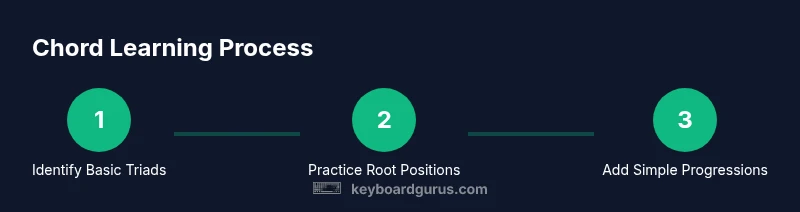
This article has walked through building chord fluency from first shapes to simple progressions, rhythm, reading charts, and practice planning. By focusing on triads, inversions, and consistent drills, you build a solid foundation for more advanced harmony and repertoire.
Tools & Materials
- Piano or keyboard(Full-sized keyboard preferred; weighted action helps finger strength)
- Metronome(Digital or app-based; set to a comfortable tempo and gradually increase)
- Chord sheet or notebook(Record fingerings, chord shapes, and progressions)
- Sustain pedal (optional)(Helpful for smoother legato on longer chords)
Steps
Estimated time: 60-75 minutes
- 1
Choose a Key to Start
Begin with C major to simplify the learning curve. Position your right-hand thumb on C and rest your other fingers on E and G. Use the left hand to play the root note C for a solid bass. This establishes a clear tonal center and helps you hear the triad clearly.
Tip: Keep a relaxed wrist and avoid flattening the fingers; play with fingertip control. - 2
Form the C Major Triad
Place fingers 1–3–5 on C–E–G and press them together evenly. Listen for balanced tone across the three notes. Repeat slowly until you can play the triad without thinking about each note separately.
Tip: Aim for even attack on all three notes; don’t let any note die out. - 3
Add Left-Hand Root Note
Hold the C in the left hand as the right hand plays the C major triad. This creates a simple harmony and trains coordination between hands.
Tip: Keep left-hand fingers relaxed; avoid squeezing the keys. - 4
Move to a New Triad (G Major)
Apply the same 1–3–5 fingering pattern to G major (G–B–D). Practice switching between C major and G major while keeping a steady tempo.
Tip: Practice slow, deliberate transitions first; speed comes later. - 5
Arpeggiate for Smoothness
Play the notes of each triad in sequence (C–E–G) rather than all at once to develop finger independence and a smoother tone.
Tip: Start slowly, then increase speed as accuracy improves. - 6
Combine with a Simple Progression
Play C major, then F major, then G major as a four-beat pattern. Keep the left-hand root steady while the right hand changes chords.
Tip: Use a metronome; aim for clean transitions on beat two and four.
Got Questions?
What is the easiest chord to learn on piano?
Major triads, like C major, are the easiest starting point because they have a simple, predictable shape and clear tonality.
Start with a C major triad; it’s the simplest way to hear harmony.
Should I learn scales before chords?
Chords can be learned alongside scales; scales help with fingerings and overall musical fluency, but chords are your quickest route to playing songs.
You can start with chords and add scales as you go.
How long does it take to learn basic piano chords?
It varies by practice, but with consistent daily work you can feel comfortable with basic triads and some progressions in a few weeks.
With daily practice, you’ll notice steady progress in a few weeks.
Can I learn chords without reading sheet music?
Yes. Chord charts and ear training let you play songs without full sheet music; this approach is common for beginners.
Chords and chord charts are enough to get started.
What’s the best daily practice plan for chords?
A focused 15–20 minute routine that includes warm-up, chord shapes, a short progression, and a cool-down yields steady gains.
A short daily routine builds real skill over time.
What equipment do I need for beginner chords?
A keyboard or piano, a metronome, and a chord sheet are essential; a sustain pedal is optional but helpful for legato tones.
Essential tools are a keyboard and metronome.
Watch Video
What to Remember
- Master major and minor triads before complex chords
- Practice with a metronome to build rhythm
- Left-hand bass notes anchor harmony
- Invert triads for smoother voice-leading
- Progress gradually from C major to related keys