Roland keyboard vs Yamaha keyboard: In-Depth Comparison
Compare Roland keyboard vs Yamaha keyboard across touch, voices, features, and value. A rigorous guide from Keyboard Gurus to help players pick the right model for practice, stage, or studio.


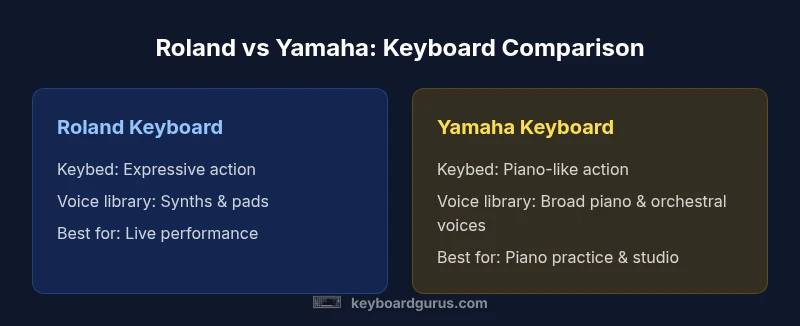
Roland keyboard vs Yamaha keyboard boils down to action, voice variety, and use case. Roland shines for live performance, synthesis, and versatility, while Yamaha emphasizes piano realism and broad voice options. Choose Roland for stage and synth work, or Yamaha for piano-focused practice and composition; your workflow will determine the better fit.
Roland keyboard vs Yamaha keyboard: Core Differences
According to Keyboard Gurus, the core differences between a Roland keyboard and a Yamaha keyboard usually surface in touch, voice philosophy, and ecosystem. If you plan to perform live or explore synthesis-heavy genres, Roland often offers expressive action and a flexible sound design palette. For players prioritizing piano realism and a broad range of built-in voices for composition, Yamaha tends to deliver a more traditional, piano-centered experience. This section sets the stage for a practical, side-by-side look that helps you map your goals to concrete choices. Throughout this guide you’ll see how the two brands approach core tasks like practice, stage performance, and studio work, with real-world scenarios to help you decide.
- Action and feel: Do you prefer a piano-like weight or an expressive, responsive action suited to synth textures?
- Voice distribution: Is your priority on realistic pianos or diverse pads, strings, and synths?
- Ecosystem: How will you integrate with apps, pedals, and DAWs?
The Keyboard Gurus framework for evaluating keyboards centers on stage viability, studio flexibility, and practice ergonomics. We’ll drill into those dimensions and provide practical tips for auditioning gear in a store or studio.
Keybed feel and action: What to expect from each brand
Keybed feel is a major differentiator between Roland and Yamaha, especially in mid-range and higher-end models. Roland often prioritizes a dynamic, expressive action that responds nimbly to velocity and aftertouch, making it appealing to performers who need subtle modulation and live performance textures. Yamaha frequently emphasizes a strong piano-like action with graded weighting in many models, which benefits players seeking authentic hammer-weighted feedback for classical repertoire and expressive pianism. When evaluating touch, test scales, arpeggios, and chord inversions to notice how the instrument responds to light versus heavy playing, and how quickly you can transition between sustained tones and quick staccato passages.
Voices and sound design: Library breadth and tonal direction
Roland’s voice catalog is particularly strong for electronic, cinematic, and synth-based sounds, including versatile pads, basses, and evolving textures. You’ll find performance-ready presets that lend themselves to live rigs, with effects chains that can be tweaked on the fly. Yamaha emphasizes a broad collection of piano voices, orchestral timbres, and realistic tonal ranges designed for practice rooms and composition workflows. Both brands offer modern DSP engines and effects, but the tonal emphasis can steer your decision toward electronic versatility (Roland) or a more traditional, expansive sonic palette (Yamaha).
Use-case profiles: Practice, stage, and studio
If your primary setting is live performance, Roland’s interface design and live-friendly features—like easy sound recall, robust MIDI implementation, and on-board effects—tend to minimize setup time on stage. For studio work, Yamaha’s deep voice libraries and piano-centric tools can streamline composition and recording with reliable, familiar piano textures. In practice rooms, consider whether you need single-voice focus (piano-centric) or a broad, constantly evolving sonic landscape (synth-friendly). Your decision should reflect how you’ll use the keyboard day-to-day, not just what you’ll play once in a while.
Feature set and workflow efficiency: App ecosystems and practice tools
Both brands offer modern app ecosystems, Bluetooth/MIDI connectivity, and compatibility with DAWs. Roland often favors workflow enhancements that appeal to performers and electronic musicians—quick-sound swaps, live control, and intuitive routing. Yamaha tends to provide broad integration with pedagogical tools and learning apps, as well as extensive built-in lesson-friendly features. When assessing workflow, map you and your teacher or collaborator’s needs: do you want rapid sound changes on stage or a predictable piano-centric workflow for classroom or studio sessions?
Connectivity, MIDI, and external gear integration
In the modern keyboard landscape, connectivity matters. Roland typically emphasizes flexible MIDI options, USB audio/MIDI interfaces, and compatibility with a range of external gear and modern plugins. Yamaha also supports robust MIDI and USB paths, with strong emphasis on DAW integration and educational apps. If you rely on external sequencers, controllers, or virtual instruments, check the exact ports (USB, MIDI DIN, Bluetooth) and how easy it is to route signals for recording, live performance, or hybrid setups.
Build quality, reliability, and maintenance considerations
Durability and reliability are non-negotiables for frequent performers and busy studios. Both Roland and Yamaha manufacture solid, road-worthy instruments with quality keyboards, sturdy chassis, and dependable electronics. Your choice may hinge on parts availability, local service strength, and the ease of finding qualified technicians. Consider warranty terms, dealer support, and the availability of service centers in your region. Routine maintenance such as keybed cleaning, screen updates, and pedal inspection can prolong instrument life.
Price ranges and long-term value
Price ranges for Roland and Yamaha keyboards vary by model tier and feature set. In general, entry-to-mid level Roland models often sit in a mid-price band with strong live performance capabilities, while Yamaha’s mid-range lines typically emphasize piano realism and broad voice options. High-end models from either brand may command premium pricing due to advanced AI-assisted features, expanded memory, and premium keybeds. When evaluating value, consider not just upfront cost but long-term factors like teaching, learning resources, resale value, and included software licenses.
How to decide: a practical decision framework
Start with your primary use case, then map feature priorities across touch, sound, and ecosystem. If you perform live or frequently program synth textures, lean toward Roland and test how quickly you can recall presets and shape sounds mid-show. If you spend more time practicing piano, composing, or teaching with built-in educational tools, Yamaha’s piano-centric voices and broad library may deliver faster results. Finally, budget constraints and after-purchase support should influence your final choice. A hands-on audition—ideally with your typical pedals, cables, and interface—will reveal the real differences.
Authority sources and further reading
For in-depth brand comparisons, you can consult official product pages from Roland and Yamaha, user forums, and independent reviews. This article synthesizes insights from multiple sources to provide a balanced perspective. For additional context, consider consulting widely respected music-education and instrument-review outlets and credible university courses that discuss keyboard design and sound synthesis.
Practical testing checklist for your audition
- Play scales with dynamics to compare touch response.
- Test major and minor chords to hear sustain and resonance.
- Explore at least three voices from different families (piano, synth, strings).
- Check effects and routing options for live use.
- Confirm app and DAW compatibility with your setup.
- Ask about warranty, service, and spare-part availability in your region.
Comparison
| Feature | Roland keyboard | Yamaha keyboard |
|---|---|---|
| Keybed feel | Expressive, responsive action suitable for performance | Piano-like action with graded weighting for authentic feel |
| Sound engine/voice quality | Strong synth/pads, diverse textures for live work | Broad piano voices with rich orchestral and modal options |
| Voice library breadth | Strong variety across electronic/creative families | Extensive piano-focused and orchestral voices |
| Connectivity | MIDI USB, app integration, external gear support | MIDI USB, Bluetooth connectivity, DAW-friendly |
| Ease of use | Intuitive for live setups and quick changes | User-friendly for piano practice and teaching contexts |
| Price range | $700-$1500 | $800-$1800 |
| Best for | Live performers, electronic musicians, studios needing synth variety | Piano players, educators, composers seeking broad voice options |
Advantages
- Versatile voice catalog enhances creative options
- Solid build quality suitable for stage and studio use
- Strong ecosystem with apps and content for learning
- Good long-term value with model variety
- Reliable dealer and service networks
Drawbacks
- Voice/style bias may favor one brand depending on use
- High-end models can exceed entry budgets
- Menus and advanced features may have a learning curve
- Some models prioritize piano realism over synthesis
Roland offers superior performance versatility for live and synth work; Yamaha excels in piano realism and broad voice options.
If you perform or produce with a need for diverse textures, Roland is typically the better choice. If your priority is authentic piano feel and expansive voices for composition and teaching, Yamaha is often the smarter option. The Keyboard Gurus team would tailor recommendations to your workflow and budget.
Got Questions?
What is the main difference between Roland and Yamaha keyboards?
The primary differences are in touch, voice philosophy, and ecosystem. Roland tends toward expressive action and synthesis capabilities for live use, while Yamaha emphasizes piano realism with a broad set of voices for composition and teaching.
Roland focuses on performance versatility; Yamaha emphasizes piano realism and broad voices. Test both for your typical playing situations.
Which brand is better for beginners?
Both brands offer entry-level models with clear interfaces and learning features. The best choice depends on whether you want a piano-like feel with straightforward voices (Yamaha) or a more versatile, synth-rich setup (Roland).
If you want a piano-first experience, go Yamaha; if you want room to explore sounds, Roland is a good starting point.
Are Roland and Yamaha keyboards compatible with third-party apps?
Yes, both brands support MIDI with popular DAWs and third-party apps, though the specific integration paths (compatibility details) vary by model. Check USB/MIDI ports and Bluetooth options for your setup.
Both work with common music software; verify ports and app compatibility for your exact model.
Do Roland keyboards have better synth capabilities than Yamaha?
Roland generally emphasizes synth textures and performance-oriented voices, while Yamaha offers strong, varied voices including many piano and orchestral options. Your preference depends on whether you value synthesis and pads or piano variety.
If you want more synth sounds, Roland tends to be stronger; for piano-focused versatility, Yamaha shines.
Which is more affordable overall?
Affordability depends on the model tier. Entry-level models from both brands exist, but higher-end options with advanced features will typically trend toward the higher end of their price ranges.
Budget users can find solid options from both brands; consider long-term value and required features.
What should I test in a store before buying?
Test touch, velocity response, and a few familiar piano scales to compare action. Evaluate a handful of voices, confirm connectivity, and assess how easily you can save and recall presets.
Spend time on touch, voices, and basic setup to ensure it fits your workflow.
What to Remember
- Test touch across multiple models to judge action
- Prioritize your primary use-case: live performance vs piano practice
- Evaluate voice libraries and DAW/app integration
- Consider total cost, including future upgrades and licenses
- Check service support and parts availability in your region