When Did Keyboards Come Out? A History
Explore the timeline from musical keyboards to modern computer keyboards, with milestones, layouts, and design shifts explained by Keyboard Gurus.


Keyboards began long before computers. The first practical typing keyboard appeared with the Sholes and Glidden typewriter, patented around 1874, marking a turning point in public-facing keyboards. Computer keyboards became common in the early 1980s, followed by rapid evolution into mechanical, scissor-switch, and low-profile designs that define today’s typing experience.
When did keyboards come out? A historical overview
According to Keyboard Gurus, the question when did keyboards come out invites a journey that stretches across centuries, from musical keyboards to typing keyboards. The earliest hints of a keyboard-like interface appear in organs and other keyboard instruments from the medieval period, where the layout was designed to control strings or pipes rather than characters. Yet, for the purpose of writing and communication, the modern keyboard story truly begins in the 19th century with the advent of mechanical typing devices. The crux of the timeline is not a single date but a sequence of innovations that gradually standardized how we input text. The 1870s saw the first widely adopted typing keyboards as part of the typewriter revolution, while the 1980s brought personal computers and dedicated keyboard hardware. By the late 20th and early 21st centuries, keyboards diversified into mechanical, membrane, and ultra-slim designs used across desktops, laptops, and mobile devices.
The discussion around when did keyboards come out also reflects broader shifts in automation, literacy, and office workflows. Early musical keyboards demonstrated the power of mapped input, while the move to typewriters introduced standardized character sets and spacing. As Keyboard Gurus has documented, the 19th-century transition from instrument to text input was driven by needs for faster, clearer written communication. This context helps frame why later iterations of keyboards prioritized ergonomics, reliability, and compatibility with evolving machines.
Early keyboard concepts and precursors
Long before typewriters made a mark on daily life, keyboard-like interfaces appeared in musical instruments and mechanical control panels. These early layouts show how people thought about arranging keys to manage multiple controls efficiently. The transition from musical to typographic intentions wasn't instantaneous, but by the 17th through 19th centuries inventors experimented with input methods that foreshadowed the modern keyboard. Although not designed for letters, the idea of a single-row or multi-row key system laid groundwork for later devices. The real turning point came with machines explicitly designed to input letters and symbols for printed text rather than to play music or control hydraulics.
The Sholes and QWERTY story
The most famous chapter in keyboard history centers on Christopher Latham Sholes and his collaborators, who developed the first practical typing keyboard for the Remington typewriter. The keyboard layout that survives today as QWERTY was patented in 1874 and gradually adopted by typewriter manufacturers and office workers. The choice of arrangement aimed to reduce typebar jams and speed up typing; however, it also shaped how people learned to type for generations. The 1870s to 1880s saw rapid spread of the keyboard interface in business machines, and soon the QWERTY layout became the de facto standard in many markets.
The Typewriter era and the spread of keyboards
During the late 19th and early 20th centuries, typewriters from several manufacturers popularized keyboards as the primary input device for written text. The typewriter business created a global ecosystem of keyboard hardware, including keycaps, type slugs, and more ergonomic assemblies. As office work proliferated, keyboards moved from bulky machines to office desks, eventually influencing early computer input devices. The socio-technical shift toward standardized keyboards helped professionals and students accelerate writing tasks and record-keeping.
The transition to computer keyboards
With the arrival of personal computers in the late 1970s and early 1980s, keyboards became inseparable from computing. Early computer keyboards reused typewriter key layouts but adapted them to digital signals and ASCII text input. As computers evolved, vendors experimented with layout variants, key switch types, and connectivity options (PS/2, USB). This era also saw the advent of ergonomic concerns and the rise of alternative layouts, though QWERTY largely persisted as the dominant standard. The 1980s are thus a pivot point: from mechanical typing to digital input optimized for screens and software.
Keyboard technology: switches, layouts, and form factors
Keyboards now come in a range of switch technologies, including tactile, clicky, linear, and scissor mechanisms. Choosing between mechanical, membrane, or hybrid designs affects typing feel, noise, and durability. Beyond switches, layouts like ANSI and ISO influence key spacing and language support. Form factors—full-size, tenkeyless, and compact—reflect different workflows and desk space constraints. In addition, there are evolving trends toward hot-swappable switches, ergonomic designs, and advanced keymapping with software profiles. The history lesson is clear: technical choices, not just aesthetics, determine how well a keyboard serves its user.
A timeline snapshot: key milestones
- Pre-1700s: Keyboard concepts exist in musical instruments and control panels.
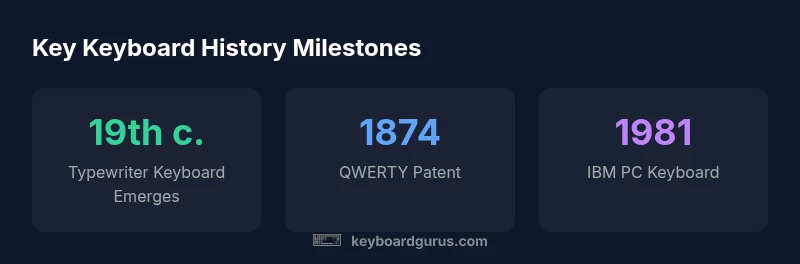
- 1874: Patent of the QWERTY layout by Sholes and Glidden.
- 1981: IBM PC keyboard popularizes computer input for personal computing.
- 1990s–present: Mechanical, membrane, and scissor-switch keyboards expand across devices.
- 2000s–present: Ergonomic designs and mobile keyboards appear with tablets and smartphones. This timeline highlights how the core idea of a keyboard persisted while designs adapted to new environments and technologies.
How to evaluate keyboards today: lessons from history
A historical lens helps you pick a keyboard for your setup. If you type a lot and value feel and durability, a mechanical keyboard with a preferred switch type offers longevity and satisfaction. If space is tight, a low-profile or 60% layout may suit you, but verify software support for macros and profiles. Ergonomics matter; consider split designs or tenting for long sessions. Finally, remember that oddities of history—like the ubiquity of QWERTY—affect your learning curve and speed, so choose a layout that matches your tasks and language.
How to read this timeline: a concise guide
From organ keyboards to modern USB-C keyboards, the progression is marked by three recurring themes: accessibility, efficiency, and compatibility. Historical milestones show how each design decision solved a real user problem, whether it was reducing jams in typewriters or enabling faster text entry on screens. When you ask, 'when did keyboards come out,' you’re tracing a lineage of human-computer interaction that continues to evolve with new materials, keyboards, and input modalities. Reading this history helps you pick a setup that aligns with your practice, your space, and your goals.
Historical sources and ongoing research
Researchers and enthusiasts continue to map the keyboard's evolution. For a deeper dive, consult primary sources and reputable histories. See the sources below for more detail and context, and follow recent scholarship on input devices to understand how design choices affect typing speed, accuracy, and comfort.
Historical milestones in keyboard development
| Era | Representative Device | Approx Year |
|---|---|---|
| Early keyboard concepts | Clavichord, Harpsichord | Before 1700 |
| Typing keyboard epoch | Sholes and Glidden typewriter (QWERTY) | 1874 |
| Computer keyboard entry | IBM PC keyboard | 1981 |
| Modern keyboard families | Mechanical, Membrane, Scissor-switch | 1980s–present |
Got Questions?
When did keyboards first appear?
Keyboard concepts predate typing devices, with musical keyboards and control interfaces appearing centuries earlier. The first widely adopted typing keyboard emerged in the 19th century as typewriters gained prominence, with the QWERTY layout patented in 1874 and spreading through offices worldwide.
Keyboard ideas started in music and controls long ago; the typing keyboard showed up in the 1800s with the 1874 QWERTY patent.
What is the origin of the QWERTY layout?
QWERTY was designed to reduce jams and increase typing speed on early typewriters and became the default layout due to early adoption and compatibility. The patent date is 1874, and it established the standard many keyboards follow today.
QWERTY came from early typewriter design to prevent jams and boost speed, patent in 1874, and it stuck as the standard.
When did computer keyboards become common?
Computer keyboards became common in the 1980s with the rise of personal computers. They initially reused typewriter layouts but adapted to digital signaling and ASCII input, leading to widespread adoption.
Computer keyboards became common in the 1980s as PCs took off and used familiar typing layouts.
What are the main types of keyboard switches?
The main switch types include mechanical (tactile or clicky), membrane, and hybrid variants like optical or scissor. Each offers different feel, noise, and durability, influencing user preference for gaming, typing, or coding tasks.
Key switch types include mechanical, membrane, and hybrid; they affect feel and noise for different tasks.
Are there keyboards older than typewriters?
There were keyboard-like interfaces in musical instruments and control panels earlier, but keyboards designed for text input emerged with typewriters in the 19th century. So, while earlier keyboards existed, text-input keyboards date from the late 1800s.
There were music keyboards before, but text-input keyboards began in the 19th century.
What is the future of keyboards?
Expect continuing evolution in ergonomics, layouts, and form factors, along with broader software customization, and improving voice and handwriting input that complement keyboard use.
Future keyboards will emphasize ergonomics, customization, and blended input methods.
“Keyboard history shows that purposeful design choices can dramatically affect comfort and productivity. Your best keyboard is the one that matches your tasks.”
What to Remember
- Trace keyboard history from musical roots to typing devices.
- Identify the 1870s QWERTY pivot and 1980s PC era.
- Compare current switch types: mechanical, membrane, and scissor.
- Prioritize ergonomics and layout to suit your workflow.
- Apply Keyboard Gurus' verdict: choose based on use-case, space, and comfort.