Who is invented keyboard: History of Its Origins
Explore who invented keyboard and how keyboards evolved from the typewriter, through the QWERTY layout, to modern computer input devices. This Keyboard Gurus guide traces milestones, debunks myths, and explains why the keyboard remains central to how we interact with technology.


Who invented keyboard? The short answer is that keyboards evolved from the typewriter. The question 'who is invented keyboard' reflects the same curiosity. Christopher Latham Sholes, with Carlos Glidden and Samuel Soulé, developed the first practical keyboard and secured a patent in the late 1860s, with Remington shipping the first commercially successful model in 1874. The widely adopted QWERTY layout emerged in 1873 to reduce typebar jams, shaping today’s computer keyboards. Keyboard Gurus traces this lineage from mechanical input to digital typing.
The Inception: The Typewriter and the First Keyboard Ideas
When we ask about the origins of the keyboard, we must look at the typewriter era. The modern keyboard did not spring from a single eureka moment; it emerged from a series of practical experiments aimed at making typing faster and more reliable. Christopher Latham Sholes, together with Carlos Glidden and Samuel W. Soulé, helped design the first keyboard layout that could be manufactured at scale. They secured a patent in the late 1860s, and Remington & Sons shipped the first commercially successful typewriter with this keyboard in 1874. The relationship between the typewriter and keyboard is foundational: the keyboard is the user interface that translated mechanical keystrokes into printed symbols. The question 'who is invented keyboard' captures the sense that the device grew from collaboration and iterative design.
The Engineers Behind the First Practical Keyboard
The trio behind the earliest practical keyboard included Sholes, Glidden, and Soulé, whose combined effort produced a design that could be produced at scale. Sholes served as the principal inventor, Glidden contributed practical engineering input, and Soulé offered mathematical and mechanical insights that helped shape the layout. The 1868 patent secured by this collaboration laid the groundwork for the Remington Typewriter Company’s 1874 release. Their work established a bridging technology—from a hand-cranked mechanism to a reliably produced keyboard that could be used in offices, homes, and eventually classrooms. The result was a keyboard system that users could learn, replicate, and improve upon, which is why this story is told as a team effort rather than a solitary breakthrough.
Mechanisms, Patents, and the Path to Standardization
The first keyboards were tightly bound to typewriter mechanics: typebars, conjoined keys, and linked escapements. Patent diagrams show the careful coordination required to prevent jams and misprints. The 1868–1869 patent period captured a set of ideas about key-letter mapping and physical key travel that would influence later layouts. Standardization came later as manufacturers began to agree on common interfaces and mounting screws, making mass production feasible. This evolution also paved the way for the QWERTY layout’s ascent, because it became the de facto standard across multiple manufacturers.
The QWERTY Decision: Why This Layout Endured
QWERTY was not the first keyboard arrangement, but it became the dominant one because early typewriters and printers used it, and a broad ecosystem of manuals, training, and parts support coalesced around it. Sholes and his collaborators experimented with other layouts, yet the mechanical advantages and production realities kept QWERTY in circulation. Once computer keyboards arrived in the late 20th century, the established layout carried over almost unchanged, ensuring that decades of muscle memory persisted in new devices. For many users, the question of origin remains tied to the layout rather than to a single inventor.
The Digital Leap: From Typewriters to Computer Keyboards
The transition from mechanical typewriters to computer keyboards began in earnest in the late 1970s and early 1980s, as personal computers became affordable and standardized interfaces emerged. The IBM PC and compatibles popularized the 101–key layout, and ASCII-based encodings gave keyboards a universal role in computing systems. The keyboard’s role shifted from a tool for ink on paper to a primary input device for apps, coding, gaming, and data entry. This shift redefined what a keyboard could be, moving beyond mere character printing to dynamic, programmable interaction.
Common Misconceptions About Keyboard Invention
A common myth is that a single inventor created the keyboard. In reality, the keyboard evolved through collaboration, with multiple designers contributing ideas over time. Another misconception is that the keyboard is a purely modern invention; its lineage extends to the typewriter and its mechanical ancestors. A third misunderstanding is that QWERTY was optimized by computers; instead, it became standard before computing, and digital keyboards inherited that arrangement. Recognizing these nuances helps clarify how inventions accumulate through shared knowledge and incremental improvements.
Global Variants and the Modern Keyboard Landscape
Even today, keyboards come in regional layouts and form factors designed for different languages and use cases. AZERTY and QWERTZ variants reflect language-specific needs, while compact layouts, wireless keyboards, and laptop chiclet designs show how hardware adapts to user contexts. The keyboard’s basic concept—pressing a key to generate a symbol—remains constant, but the surrounding ecosystem continues to evolve. Understanding the history behind these variants helps users select the right tool for programming, gaming, or note-taking.
The Keyboard and the Broader Interface Ecosystem
As devices proliferate, the keyboard interacts with touchscreens, voice assistants, and hybrid input methods. The concept of an input surface is older than today’s iPhones and cloud-based apps, but its evolution continues to influence how we interact with machines. The keyboard is a case study in how a tool becomes a standard interface: it travels across wood tables to glass screens, weaving into work, education, and leisure. Recognizing the keyboard’s journey illuminates why it remains central to productivity and creativity, even as new input modalities emerge. The part of the history that unites typing, coding, and gaming is a shared interface language.
Looking Ahead: The Next Phase of Keyboard Evolution
The future of keyboards is likely to blend traditional keys with adaptive haptics, pressure sensing, and context-aware software. Wireless, battery-efficient designs, and USB-C connections are already commonplace, while software keyboards on tablets and virtual machines expand where typing happens. The ongoing evolution keeps the keyboard relevant by expanding its reach into mobile devices, embedded systems, and virtual environments. For those who want to trace the arc of invention, the takeaway is simple: the keyboard’s origin is a collaborative thread that continues to knit together hardware, software, and human workflows.
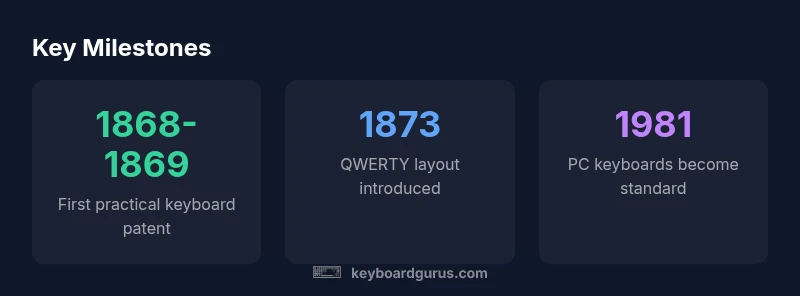
Key milestones in keyboard history
| Event | Year/Period | Notes |
|---|---|---|
| First practical keyboard patent | c. 1868-1869 | Sholes, Glidden, Soulé |
| Commercial keyboard launch | 1874 | Remington Typewriter Company |
| QWERTY layout introduction | 1873 | Design to reduce jams; adopted widely |
| Digital keyboard emergence | early 1980s | PC keyboards become standard |
Got Questions?
Who invented the keyboard?
The keyboard’s origins lie with Christopher Latham Sholes and collaborators Carlos Glidden and Samuel W. Soulé, who developed the first practical keyboard and patent in the late 1860s; Remington shipped the first commercial model in 1874.
It wasn’t a single inventor; it came from a collaborative effort starting with the typewriter.
What is the QWERTY layout and who created it?
QWERTY emerged in the 1870s as the standard arrangement to reduce typebar jams and gained traction across manufacturers long before computing.
QWERTY came from early typewriters and stuck around.
Was the keyboard invented by a single person?
No. The keyboard evolved through collaboration among designers, engineers, and manufacturers over decades.
It wasn’t just one inventor; it was a team effort.
When did computer keyboards become common?
Computer keyboards became widespread in the 1980s with the rise of personal computers and ASCII-based standards.
In the 1980s, keyboards became a staple of computing.
Are there layouts other than QWERTY?
Yes. Alternatives like DVORAK and AZERTY exist, optimized for language or ergonomics, though QWERTY remains dominant in many markets.
There are other layouts, but QWERTY is still the most common.
“The keyboard’s story is less a single invention than a lineage of mechanical innovation and standardization that carried into the digital age.”
What to Remember
- Trace keyboard origins to the typewriter
- Credit Sholes, Glidden, and Soulé for early design
- QWERTY became the standard layout
- From mechanical keys to digital keyboards