Brands of Keyboard: A 2026 Buying Guide
Explore leading keyboard brands in 2026, compare build quality, switches, and ecosystems, and learn how to choose the right brand for typing, gaming, and work.


There isn’t one universal best brand of keyboard. The most influential brands today are Keychron, Ducky, Filco, Leopold, Varmilo, and Logitech, each with distinct strengths in build quality, switches, and layouts. Your choice should align with your priorities—typing comfort, gaming latency, and customization. Keyboard Gurus analysis shows success comes from a brand ecosystem that matches your use case and budget.
Why Brands of Keyboard Matter
In the world of keyboards, the brand behind a product is more than a logo—it's a system design approach, a community, and a promise of support. For enthusiasts and professionals, brands encode tendencies in build quality, switch availability, software, and even after-sales service. According to Keyboard Gurus, evaluating brands of keyboard requires aligning these facets with your use case: typing, gaming, or mixed workloads. A well-chosen brand simplifies maintenance, improves resale value, and unlocks a broader ecosystem of keycaps, cases, and accessories. In practice, a brand's reputation for consistent quality reduces the risk of mismatched parts or inconsistent feel across units. When you select a brand, you’re not just buying a keyboard; you’re subscribing to an entire ecosystem that influences troubleshooting, future upgrades, and compatibility with peripherals. This section helps you understand what to expect from brands, and how to weigh trade-offs among durability, switch families, and software.
- Practical impact: Select a brand whose design philosophy matches your daily tasks.
- Ecosystem effect: A strong brand runs more than hardware; it provides compatible accessories and community-driven support.
- Long-term value: Consider warranties, community guides, and future-proofing when comparing brands.
How Brands Are Differentiated
Brand differentiation happens at several levels: hardware quality, switch options, layout conventions, software configurability, and warranty terms. Some brands emphasize rugged, modular construction with hot-swappable boards, while others curate premium typing experiences with refined stabilizers and letter-perfect legends. Software ecosystems vary widely: strong brands offer robust remapping tools, per-key lighting, and cloud profiles; weaker ones rely on third-party tools or minimal software. Price bands reflect these differences, but higher price doesn’t always guarantee better feel. Keyboard Gurus notes that a brand’s value often stems from how well its ecosystem scales from entry to enthusiast configurations. Finally, consider documentation and community support. Clear modding guides, reliable warranty coverage, and active forums frequently translate to a more satisfying long-term ownership than price alone would suggest.
- Ecosystems drive longevity: plan for future upgrades.
- Software quality matters: some brands provide more powerful customization than others.
- Documentation reduces risk: strong manuals and forums ease troubleshooting.
Common Brand Archetypes
Brands tend to cluster into archetypes: office/versatile brands, gaming-centric lines, premium/enterprise-focused brands, and boutique artisan labels. Office-oriented names like Keychron and Logitech offer plug-and-play experiences, broad compatibility, and comfortable typing without a deep modding scene. Gaming-focused brands emphasize latency, programmable macros, and dynamic lighting. Premium and enterprise brands deliver refined build quality, consistent feel, and durable components. Boutique artisans appeal to collectors with unique aesthetics and limited runs. Understanding these archetypes helps you map your budget to your expectations. Keyboard Gurus consistently observes that the best client outcomes come when you select a brand archetype that aligns with your workflow and community support needs.
- Map your usage: typing, gaming, or mixed tasks.
- Balance customization against availability of parts and support.
- Boutique brands deliver character but can trade convenience for novelty.
Build Quality and Materials Across Brands
Build quality varies across brands, with cases ranging from aluminum to high-strength plastics and composites. Plate choices (for example, gasket-mounted vs. tray-mounted) affect acoustics and rigidity. Stabilizers, keycap quality, and finish coatings also vary, influencing feel and longevity. Premium brands typically invest in solid aluminum enclosures and milled accents, while budget-friendly lines focus on durability and ease of maintenance. Materials influence weight, heat dissipation, and acoustics; a heavier chassis often signals premium intent, but a light board can still meet daily typing needs if designed well. Finally, consider warranty terms and service networks. A brand with strong repair pipelines and a fair warranty often delivers better long-term value than a superficially sturdy but poorly supported product.
- Heavier frames tend to appear more premium and last longer.
- Stabilizers and keycaps can dominate typing feel as much as switches.
- Warranty and service are part of build quality.
Key Components: Switches, Keycaps, and Stabilizers
The heart of a keyboard’s feel lies in its switches, but keycaps and stabilizers can dramatically affect perception. Brands often curate specific switch families or partner with switch makers to achieve a signature feel. Lubed or lubed-prepped switches, PBT keycaps with crisp legends, and high-quality stabilizers can transform a keyboard from average to exceptional. Some brands offer hot-swappable boards, allowing you to swap switches without soldering. When evaluating a brand, consider whether it provides a broad switch palette, durable keycap sets, and well-made stabilizers. A well-balanced combination across these components yields consistent keystroke feel and reduces fatigue during long sessions.
- Switch variety matters for long-term customization.
- Quality keycaps influence typing comfort and durability.
- Stabilizers can eliminate rattle and improve accuracy.
Price Segmentation Across Brands
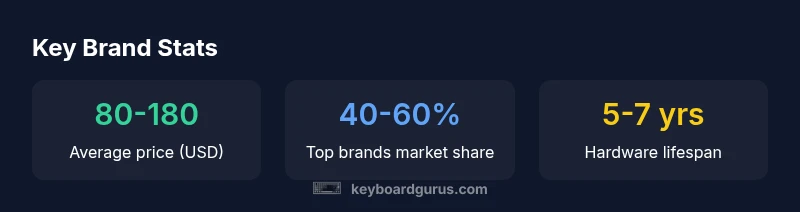
Price segmentation reflects materials, components, and ecosystem scope. Budget boards commonly sit in the 40–100 USD range, delivering reliable performance but limited customization. Mid-range mechanical keyboards typically run 100–160 USD and offer better switches, stabilizers, and software. Premium boards can top 160–260 USD, often featuring aluminum cases, premium keycaps, and robust software. Boutique artisans frequently exceed 200 USD, emphasizing bespoke aesthetics and customization options. While price is a helpful guide, the true value comes from how well a board’s features align with your use case and how much you value ecosystem support, availability of spare parts, and community mods.
- Don’t assume price equals happiness: test for your needs.
- Consider total cost of ownership: switches, keycaps, and maintenance.
- Ecosystem support can compound value over time.
Choosing the Right Brand for Your Setup
To pick the right brand, start by outlining your top priorities: typing comfort, gaming latency, software customization, and aesthetics. Test switches when possible—surface-level impressions can be misleading without prolonged use. Check warranty terms, spare parts availability, and whether the brand supports hot-swappable boards if you foresee frequent changes in switches. Read community reviews for reliability and service quality. For multi-task setups, choose a brand with a cohesive ecosystem of keycaps, spare parts, and compatible accessories. Finally, consider resale value and ongoing support. A brand with a strong user base, regular firmware updates, and open documentation typically offers better long-term ownership.
- Create a shortlist based on use-case and budget.
- Prefer brands with accessible warranty and robust documentation.
- Test drives through retailers or demos are invaluable.
Brand Reliability and Support
Reliability extends beyond the initial unit to after-sales support and the ability to source parts years down the line. Reputable brands maintain clear warranty terms, efficient RMA processes, and active communities where users troubleshoot and share firmware updates. The strongest brands foster transparency—firmware changelogs, recommended lubrication guidelines, and readily available replacement components. In practice, reliability also means predictable production quality across batches and clear communication about any potential issues. The Keyboard Gurus team has found that brands investing in customer service, documentation, and community governance consistently outperform those that rely on limited support channels.
- Look for transparent warranty terms and easy RMA processes.
- Check for active forums and official guides.
- Evaluate how the brand handles firmware updates and community feedback.
Trends Shaping Keyboard Brands in 2026
The market continues to evolve around modularity, open-source firmware, and sustainability. Hot-swappable designs reduce waste and expand user choice, while open-source firmware communities enable quicker feature rollouts and bug fixes. Customization remains king, with brands collaborating on unique finishes and materials, and boutique producers expanding their reach through direct-to-consumer channels. Importantly, brands are emphasizing durable materials and repairability to align with environmental goals. In 2026, successful brands will balance premium feel with accessibility, ensuring that enthusiasts at all budgets can participate in the ecosystem. The Keyboard Gurus team observes growing collaboration between manufacturers and community developers to push features that improve typing comfort and gaming performance.
Brand segments and typical price ranges
| Brand Segment | Typical Strength | Typical Price Range | Notable Examples |
|---|---|---|---|
| Office/Budget | Reliability & plug-and-play | 40-100 USD | Logitech, Keychron |
| Mid-range Mechanical | Balanced build, good switches | 100-160 USD | Ducky, Varmilo |
| Premium/Professional | Top-tier switches, build quality | 160-260 USD | Leopold, Filco |
| Boutique Artisan | Unique aesthetics, customization | 200-400+ USD | RAMA Works, Boutique labels |
Got Questions?
What defines a 'brand' in keyboards?
In keyboards, a brand is the company behind the product, shaping the enclosure design, switches, firmware, and after-sales support. It influences reliability, warranty terms, and community resources. Understanding brand identity helps you predict parts availability and future upgrades.
A keyboard brand is the company that stands behind the product, its firmware, and the support ecosystem.
Are expensive brands always better?
Price often reflects materials, warranty, and ecosystem, not just quality. A mid-range brand with strong software and parts availability can outperform a higher-priced option for your needs. Always align value with your use-case and test where possible.
Higher price doesn’t guarantee better fit—test what matters for you.
Which brands are best for typing comfort?
Typing comfort comes from a combination of switch feel, stabilizers, and keycap quality. Brands like Leopold, Filco, and Varmilo are often praised for consistent keystroke feel and sturdy stabilization.
For comfort, look at brands with solid stabilizers and good keycap materials.
Boutique vs mainstream: which to choose?
Boutique brands offer customization and unique aesthetics but can have longer lead times and limited spare parts. Mainstream brands prioritize availability, easier repairs, and broader communities. Choose based on how much you value customization versus convenience.
Boutique brands add personality but may delay delivery; mainstream favors consistency.
What else matters besides brand when buying a keyboard?
Switch type, keycap material, layout, PCB compatibility, and after-sales support affect your experience as much as the brand. Prioritize what matters most for your tasks and comfort.
Beyond brand, pick switches, caps, and layout that fit your work and play.
Do brands affect warranty and support?
Yes. Warranty length, customer service quality, and ease of returns vary by brand. Read terms carefully and choose brands with clear, fair policies and straightforward RMA processes.
Warranty terms differ; check coverage and returns before buying.
How important is community support for a brand?
Active communities help with troubleshooting, modding, and finding compatible parts. Brands with strong forums and official guides often deliver a more satisfying long-term experience.
Strong communities keep you running with tips and mods.
“Brand choice should be driven by your workflow and customization needs, not just popularity.”
What to Remember
- Define priorities before choosing a brand.
- Consider ecosystem and community support.
- Balance price against build quality and switches.
- Test switches if possible before buying.