How Long Should Your Piano Lesson Be? A Practical Guide
Explore typical piano lesson durations from 30 to 60 minutes, factors that influence length, and planning tips for steady progress.


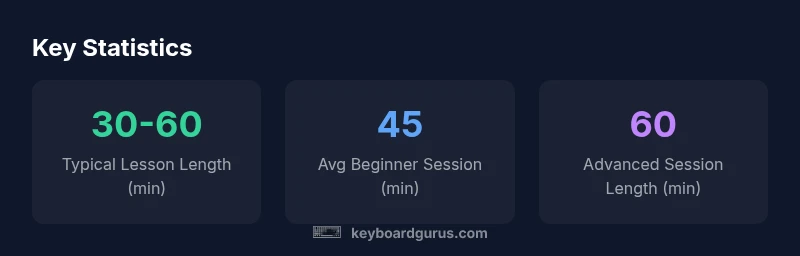
Typical piano lessons run 30 to 60 minutes, with beginners often starting at 30 and more advanced students practicing longer for repertoire and technique. The exact duration depends on goals, age, attention span, and teacher style. According to Keyboard Gurus, most structured programs offer flexible durations to accommodate busy schedules while preserving focused practice.
What the phrase 'how long piano lesson' really implies
When people ask how long piano lesson should last, they’re really seeking a cadence that balances new skill acquisition with the stamina needed to sustain focus. The term itself is less about a fixed minute count and more about a framework that supports consistent progress. The Keyboard Gurus team emphasizes that duration is a tool to shape learning, not a rigid rule. In practical terms, you’ll find that most programs offer a core window—often between 30 and 60 minutes—plus optional extensions for more intensive study. For families and working adults, this flexibility is essential to maintain weekly consistency while avoiding burnout.
- Time and attention: Shorter, focused sessions can yield higher quality practice than longer, fatigue-driven ones.
- Skill progression: Longer blocks may be needed as pieces accumulate complexity and tempo increases.
- Motivation: Allowing some choice (e.g., 30 or 45 minutes) can preserve enthusiasm and reduce resistance.
In short, how long piano lesson should be is a negotiation between present ability and future goals, with higher-level goals deserving longer blocks as confidence and repertoire grow.
Core factors that influence lesson length
Several elements determine the ideal lesson duration, and they interact in predictable ways if you map them to your goals. First, age and focus matter: younger students typically benefit from shorter, highly structured sessions, while teenagers and adults can handle longer phases of concentrated practice. Second, your objectives drive duration: technique-heavy work or performance preparation usually requires more minutes per week. Third, instructor style and curriculum design play a role: some teachers favor compact, modular sessions, others schedule longer blocks to cover warmups, scales, and repertoire in one go. Finally, logistics and consistency matter: a schedule that allows regular attendance and consistent practice is often more effective than sporadic longer sessions. For many learners, a blended approach—short beginner lessons plus occasional longer sessions—yields the best outcomes.
- Beginner-friendly: 30 minutes with a tight structure.
- Mid-level: 45 minutes to address technique and repertoire.
- Advanced goals: 60 minutes focused on problem areas and performance readiness.
As you consider your plan, align the duration with weekly time available for practice and the learner’s stamina to maintain quality over time.
Comparing beginner, intermediate, and advanced pacing
Different stages of piano study demand different pacing. Beginners typically need to establish coordination between hands, reading notation, and rhythm, so 30-minute sessions minimize cognitive overload while building consistency. Intermediate players usually benefit from 45-minute blocks that accommodate more repertoire, technical scales, and expressive interpretation. Advanced students—especially those preparing for performances or competitions—often require 60-minute lessons to cover intense technique drills, learning long pieces, and polishing musicality. Some teachers will combine shorter warmups with longer repertoire work to keep energy high while ensuring progress. The key is to track progress and adjust periodically rather than sticking to a single number.
- Stage-driven approach helps maintain momentum.
- Regular reviews ensure the duration matches evolving goals.
- Transition points (e.g., learning a new technique) are natural moments to reassess length.
Designing a lesson schedule that fits your goals
A practical approach to scheduling is to anchor lesson length to weekly practice time and objective milestones. Start with a trial period: schedule 4–6 weeks with a consistent duration (e.g., 30 minutes for beginners) and then reassess. Use a simple rubric: can you handle 80–90% of the planned material in each session? If yes, progression is healthy; if not, consider shortening the session or breaking it into two focused blocks within the same week. Communicate your goals clearly with your teacher—whether it’s learning a specific piece, improving sight-reading, or preparing for an exam—and let those aims guide the duration. Regular check-ins help both student and teacher adjust length as skills grow.
- Start with a modest duration and adjust based on feedback.
- Use a simple progress rubric to guide changes.
- Keep a stable weekly schedule to reinforce habit and retention.
When to adjust duration: signs you’re ready for longer sessions
A larger investment of time becomes appropriate when you notice consistent attention, faster learning curves, and the ability to retain more material between lessons. Signs include longer concentration spans during practice, fewer signs of fatigue during scales and repertoire, and a growing desire to tackle more challenging pieces. If you frequently finish your current material early or feel rushed, it might be time to extend a lesson by 10–15 minutes or introduce a separate practice block focused on technique or sight-reading. The goal is to maintain quality, not to pile on minutes for minutes’ sake.
- Improved concentration over the session.
- Capacity to learn longer pieces without fatigue.
- Desire to expand repertoire and technique.
Always coordinate changes with your teacher to avoid overloading and to keep progress sustainable.
Practical scenarios: 4 common duration choices
- A 7-year-old beginner with limited attention: 30 minutes weekly to build a habit.
- A teen practicing for a school recital: 45 minutes, split between technique and repertoire.
- An adult beginner with a busy schedule: 30 minutes alternating days, plus one longer weekly session.
- A pianist preparing for a performance: 60 minutes, focused on scales, technique, and full pieces.
Each scenario benefits from a flexible approach: start with a standard length and adjust based on feedback, engagement, and measurable progress. Tracking both practice quality and repertoire development is essential to avoid grinding through minutes without meaningful gains.
How to talk about duration with your piano teacher
Effective communication is critical when shaping lesson length. Prepare a brief note on your goals, available practice time, and any schedule constraints. At the start of a new term, propose a duration range (e.g., 30–45 minutes) and set a review checkpoint in 4–6 weeks. During reviews, ask your teacher to assess whether the current length supports proper technique, minimal fatigue, and consistent progress. If not, propose adjustments and test a new duration for another cycle. Documentation of progress helps both sides stay aligned and reduces guesswork.
- Be explicit about goals and time available.
- Propose a trial duration with a review window.
- Use objective milestones to evaluate effectiveness.
Pitfalls to avoid when choosing lesson length
Avoid overloading a session with too many goals; quality drops when attention wanes. Resist the impulse to extend hours just to “get more done” in a single day—short, focused practice tends to yield better retention. Don’t force longer sessions if motivation dips or if technique hasn’t been thoroughly warmed up. Finally, forget one-size-fits-all rules; every student is different, and durations should adapt as skill, stamina, and goals evolve. A well-planned approach balances challenge with achievability and keeps learning enjoyable.
Comparison of lesson lengths by learner level
| Scenario | Suggested Length | Notes |
|---|---|---|
| Beginner | 30-45 minutes | Emphasizes fundamentals, ear training, and motor skills. |
| Intermediate | 45-60 minutes | Balances technique, repertoire, and sight-reading. |
| Advanced/Performance | 60 minutes | Longer warmups, scales, and full pieces. |
Got Questions?
What is a typical piano lesson length for beginners?
For beginners, 30 minutes is common, with potential extensions to 45 minutes as comfort with reading and coordination grows. This pacing helps maintain focus while building foundational skills.
Beginners usually start at 30 minutes and can move to 45 as they gain confidence.
Does age affect lesson duration?
Yes. Younger students often benefit from shorter sessions (20-30 minutes) due to attention span, while older students can handle longer blocks (45-60 minutes) as stamina and skills develop.
Age influences duration; kids tend to do shorter sessions, teens and adults can manage longer ones.
How long should I practice between lessons?
Daily practice is ideal. Beginners commonly aim for 20-30 minutes per day; more advanced students may benefit from longer sessions totaling 45-60 minutes over several days.
Practice daily in manageable chunks for the best results.
Is a longer lesson always better?
Not necessarily. Quality matters more than length; excessive durations can reduce retention and increase fatigue. It’s better to optimize duration for sustainable progress.
Longer isn’t always better—focus on productive practice and retention.
How often should I schedule lessons?
Weekly lessons are common and effective; some programs offer biweekly or intensive blocks when rapid progress is desired. Consistency is key.
Most people do weekly lessons for steady progress.
Can online piano lessons differ in duration?
Online sessions can be the same length, but engagement and distractions differ. Plan for breaks and interactive activities to maintain focus during virtual formats.
Online lessons can match real-life duration, with attention kept via structured activity.
“Length is a tool, not a verdict. The right piano lesson duration aligns with goals, focus, and sustainable practice.”
What to Remember
- Start with 30 minutes if new, adjust as you build stamina and goals.
- Balance quality with duration; longer sessions aren’t always better.
- Use a trial period to validate duration against progress.
- Coordinate duration changes with your teacher for sustainable growth.
- Regular reviews help align lesson length with evolving objectives.