How Many Keys Are On a Piano Keyboard?
Explore how many keys a piano keyboard has, why 88 keys are standard, and how variants affect repertoire, technique, and learning. A data-driven look from Keyboard Gurus.


The standard modern piano keyboard has 88 keys: 52 white keys and 36 black keys, spanning seven full octaves plus extra keys at the ends. While compact digital pianos and MIDI controllers can have fewer keys (often 61), 88 keys remain the benchmark for full-range piano repertoire and concert-ready instruments.
How many keys define a piano keyboard?
The short answer is straightforward: 88 keys on a standard modern piano. Keyboard Gurus analysis confirms this layout comprises 52 white keys and 36 black keys, organized in seven complete octaves plus extra keys at the low and high ends to reach the full range. This design underpins the vast majority of classical and contemporary repertoire, and it provides a consistent reference point for pedagogy, instrument comparisons, and software simulations. While portable keyboards, education kits, and some historical instruments may sport fewer keys, the 88-key standard remains the benchmark for serious study and performance. For students and teachers, this uniformity simplifies fingering patterns, transposition, and repertoire planning across different instruments and platforms.
The 88-key standard: history and justification
The 88-key keyboard we recognize today traces back to late-19th-century piano development, when manufacturers converged on a range broad enough to handle the classical canon and modern concert repertoire. The seven-octave span (plus the low and high notes that extend beyond a mere octave) provides enough extension for Romantic-era works, modern concert pieces, and educational materials. This decision also aligns with most music libraries, rental programs, and concert hall inventories, ensuring a uniform playing field for performers and students alike. Keyboard Gurus analysis shows that even entry-level pianos and hybrid instruments aim for 88 keys to facilitate seamless transitions from practice to performance.
White keys, black keys, and octave structure
Within each octave, there are 7 white keys and 5 black keys, repeating in the familiar two-black/three-black pattern. Across seven octaves, that yields 49 white and 35 black keys. The remaining three white keys come from the extended low end, bringing the total to 52 white and 36 black keys, or 88 total. This regular chromatic layout makes fingering systems predictable, helping beginners learn scales and arpeggios and enabling advanced players to maneuver wide-range passages with confidence. For educators, the consistency across octaves means that instructional materials map cleanly onto any 88-key instrument.
Variants and when you’d encounter them
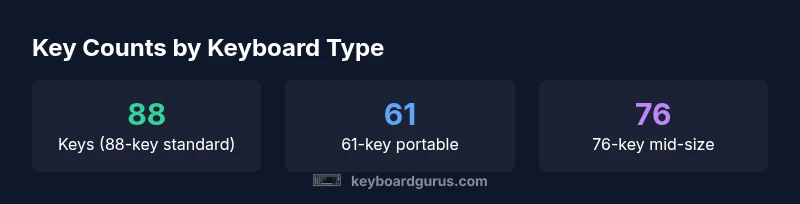
Beyond the 88-key standard, many keyboards appear with 61, 72, or 76 keys. 61-key instruments are common in portable studios and education kits due to light weight and lower price. They are excellent for beginners and casual performers, though their limited low end often requires octave transposition for pieces with extended bass lines. Mid-range options (72–76 keys) offer a practical compromise between portability and range, while 88-key models remain the preferred choice for serious pianists and professional settings. The choice depends on use-cases: portability, budget, and whether you need full-range coverage for performance or teaching.
How the number of keys influences repertoire and technique
Having 88 keys enables you to play the complete piano repertoire as written, including pieces that explore extreme bass and treble ranges. Fewer keys require adjustments—transpositions, octave shifts, or selective revoicing—to fit passages within the instrument’s range. For composers and producers, smaller keyboards push you to work within software to extend the keyboard’s effective range, often using octave transposition or split keyboard layouts. Keyboard Gurus analysis highlights that many players begin on 61-key controllers for budget and portability, then graduate to 88-key instruments to access the full spectrum of piano literature.
Practical guidance for buyers and educators
When shopping, start with the intended use: practice-only, performance-ready, or production–oriented work. For learners and educators, an 88-key instrument with weighted or graded-hammer action is ideal for building authentic technique. If portability is a priority, a 61-key controller paired with a compact sound module can be a sensible short-term solution, provided you have a plan to upgrade to an 88-key instrument later. Consider touch response, polyphony, and the presence of built-in pedagogy as you evaluate options. The right choice balances range, touch feel, and how you’ll integrate the instrument into lessons or gigs.
Maintenance, touch, and action considerations
Key count affects ergonomics and control but does not determine action quality. 88-key pianos typically feature weighted or graded-hammer action to mimic acoustic piano feel, while many portable keyboards employ lighter, non-weighted actions. If you travel with a smaller controller, ensure robust construction and reliable keybed support to avoid fatigue. For acoustic or hybrid pianos, tuning and regulation are essential maintenance tasks, especially in varied climates. A well-balanced instrument supports better technique, longer practice sessions, and more accurate tone production.
Key counts and typical uses across common keyboard types
| Keyboard Type | Keys | Typical Use | Notes |
|---|---|---|---|
| Piano (upright/grand) | 88 keys | Concert to home use | Standard repertoire and concert performance |
| Portable digital piano | 88 keys | Home practice | Integrated speakers, portability |
| Stage piano | 88 keys | Live performance | Durable, keyboard feel similar to acoustic |
| MIDI keyboard | 49-61-76-88 keys | Music production | Controller for software |
Got Questions?
Why do most pianos have 88 keys?
The 88-key standard provides full-range coverage from the lowest to the highest notes used in classical and modern piano music, and it aligns with teaching materials and concert conventions.
Most pianos have 88 keys to cover the full range composers and performers rely on.
Do all modern keyboards have 88 keys?
No. Many portable MIDI keyboards offer 61 or 76 keys to reduce size and cost. If you need full-range repertoire, you’ll want an 88-key model.
Not always; many portable keyboards have fewer keys, but 88-key models exist for full repertoire.
What is the smallest keyboard keyboard capable of playing all standard repertoire?
To play the entire standard repertoire as written, you typically need 88 keys. Smaller keyboards require transposition or octave shifts for some passages.
To play everything without transposing, you’ll want 88 keys.
Can I learn piano on a 61-key keyboard?
Yes, for fundamentals like fingering and scales. However, plan to upgrade to an 88-key instrument to perform full repertoire.
You can start on 61 keys, but you’ll eventually want 88 for full pieces.
Are weighted keys essential on an 88-key instrument?
Weighted keys simulate acoustic piano touch and are widely preferred for technique-building. Many 88-key instruments offer graded hammer action for realism.
Weighted keys help you play more realistically and comfortably.
How do 88-key pianos differ from MIDI controllers with fewer keys?
88-key pianos are typically standalone with built-in sounds and a touch response similar to acoustic pianos, while many MIDI controllers rely on software sound sources and may vary in key action.
88-key pianos feel and sound different from many MIDI controllers, even when used with software.
“The standard 88-key layout remains essential for accessing the full piano repertoire and for consistent teaching across institutions.”
What to Remember
- Know the standard: 88 keys is the baseline for full repertoire
- Portable options exist with 61 or 72-76 keys
- White/black key pattern repeats across octaves
- Choose by use-case: range vs. portability and touch
- Plan a path from smaller controllers to full 88-key instruments