Piano Keyboard Play: A Complete How-To Guide
A complete how-to guide for piano keyboard play, covering posture, scales, chords, rhythm, practice routines, and repertoire. Learn techniques from beginner fundamentals to fluency with practical exercises and clear milestones.


Goal: master piano keyboard play by building solid technique from the ground up. You'll work on correct posture, hand position, scales, arpeggios, simple chords, and a 4-bar practice routine you can repeat daily. The guide also covers practice plans, tempo control, and common mistakes to avoid.
Understanding piano keyboard play: scope and goals
Piano keyboard play is a skill that blends technique, musicality, and consistent practice. At its core, you’ll develop accurate fingerings, relaxed hand motion, and the ability to produce a clean tone across the keyboard. According to Keyboard Gurus, beginners should focus on safe technique before speed or repertoire. Establishing clear goals—such as playing a simple 4-bar melody with proper timing—helps you measure progress and stay motivated as you explore scales, chords, and basic arpeggios that form the foundation of most piano music. This section lays out what you’re aiming for, the kinds of exercises that deliver results, and how to structure your early sessions for maximum gain.
Setup: posture, seating, and hand position
Effective piano playing starts with a comfortable, neutral posture. Sit at a height where your forearms are parallel to the floor and your elbows are relaxed. Your wrists should remain level and flexible, never perched high or dropped low. Hands should float over the keys with curved fingers, and the finger pads should gently rest on the keys. This alignment prevents strain and promotes precise finger control. As you practice, check that your shoulders are relaxed and your neck stays long. A stable setup makes every exercise—whether scales or simple chords—feel natural rather than forced.
Core building blocks: scales, arpeggios, and chords
The piano keyboard play skill grows fastest when you master three pillars: scales, arpeggios, and chords. Start with a C major scale in both directions to develop even tone and consistent fingering (right hand: 1-2-3-1-2-3-4-5 ascending; 5-4-3-2-1-3-2-1 descending). Next, practice arpeggios—playing the notes of a chord in sequence—to improve hand independence and melodic flow. Finally, introduce simple triads and common progressions (for example, I-IV-V in C major) to build harmonic awareness. These elements translate across genres, from classical to pop and beyond.
Rhythm, timing, and practice routines
Rhythm is the gateway to expressive piano playing. Begin with a comfortable tempo and a metronome set to a slow, steady pace (e.g., 60–72 BPM). Practice with a steady beat while counting aloud or tapping your foot. As you become more accurate, gradually increase the tempo in small steps while preserving even tone and clean note attacks. A structured routine—short warm-ups, a scale/arpeggio block, a chord progression, and a short piece—helps you build consistency without burnout. Keyboard Gurus analysis shows that regular, focused sessions outperform sporadic, lengthy practices.
Structured practice routines you can follow
A simple, repeatable practice structure accelerates progress: 1) warm-up (5 minutes of finger independence drills), 2) scale/arpeggio work (8–10 minutes), 3) chord progressions (5–7 minutes), 4) a short piece or improvisation (5–8 minutes), and 5) review and reflection (2–3 minutes). This sequence reinforces technique while keeping sessions varied. Track your tempo, accuracy, and tone quality each day to visualize improvement. Adjust the routine as you grow, increasing complexity gradually while preserving fundamentals.
Exercises: step-by-step to build fluency
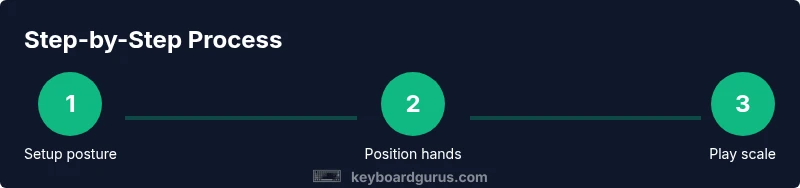
This section offers practical steps you can begin today. For reference, the aims are to (a) develop finger strength and independence, (b) reinforce accurate fingering, and (c) cultivate a musical sense of phrasing. 1) Set posture and hand position. 2) Play a one-octave C major scale, ascending with 1-2-3-1-2-3-4-5 and descending with 5-4-3-2-1-3-2-1. 3) Add the C major arpeggio (C-E-G, E-G-C) in the right hand at a slow tempo. 4) Practice a I-IV-V progression in C major (C major triad, F major triad, G major triad) while keeping steady rhythm. 5) Put it together in a short 4-bar piece, combining scale runs and chord accompaniment.
Common mistakes and how to fix them
Common issues include tense shoulders, pinched fingering, and uneven tempo. To fix them, pause and reset your posture, loosen your grip, and verify fingerings against a simple fingering chart. Use a mirror or video recording to observe hand shape and wrist alignment. Slow down to ensure accuracy before speeding up. If tone quality is inconsistent, focus on even attack and relaxed release; disagree with your own sound by slowing down and listening for consistency.
Choosing repertoire and tracking progress
Choose beginner-friendly pieces in a comfortable key (C major or A minor) to minimize unnecessary accidentals and maximize musical confidence. Start with short, familiar melodies and gradually add more complex rhythms and longer phrases. Create milestones (weekly) and record your performances to compare improvements. Regularly revisit scales, arpeggios, and chords to reinforce muscle memory, then expand to new keys and styles as your fluency grows.
Equipment and space considerations for piano keyboard play
You don’t need a grand piano to start; a full-size 88-key keyboard with weighted or semi-weighted keys is ideal for developing touch and dynamics. A sturdy bench, proper lighting, and a music stand make practice productive. If space is limited, consider a compact digital piano with adjustable tempo and metronome features. Pair your setup with a metronome app and a dedicated practice schedule to maintain consistency across environments.
Tools & Materials
- Full-size keyboard or digital piano (88 weighted keys recommended)(Weighted keys help simulate acoustic piano touch; prioritize weight and sensitivity for better feel.)
- Bench(Adjust height so forearms are parallel to the floor; sit at a comfortable distance from the keys.)
- Metronome or metronome app(Set initial tempo to a slow, steady pace (e.g., 60 BPM) and increase gradually.)
- Music stand(Supports sheet music or practice notes for easy reading.)
- Sheet music or beginner method book(Start with simple melodies or method books that emphasize technique and rhythm.)
- Headphones (optional)(Useful for private practice or quiet environments.)
Steps
Estimated time: 45-60 minutes
- 1
Set posture and seating
Adjust your bench height so your forearms are parallel to the floor. Sit tall with relaxed shoulders and keep wrists level and flexible. Verify that your elbows are slightly in front of your torso to avoid tension.
Tip: Check for tension in the neck and shoulders; a few deep breaths can help release stiffness. - 2
Position your hands and fingers
Let your hands hover above the keys with curved fingers; the fingertips should touch the keys lightly. Rest the thumb on C if you’re starting with C major patterns. Keep wrists relaxed and avoid collapsing the arch of your hands.
Tip: Use finger pads to contact keys; avoid pressing with flat fingers to maintain control. - 3
Play the C major scale
Play the C major scale in one octave, ascending with 1-2-3-1-2-3-4-5 and descending with 5-4-3-2-1-3-2-1. Maintain even tempo and clean tone on each note.
Tip: Start very slowly; precision beats speed at first. - 4
Add arpeggios in C major
Play the C major arpeggio (C-E-G) in the right hand, then the E-G-C pattern. Alternate with a simple left-hand accompaniment if comfortable.
Tip: Ensure clean separation between notes; avoid smudging notes together. - 5
Practice I-IV-V progression
Play C major triad (C-E-G) and F major triad (F-A-C) in a simple pattern, keeping a steady rhythm and even tone. Experiment with adding a basic right-hand melody over the chords.
Tip: Use a metronome to keep consistent tempo across changes. - 6
Put it together in a short piece
Combine scale, arpeggio, and triad patterns into a four-bar phrase. Focus on phrasing, dynamics, and clear articulation at a slow tempo.
Tip: Record yourself to hear tone, timing, and expression more objectively.
Got Questions?
What is piano keyboard play in practical terms?
Piano keyboard play refers to producing musical sounds on a keyboard by coordinating posture, finger technique, rhythm, and musical expression. It starts with fundamentals like posture and fingering and expands into scales, chords, and repertoire.
Piano keyboard play means using proper technique to play melodies and chords on a keyboard, starting with basics and gradually tackling more complex material.
Do I need an acoustic piano to start?
No. A full-size keyboard with weighted keys can provide a realistic touch and enough range for developing technique. A weighted action is preferable for building finger strength and control.
You don’t need a grand piano—an 88-key weighted keyboard is a great starting point.
How long before I see progress?
Progress depends on practice regularity. Many beginners notice improvements in finger strength and rhythm within a few weeks of consistent, focused sessions.
With daily practice, you’ll likely feel steadier in timing and tone after a few weeks.
Should I use a metronome every session?
Yes. A metronome helps establish steady tempo and even rhythm, which are essential for musical phrasing and accuracy.
Practicing with a metronome builds reliable timing and reduces speed errors.
What pieces should I start with for piano keyboard play?
Begin with simple melodies in C major or A minor to minimize accidentals and focus on technique. Gradually introduce short pieces that reinforce scales and chord progressions.
Choose easy, familiar tunes in a single key to build confidence before expanding to more complex pieces.
Watch Video
What to Remember
- Begin with proper posture and relaxed hands.
- Build fluency through scales, arpeggios, and chords.
- Use a metronome to lock in timing.
- Progress with a structured, repeatable routine.
- Track milestones with short, repertoire-based goals.