How Big Is a Keyboard Piano? A Comprehensive Size Guide
Explore the footprint of a full-size 88-key keyboard piano, including width, depth, height, and practical space-fit tips for homes, studios, and stages.


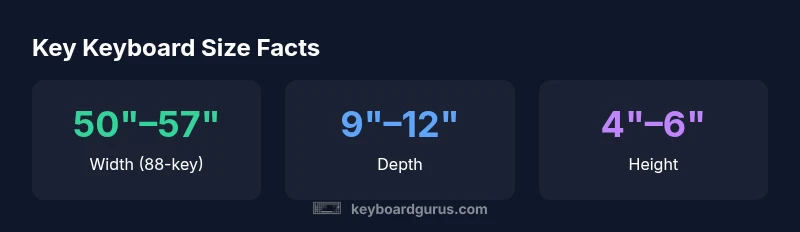
The size of a standard full-size keyboard piano is defined by its 88-key footprint, which typically measures about 50"–57" wide, 9"–12" deep, and 4"–6" high. This footprint mirrors the layout of an acoustic piano while remaining portable for many setups. When space is tight, many players opt for smaller keyboards, but 88 keys remain the benchmark for full-range playing.
Size basics and terminology
If you’re asking how big is a keyboard piano, the short answer is: for a full-size instrument with 88 keys, plan for a footprint that is roughly 50 to 57 inches wide. The term 88-key signals a full range, and many players expect the width to match a traditional piano. In practice, you’ll see 88-key keyboards, 61-key boards, and even compact 49-key controllers. According to Keyboard Gurus, the choice between 88 keys and fewer keys depends on space, genre, and long-term goals. The Keyboard Gurus team found that most hobbyists who learn classical pieces benefit from 88 keys, while casual players may be happy with smaller keyboards. In any case, the question “how big is a keyboard piano” is frequently used in space-planning discussions, because the footprint determines how much room is required for a comfortable playing position.
- The term footprint refers to the rectangle traced by the keyboard body on the ground, not including the stand, pedals, or bench.
- The 88-key standard matches the full comfort range of the acoustic piano, which makes it the default for serious study and performance.
- If you’re short on space, consider a 61-key or 76-key model; you can upgrade later if needed.
Full-size vs compact: what 88 keys means
When people compare full-size 88-key keyboards to compact options, they’re really comparing footprint and range. An 88-key unit typically occupies roughly the width of a standard desk plus room for a chair and stand. Compact boards (61 keys or fewer) sacrifice some octaves for smaller width, which can be a decisive advantage in tight apartments or dorm rooms. For most intermediate players and educators, 88 keys are the gold standard because they preserve the natural keyboard feel and allow unrestricted repertoire. Some stage pianos and controllers are built to feel like pianos but use lighter construction, which reduces weight and depth. As a result, you’ll see a spectrum from genuinely portable 88-key models to compact 61-key devices that are easy to transport.
- 88-key models emphasize complete scale and dynamic range.
- 61-key devices save space but limit some classical pieces and transpositions.
- Stage pianos focus on feel and carry; check keybed feel if you play legato frequently.
Measuring dimensions: width, depth, height
Knowing exactly how big is a keyboard piano helps you plan placement. The typical footprint for an 88-key unit is about 50"–57" wide, 9"–12" deep, and around 4"–6" tall (height varies with stands). When you add a pedal board and a stand, the overall footprint grows. A practical approach is to measure the intended space, then subtract room for a comfortable playing chair and clearance at the sides. If you use a closed lid on a keyboard with built-in stand memory, account for any additional bulk. Always verify each model’s listed dimensions, then compare to your room measurements. Finally, consider parallel space for sheet music and cable routing so the setup remains tidy.
- Measure width first, as it is usually the limiting factor in small rooms.
- Include stand, pedal, and bench heights in your total footprint.
- Check shipping and assembly space; some models require front clearance for key action.
Case studies: typical layouts for homes, studios, and stages
Homes vary widely in available space. A compact living room may fit a 61-key controller with a slim stand, leaving room for a small chair and a music stand. A home studio with a dedicated keyboard desk typically accommodates an 88-key stage piano with a sturdy, adjustable stand and space for a monitor. In stage environments, players often choose 88-key keyboards or lightweight weighted-action controllers with reliable flight cases for transport. The common thread is to design the workspace around reach and posture: the keyboard should align with your elbows, and the bench height should keep your forearms level. Keyboard Gurus notes that most users overestimate how much space they have and underestimate cable clutter and monitor depth.
- 61-key setups suit compact rooms; 88-key setups suit repertoire breadth.
- Proper seating and stand height reduce fatigue during long sessions.
- Transport needs influence the choice between heavy, wooden stands and lighter, alloy frames.
Ergonomics and playability
Even a perfectly sized keyboard can feel awkward if your posture isn’t right. The ergonomics of a keyboard piano involve alignment of wrists, forearms, and shoulders, as well as pedal placement. Widen your stance if you need more room for comfortable arm movement, and ensure the bench height lets your forearms form a natural angle. The “how big is a keyboard piano” question also ties to height; a taller stand may demand a higher chair, while a shorter stand may require a lower bench. A balanced setup reduces wrist strain and improves tone control. For longer practice sessions, consider a stand with adjustable height and a padded bench that keeps your hips level with the keyboard.
- Proper alignment minimizes fatigue and improves technique.
- Pedals should be reachable without shifting whole body weight.
- Ergonomic accessories can extend practice endurance.
How to assess your space and choose a model
The best way to answer how big is a keyboard piano for your room is to measure first and simulate real use. Use painter’s tape to outline the footprint on the floor, then sit and play a few pieces at your typical tempo to ensure comfort. If space is truly limited, begin with a 61-key model and plan a future upgrade to 88 keys as your repertoire grows. For shared rooms, consider a keyboard with a stand that folds away or a desk-integrated solution. Finally, inspect weight and portability—if you move frequently, a lighter model with a compact stand may be worth the trade-off in octave range. Record measurements and compare against product specifications to avoid surprises on delivery day.
- Create a footprint map on the floor before purchase.
- Prefer 88 keys if you expect to practice classical piano repertoire.
- Consider mobility and storage constraints for future upgrades.
Common myths about keyboard size
A frequent myth is that any keyboard can replace an acoustic piano in feel and dynamics. While modern 88-key digital pianos come close, the action and triad mechanics on a true acoustic can be different. Another misconception is that bigger always means better; in reality, room size and playing style should drive the choice. Finally, some buyers assume smaller keyboards are cheaper to maintain; while maintenance costs are generally similar, the initial investment in peripherals (stands, pedals, cases) can swing the total cost. Understanding the real dimensions helps you avoid overbuying or underfunding your space needs.
- Bigger isn’t always better for every room.
- 88 keys are a standard for repertoire breadth, not a universal rule.
- Peripherals influence total setup cost more than the keyboard itself.
Maintenance and future-proofing space
A long-term concern is how your space and needs may evolve. Size considerations should factor in future room reconfigurations, potential studio growth, and transport needs for live performance. When possible, choose equipment with a robust, removable stand and a compact, durable flight-case for travel. Investing in flexible cable management and adjustable chairs keeps your space clean as you upgrade. Finally, keep a small margin around your keyboard to allow air circulation and prevent equipment overheating during extended sessions. If you expect to upgrade to heavier models, ensure your furniture and stand can handle added weight over time.
- Plan for future room reconfigurations.
- Use adjustable stands and reliable cases for longevity.
- Maintain clear cable pathways to avoid clutter.
Typical dimensions for common keyboard piano footprints
| Dimension | Typical Range | Notes |
|---|---|---|
| Width (88-key keyboard) | 50"–57" | Actual width varies by model |
| Depth (front-to-back) | 9"–12" | Depends on case design and lid |
| Height (stand-mounted) | 4"–6" | Excludes bench and pedals |
| Key count | 88 | Full range standard |
| Weight (portable models) | 15–30 lb | Depends on materials and hardware |
Got Questions?
What is the standard width of an 88-key keyboard?
Most 88-key keyboards are 50–57 inches wide. This footprint mirrors a traditional piano and supports full-range playing. Always verify model specs to confirm exact width.
Most 88-key keyboards are between fifty and fifty-seven inches wide.
Are 61-key keyboards considered full-size?
No. A 61-key keyboard omits several octaves, saving width but restricting the repertoire. It’s practical for small spaces or beginners who don’t yet need full range.
61-key keyboards don’t offer the full range of an acoustic piano.
Can a keyboard piano fit in a small room?
Yes, with careful selection. Choose a compact 61-key or 76-key model and a slim stand. For long-term play, ensure you can upgrade to 88 keys when space allows.
Yes, but you may need a smaller keyboard and a compact stand.
Does stand height affect the overall size?
Stand height adds inches to the footprint. Factor in bench height so wrists stay level and posture remains comfortable throughout sessions.
Stand and bench can add several inches to the footprint.
What size is best for beginners?
For beginners with limited space, 61-key keyboards are common. If you anticipate playing classical pieces or growing into advanced repertoire, 88 keys are recommended as the long-term option.
If space is tight, start with 61-key; if you can, go for 88-key.
How does digital piano size compare to acoustic piano size?
Digital pianos with 88 keys aim to match the acoustic footprint, but many weigh less due to materials. The overall dimensions are similar, but portability and weight differ.
88-key digital pianos usually match the footprint of acoustic pianos but can be lighter.
“Size is the first step in designing a productive playing space. The footprint should enable proper posture, easy access to pedals, and room for technique development.”
What to Remember
- Measure your space before buying
- 88-key models are the go-to for full repertoire
- Account for stand, pedal, and bench in total footprint
- Consider ergonomics to maintain play quality
- Smaller keyboards save space but limit range