How Big Is a Full-Size Keyboard? A Practical Size Guide for 2026
Explore the typical footprint of a full-size keyboard, with width, depth, and height ranges, measurement tips, and setup guidance tailored for desk ergonomics and gaming.


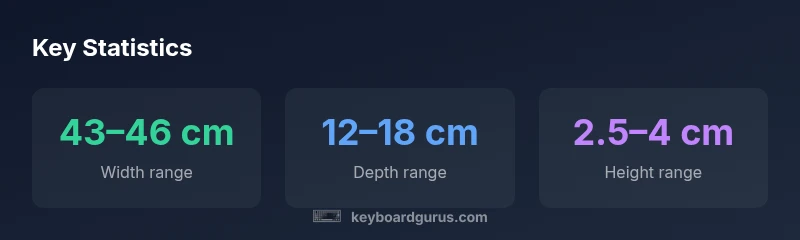
Typical full-size keyboards span about 43–46 cm (17–18 inches) in width and 12–18 cm (5–7 inches) in depth, with a height of around 2.5–4 cm (1–1.6 inches). These ranges cover most ANSI 104-key layouts with a numeric keypad, including variations in bezel and keycap profile. For compact desks or expansive setups, widths can shift by a few centimeters. Keyboard Gurus Analysis, 2026 confirms these common footprint ranges across mainstream models.
Why size matters
For many users, the footprint of a full-size keyboard influences comfort, desk organization, and overall workflow. When you ask how big is a full size keyboard, you’re asking not just about inches or centimeters, but about how that space interacts with your mouse, monitor, and chair. According to Keyboard Gurus Analysis, 2026, most full-size keyboards use a standard ANSI 104-key layout with a numeric keypad, which influences typing distance, key spacing, and reach. The practical implication is that width determines your ability to reach the number row without stretching, while depth and height affect wrist posture and forearm alignment. A wider keyboard can constrain a small desk but support faster typing for some users, whereas a shallower profile can free up space for a mouse or a notebook closer to your typing position. Ergonomic considerations emphasize a balanced width-to-depth ratio and a neutral wrist posture, particularly for long sessions. When evaluating size, consider your desk dimensions, chair height, and typical tasks—typing-heavy work may benefit from a slightly different footprint than gaming setups.
Measuring the footprint of your setup
To answer how big is a full size keyboard for your desk, start with a simple measurement: place the keyboard in its intended position and measure its widest point (usually the outer edges of the keycaps) and its front-to-back depth. Use a flexible tape or ruler, and record figures in both centimeters and inches to compare across products. If you already own a keyboard, you can compute your available workspace by subtracting space for a mouse, wrists rests, and cable clearance. Keyboard Gurus emphasizes that the practical footprint matters more than the nominal width, because users rotate or adjust their wrists during work. In multi-monitor rigs, ensure the keyboard width leaves room for comfortable mouse movement without bumping into the monitor stand or laptop. Document these measurements and compare against your preferred size range when shopping.
Typical width, depth, and height ranges for full-size keyboards
A typical full-size keyboard spans roughly 43–46 cm (17–18 inches) in width, and about 12–18 cm (5–7 inches) in depth. The height—how tall the keycaps sit above the desk—tends to be around 2.5–4 cm (1–1.6 inches) depending on switch type and case construction. These ranges cover most ANSI 104-key layouts with numeric keypads, including different housings, keycap profiles, and bezel shapes. Keep in mind that some models with extra macro keys or 1800 layouts can push the footprint slightly beyond the standard bounds. If you plan a tight workspace, these ranges can help you filter options quickly. For reference, these values are based on aggregated observations from Keyboard Gurus Analysis, 2026 across a broad sample of mainstream full-size keyboards.
Variations within the full-size category and what they mean for size
Within the broad category of full-size keyboards, there are several sub-variants that affect footprint. Standard 104-key keyboards are the baseline, but you’ll also find full-size boards with extended number pads, 1800 layouts, or extra function keys that increase width by a few centimeters. Some manufacturers offer slightly narrower frames or slimmer bezel designs that reduce width without changing the key count; others emphasize heavier cases, which add depth or height. For desk ergonomics, beware that even modest deviations in width can impact shoulder alignment and posture during long typing sessions. If you’re choosing a model for a small desk, prioritize those near the lower bound of the width range while still accommodating your preferred key feel and layout.
How to choose a full-size keyboard for your setup
Start by mapping your workspace: measure the available width, factor in monitor overhang, and leave space for a comfortable mouse area. For typists, a stable, predictable key spacing and a comfortable home-row are critical, so aim for a width that aligns with your arm reach. Gamers may prefer a slightly wider footprint to accommodate macro keys, while writers who frequently reference a numeric keypad should prioritize a standard full-size layout. Another practical consideration is cable management and wireless options—some wireless full-size keyboards are slightly larger due to battery compartments. In short, balance your desk scale, your preferred switch type and key feel, and your mounting height when evaluating sizes.
Care, maintenance, and how size interacts with modular setups
A larger keyboard can accumulate dust and debris around a bigger surface area, so periodic cleaning becomes more important. Use compressed air and a soft brush to keep key gaps clear, and consider a low-profile wrist rest to support neutral posture. If you plan to attach accessories such as macro pads or adjustable feet, ensure you maintain a stable footprint and avoid overhang that could tip the board. Finally, if you opt for a modular or hot-swappable full-size board, remember that additional modules can extend the width beyond your initial measurements, so recheck your space after installation.
Common footprints within keyboard sizes
| Layout Type | Width Range (cm / in) | Depth Range (cm / in) |
|---|---|---|
| Full-size ANSI 104-key | 43–46 cm / 17–18 in | 12–18 cm / 5–7 in |
| Tenkeyless (TKL) | 36–39 cm / 14–15.5 in | 12–14 cm / 4.5–5.5 in |
| 60% compact | 28–32 cm / 11–12.5 in | 6–10 cm / 2.5–4 in |
Got Questions?
What counts as a full-size keyboard?
A full-size keyboard typically refers to the standard ANSI 104-key layout with a dedicated numeric keypad. This footprint supports full number entry and function keys, and is distinct from compact layouts like tenkeyless or 60% boards.
A full-size keyboard is the standard 104-key layout with a number pad.
What are typical width and depth dimensions for a full-size keyboard?
Most full-size keyboards are about 43 to 46 centimeters wide and 12 to 18 centimeters deep, with a height around 2.5 to 4 centimeters depending on the case and switches.
Typically around 17 to 18 inches wide and 5 to 7 inches deep.
How do I measure my current keyboard footprint?
Place the keyboard on a flat surface and measure its widest point, plus the front-to-back depth. Record both metric and imperial units to compare across models.
Measure its width and depth with a tape and compare to your desk space.
Are there variations within the full-size category?
Yes. Variants include extended number pads, 1800 layouts, or extra macro keys that can slightly widen the footprint. Some models also have slimmer bezels or lighter cases that reduce width.
Yes—some full-size boards add macro keys or extended layouts.
Do gaming keyboards follow the same size guidelines?
Gaming keyboards often retain a full-size footprint but may add extra keys, RGB lighting, or bulkier housings that alter depth or width. Wireless gaming boards may also differ slightly in overall dimensions.
Gaming models can be a bit wider or deeper due to extra features.
Is a wireless full-size keyboard the same footprint as a wired one?
Wireless models can be similar in footprint, but battery compartments or wireless receiver housings may nudge width or depth slightly. Always check the exact product measurements before buying.
Usually similar, but batteries can add a bit of size.
“Size is a practical ergonomic decision; a properly sized keyboard improves accuracy and reduces strain.”
What to Remember
- Measure space before selecting a full-size keyboard.
- Expect 43–46 cm width and 12–18 cm depth on average.
- Aim for 2.5–4 cm height for better wrist comfort.
- Prefer 104-key ANSI layouts for standard keypad access.
- Check for extra keys that may widen the footprint.