How to Play Piano Keyboard for Beginners
A comprehensive beginner’s guide to playing piano keyboard. Learn posture, finger numbers, rhythm, reading music, and a simple practice plan to start confidently in 2026. Clear, structured guidance from Keyboard Gurus.


By the end of this guide, you’ll be able to play simple melodies on a standard piano keyboard as a beginner. You’ll learn hand position, basic rhythm, and how to read beginner-friendly notation, plus a practical 4-week practice plan. According to Keyboard Gurus, starting with a clear routine and small, achievable goals keeps you motivated and consistent.
Understanding the piano keyboard layout
A standard piano keyboard has 88 keys, repeating the same pattern of white and black keys across several octaves. The white keys are the natural notes A through G, and the black keys are sharps and flats. The central reference point is middle C, which helps you locate nearby notes quickly. Visualize the keyboard as a sequence of octaves: each octave contains seven white keys (C to B) and five black keys. When you move from one C to the next, you’ve moved up one octave. For beginners, start by locating middle C and learning a few notes on either side. A good habit is to label or memorize C, D, E, F, G, A, B across the keyboard and recognize the recurring pattern of two-black-key and three-black-key groups. This framework makes it easier to find melodies and build scales. For a quick visual guide, see the inline diagram: .
Posture, hand position, and finger numbering
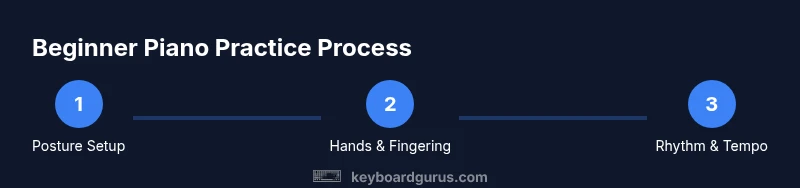
Your posture influences tone, accuracy, and endurance. Sit at a comfortable height so your forearms are roughly parallel to the floor and your elbows are slightly above the keys. Keep wrists relaxed and level; avoid resting wrists on the keyboard while playing. Curve your fingers and keep your fingertips rounded, like you’re holding a small ball. The thumb should cross under the other fingers when moving across keys. Finger numbering is standardized: 1 = thumb, 5 = pinky. Use numbers consistently when reading scales, arpeggios, and melodies. For beginners, plan two alignment checks per practice: a handshake with the keyboard at the start and a quick wrist check after each short phrase. Practice slowly at first to avoid tension, then gradually increase speed as your hands settle into the correct shape. See the diagram: .
The basics of rhythm and timing
Rhythm is the backbone of music. Start with a steady tempo using a metronome set to a comfortable speed, often 60–72 beats per minute for beginners. Count aloud as you play: “1-2-3-4” for quarter notes, and subdivide for eighth notes as needed. In 4/4 time, there are four beats per measure; practice clapping the rhythm before you play to internalize timing. When you play a simple exercise, aim to hit every note on the beat first, then layer in subdivisions. A straightforward way to build rhythm is to practice short patterns (two to four notes) and repeat them for several measures, keeping a consistent volume and attack. Metronome practice helps you avoid rushing or slowing down, which is common for new players. See a basic rhythm chart here: .
Reading sheet music vs. play-along basics
Reading music introduces notation for pitch (notes on lines and spaces) and rhythm (note values). On a standard grand staff, treble clef covers the right hand and bass clef covers the left. The first goal for beginners is to recognize a few note names by sight and count durations. If you don’t read fluently yet, you can start with play-along or simplified notation that uses letter names above the staff. Alternatively, use simple chord lead sheets. The key is to connect the written symbols to finger movements on the keyboard, not to memorize everything at once. Practice with short fragments and gradually add more notes as you grow confident. For visual support, see the side-by-side exercise: .
Step-by-step exercise: First melodies and scales
Exercise A focuses on the C major scale and a familiar melody to build coordination. Start with the right hand playing C–D–E–F–G, using fingers 1–2–3–4–5. Move slowly, keeping the wrist relaxed and the fingertip contact constant. If your tempo wobbles, pause and reset to a comfortable speed. Then try Mary Had a Little Lamb in the key of C, using a simplified fingering: E–D–C–D–E–E–D–D–E–G–F–E, aligning each note with the beat. Use a metronome at a gentle pace and count aloud to reinforce timing. Finish by playing the same phrases one octave lower with the left hand or a simple accompaniment. See the accompanying diagram: .
Building a practice routine for beginners
Consistency beats intensity. Plan a 20–30 minute daily session with a clear structure: 5 minutes of warm-up (finger exercises and pentatones), 10–12 minutes of scales and arpeggios, 5–8 minutes of a simple melody, then 3–5 minutes of review and self-check. Use a metronome to track progress, starting at a comfortable tempo and increasing by small increments as accuracy improves. Include short breaks to prevent fatigue and keep your hands relaxed. Record your sessions every week to monitor growth and identify recurring mistakes. If possible, practice at the same time each day to build a habit. For variety, rotate between technique work, repertoire, and sight-reading drills. A simple, repeatable template helps you stay on track.
Common mistakes and fixes
Common beginner errors include tense shoulders, stiff wrists, and rushing through phrases. The fix is to lower tension: drop the shoulders, loosen the jaw, and keep wrists level with the keyboard. Avoid looking at your hands constantly; instead, glance at the music only as needed and listen for overall balance. Another frequent issue is rushing; slow down using the metronome and practice one phrase at a time. Insufficient warm-up reduces finger independence, so start each session with 3–5 minutes of gentle finger conditioning. Finally, don’t skip rest; short breaks maintain accuracy and prevent injury. See practice-ready diagrams for hand shapes and fingerings: .
Tools, apps, and learning resources
Beginner-friendly tools can accelerate progress without overwhelming you. A full-size keyboard or 88-key digital piano is ideal, though many beginners start on 61-key or 76-key keyboards. A dependable metronome (physical or app-based) helps keep timing consistent. Consider beginner method books or online courses that focus on daily, achievable goals. For data-driven progress, track your practice time, tempo, and accuracy in a simple spreadsheet. Use apps that provide interactive exercises, note identification, and slow-motion playback to reinforce technique. Finally, find a quiet practice space with a stable keyboard and a comfortable bench. See the essential setup checklist here: .
How to track progress and stay motivated
Set small, measurable milestones such as learning a new 4-note phrase, increasing metronome tempo by 5 BPM, or playing a short tune without errors. Keep a weekly log of what went well and what required more focus. Record audio or video of performances and compare with earlier attempts to visualize your growth. Celebrate each milestone, and adjust your plan if you stall. A visible plan helps motivation stay high, especially when you see tangible results week over week. For accountability, share your progress with a friend or teacher who can provide constructive feedback.
What to expect in the first 30 days
In the first month, expect steady, incremental progress rather than dramatic leaps. You’ll likely notice improved finger independence, better rhythm consistency, and greater comfort with the keyboard. Some days will feel slow or awkward, but consistent practice builds neural pathways that translate into more fluid playing. By week four, you should be able to play a simple melody smoothly with the right hand, and with a light left-hand accompaniment, depending on your pace. Stay curious and patient; the key is consistent effort, not perfection. A focused 30-day plan helps you build confidence and momentum.
Tools & Materials
- Piano or keyboard (full-size, 88 keys preferred)(Weighted keys are best; for beginners, semi-weighted is acceptable)
- Metronome or metronome app(Set to 60-72 BPM for starting tempo)
- Leveled beginner sheet music or method book(C major scale and simple melodies (e.g., Mary Had a Little Lamb))
- Music stand or stable surface(To hold sheet music)
- Note naming stickers or color-coded labels (optional)(Helps with learning letters and fingering)
Steps
Estimated time: 30-45 minutes
- 1
Set up your space
Arrange a stable bench, adjust chair height so forearms are parallel to the floor, and keep hips and feet comfortable. A tidy space reduces distractions and supports better posture. Make sure the keyboard is at a height where your wrists can float above the keys without strain.
Tip: Check posture in a mirror before you start and adjust until shoulders, wrists, and elbows form a relaxed, natural alignment. - 2
Find middle C and key names
Locate middle C as your central reference point. Learn a few surrounding notes (C, D, E, F, G) and become fluent with the 2-3-2-3-2 grouping of black keys. This spatial awareness makes it easier to navigate scales and melodies.
Tip: Use a tiny label or memory cue for C to anchor the start of your practice sessions. - 3
Establish hand shape and fingering
Curve your fingers, let the fingertips touch the keys, and keep the thumb ready to glide under. Remember: 1 is thumb, 5 is pinky. Practice the natural hand shape with a few muted notes to feel the balance.
Tip: Do not squeeze the keys; a light, even touch yields cleaner tone. - 4
Practice C major scale
Play the C major scale with the right hand: C–D–E–F–G, using 1–2–3–4–5. Focus on even tempo and even tone across all notes. Repeat ascending and descending to build coordination.
Tip: Keep your wrist relaxed and avoid lifting fingers too high between notes. - 5
Play a simple melody
Try a familiar tune like Mary Had a Little Lamb in C. Use simple fingering: E–D–C–D–E–E–D–D–E–G–F–E, aligning each note with the beat. Start slow and gradually increase speed as accuracy improves.
Tip: Use a metronome at a gentle pace to maintain steady timing. - 6
Coordinate hands
Once you’re comfortable with one hand, add the left hand with a basic accompaniment (one note per beat or a simple chord). Start slowly and ensure both hands align rhythmically before increasing tempo.
Tip: Keep the left hand’s volume balanced with the right hand for a cohesive sound. - 7
Introduce a metronome
Incorporate a metronome into practice to train steady tempo. Begin at a comfortable speed, counting aloud, and gradually raise the tempo in small increments while maintaining accuracy.
Tip: If you can’t stay on beat, slow down and refine the difficult section first. - 8
Review and plan next steps
End each session by summarizing what improved and what still needs work. Set a concrete goal for the next session, such as mastering a new phrase or increasing tempo by a few BPM.
Tip: Keep a short practice log to track progress and keep motivation high.
Got Questions?
Do I need to read music to start playing?
No—many beginners start with play-alongs, letter-name cues, or simplified notation and gradually learn to read standard staff notation. Focus first on getting comfortable with the keyboard and rhythm, then add reading skills as you progress.
You don’t need to be fluent in reading music at first—start with easy melodies and rhythm, then build reading skills over time.
How long until I can play a simple song?
For many beginners, a basic tune can be achievable within a few weeks of steady practice, especially with a structured routine and a slow tempo. Expect gradual improvement rather than instant mastery.
With consistent practice, you can reach a simple song within a few weeks.
What tempo should I start with?
Begin at a tempo where you can play accurately, often around 60–72 BPM. Increase tempo only after you can maintain correct notes and even rhythm.
Start slow, then build up tempo gradually as you gain accuracy.
Are weighted keys essential for beginners?
Weighted keys provide a more authentic feel and dynamics, but many beginners start on lighter, non-weighted keyboards or digital pianos. Choose based on your budget and commitment level.
Weighted keys aren’t mandatory to start; you can begin on an affordable keyboard and upgrade later if you want more realistic touch.
How often should beginners practice?
Aim for daily practice, even if only 15–20 minutes. Consistency beats long, sporadic sessions and accelerates progress.
Daily short practice sessions will help you move faster than longer, irregular ones.
Should I take lessons or learn online?
Both work well. Self-guided online resources paired with occasional feedback from a teacher can provide structure and accountability without a large time commitment.
Online resources are great, and a teacher can give you personalized feedback when you need it.
Watch Video
What to Remember
- Start with a solid posture and relaxed hands.
- Learn middle C identification to navigate the keyboard.
- Build rhythm with a metronome and simple patterns.
- Practice scales and a short melody to develop coordination.
- Track progress and stay consistent for lasting results.