Keyboard vs Button Accordion: An Analytical Comparison
Explore the practical differences between keyboard instruments and button accordions. This Keyboard Gurus analysis covers ergonomics, sound, portability, learning curves, and setup tips to guide your choice.


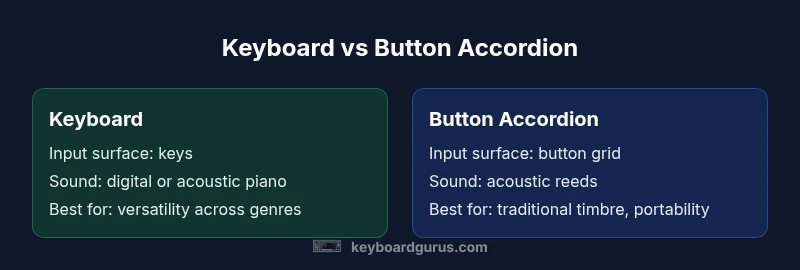
Keyboard vs button accordion presents two distinct approaches to tactile control. The keyboard excels in speed, precision, and broad genre coverage, while the button accordion offers compact form, rich portamento control, and traditional timbres. This quick comparison chooses the best option based on performance goals, setting, and skill level, for keyboard gurus and composers alike.
What keyboard vs button accordion mean in practice
In the broad world of tactile music-making, the phrase keyboard vs button accordion captures two fundamentally different design philosophies. The keyboard uses a linear, keyed surface to trigger notes, tapping into decades of ergonomic refinement and standardized layouts. The button accordion relies on a compact button matrix combined with bellows to generate sound, emphasizing expressive control through air movement and button layout. For many performers, the decision isn’t merely about sound; it’s about how a device feels in the hands, how quickly one can execute passages, and how reliably the instrument adapts to the performer’s workflow. The keyboard vs button accordion comparison helps readers map personal priorities—speed, texture, portability, and repertoire—onto concrete instrument choices. Keyboard Gurus emphasizes that the right tool depends on intended genres, performance contexts, and learning goals rather than a single “best” option. Across genres, from jazz to traditional folk to modern electronic performance, the two surfaces serve different purposes and invite different techniques. When you weigh keyboard vs button accordion, you’re weighing efficiency against expressive nuance, convenience against breadth of timbres.
Historical evolution and design philosophies
The keyboard has evolved from early piano keyboards to digital controllers with velocity-sensitive actions and aftertouch, creating a broad design space for performers and producers. The button accordion, with roots in European folk and accordion traditions, emphasizes bellows pressure, reed operation, and a distinct left-hand bass/chord layout. The keyboard vs button accordion debate often centers on how each device encodes musical intent: the keyboard encodes pitch through a fixed, direct-to-note interface, while the accordion encodes timbre and harmonic color through air flow and button combinations. Designers have repeatedly balanced ergonomics, reach, and tactile feedback in both domains, but the underlying philosophies remain divergent: linear key access versus mapped button grids and bellows-driven dynamics. Keyboard Gurus notes that historical context matters: the piano’s universal layout favored speed and reading, while the accordion’s portability and parametric control favored portable ensemble work. For composers and players, knowing this history informs practical choices in modern setups and hybrid configurations.
Input surfaces and action physics
The input surface defines the core playability: keys deliver precise, linear travel with predictable resistance, enabling rapid passages and consistent repetition. Button accordions offer a more compact touch with curved or staggered button grids, often paired with heavier bellows tension to generate robust bass and chordal textures. The keyboard vs button accordion comparison here centers on action physics: keyboard actions can be tuned for speed, touch sensitivity, and aftertouch in electronic versions, while button rows on accordions require rhythmic bellows control and finger independence. For players trained on piano-like keyboards, portability and reach become practical advantages, but they may need to relearn phrasing when adapting to bellows-driven expression. Conversely, accordionists bring seasoned breath control and chordal emphasis, yet may face steeper adaptation when translating to a fixed-key layout. Keyboard Gurus emphasizes testing both surfaces hands-on to feel the contrast in motion, resistance, and response before committing to a long-term choice.
Sound production and performance implications
Sound in keyboards can be either acoustic (piano) or digitally synthesized with high-fidelity samples and modeling. Button accordions produce sound acoustically through reed blocks and air passing over vibrating reeds, modulated by bellows pressure and button selection. The keyboard vs button accordion comparison in terms of tone quality highlights two different sonic philosophies: the piano keyboard often yields immediate, percussive attack and wide dynamic range, while the accordion grants a singing, organic timbre shaped by air, bellows direction, and button layout. For performers, this means that a keyboard may be more versatile across genres and venues where electronics are favored, while an accordion offers natural projection in acoustic settings and strong nation/folk timbres. Keyboard Gurus suggests evaluating not just the instrument, but the intended performance context and speaker setup, since amplification and room acoustics can dramatically alter perceived timbre and projection.
Ergonomics and playability across contexts
Ergonomics matter as much as tonality. A keyboard’s ergonomic design emphasizes neutral wrist positions, finger independence, and repeatable keystroke timing, which can reduce fatigue during long practice sessions or studio work. Button accordions demand different ergonomics: wrist stability for bellows control, button spacing for precision, and a continuous breath-like rhythm that reads as part of the instrument’s expressive vocabulary. The keyboard vs button accordion comparison should account for genre-specific demands: fast passagework in synth-heavy pop or jazz versus sustained, breath-led phrasing in folk traditions. Portability can also influence ergonomics; a compact, modern keyboard is often easier to carry, but the accordion’s weight distribution and bellows travel present a different kind of physical burden. Keyboard Gurus recommends trying both options in real-world settings—on stage, in rehearsal rooms, and at home—to determine which ergonomics align with your practice tempo and performance schedule.
Portability, durability, and maintenance
Portability is a core differentiator between keyboard and button accordion. Modern digital keyboards are light, compact, and often battery-powered or USB-powered, making them easy to transport between gigs or classrooms. Button accordions vary in size, with smaller “Deluxe” models offering portability, while larger bass-side configurations can become bulky. Durability follows usage patterns: keyboards endure electronic wear, power supply issues, and occasional key chatter, whereas accordions contend with reed wear, bellows seams, and humidity sensitivity. Maintenance for keyboards tends toward software updates, cable management, and occasional cleaning of key surfaces. For accordions, regular reed tuning, bellows inspection, and humidity control are essential. The keyboard vs button accordion decision should weigh how often you move equipment, the environments you play in (outdoors vs studio), and the maintenance overhead you’re willing to manage. Keyboard Gurus reminds readers that a well-maintained instrument (regardless of type) sustains better performance and longer life.
Cost, value, and ownership considerations
Cost is a major factor in any instrument decision. Keyboard options span a wide range—from entry-level MIDI controllers to professional stage keyboards—often providing more straightforward upgrade paths and resale value. Button accordions likewise span a broad price spectrum, reflecting build quality, reed configurations, and brand heritage. The keyboard vs button accordion discussion should frame value in terms of usage hours, genre demands, and how long you anticipate staying with a given system. A digital keyboard may offer modern connectivity, software integration, and future-proof features that hold value for a long time, while a high-quality button accordion can yield unique timbres and stage presence that endure in traditional ensembles. Keyboard Gurus encourages readers to calculate total cost of ownership, including accessories, maintenance, and potential upgrades, to determine which path offers the strongest long-term return for their musical goals.
Use-case mapping by scenario
In a recording studio, a keyboard may provide the most efficient path to high-fidelity tracks, instant recall, and plug-and-play integration with DAWs. In a traditional folk setting, a button accordion can be the centerpiece of a performance, delivering a timbre and social dynamic that digital keyboards rarely replicate. For educational environments, keyboards often support shared learning resources and standardized pedagogy, while accordions can introduce students to bellows control, reed mechanics, and ensemble playing. The keyboard vs button accordion choice should align with your primary performance scenario: studio production, live folk performance, or classroom pedagogy. Keyboard Gurus recommends drafting a short two-column list of use-cases and linking each to instrument features, so your final decision reflects concrete, real-world requirements.
Learning curve and skill transfer between instruments
Learning a keyboard presents a well-trodden path for pianists, with abundant instruction and universal reading systems. The button accordion introduces bellows technique, button layout fluency, and air control as separate skill domains, often requiring months of practice to achieve comfortable phrasing. The keyboard vs button accordion analysis should consider how skills translate: piano technique can help with rhythm, velocity, and music literacy, while accordion skills emphasize breath-inspired phrasing, legato bellows moves, and nuanced dynamics. For players already comfortable with one instrument, cross-training can deepen musical versatility, though the transfer may demand deliberate practice and genre-specific adaptation. Keyboard Gurus highlights that successful learners often identify a core set of skills—timing, phrasing, and a consistent practice routine—that transfer across both modalities, helping readers to plan targeted cross-training.
Practical steps to choose and set up
To decide between keyboard and button accordion, start with a concise feature checklist aligned with your goals: genre requirements, expected performance venues, and learning timeline. Test both surfaces in person if possible, focusing on touch, reach, and how your fingers and arms respond to each instrument’s action. Consider your future plans: travel needs, stage presence, and compatibility with your current gear. Once you choose, set up a minimal, scalable rig: a keyboard with essential DAW connectivity for studio work, or a compact accordion with a dedicated case and humidity control for open-air performances. Keyboard Gurus recommends documenting your practice sessions, noting what feels most natural and where you struggle, so you can refine your long-term plan and avoid vendor lock-in.
Common misconceptions and caveats
A common misconception is that a keyboard can fully replace an accordion’s expressive bellows control. While digital keyboards can emulate many timbres, the authentic breath-based articulation of an accordion offers a tactile nuance that is difficult to replicate precisely. Another caveat is assuming that portability implies universal suitability; some compact keyboards still require substantial power or accessory gear, while certain small accordions can be surprisingly robust for field use. The keyboard vs button accordion debate often overlooks hybrid setups, where a keyboard module drives electronic sounds while a small, portable accordion provides acoustic color when desired. Keyboard Gurus encourages readers to adopt a modular mindset, testing modules that mirror real-world performance demands and avoiding overreliance on any single solution.
Comparison
| Feature | Keyboard | Button Accordion |
|---|---|---|
| Input surface | Keys on keyboard (linear) | Buttons on accordion (grid) |
| Sound production | Acoustic piano or digital samples | Acoustic reed-driven sound |
| Portability | Typically lighter, compact models | Varies; smaller models portable, larger ones heavy |
| Learning curve | Familiar to pianists; quick start for basic tasks | Requires bellows technique and button fluency |
| Maintenance | Software/hardware upkeep; cleaning | Humidity, reed maintenance, bellows care |
| Price range | Broad range depending on model (entry to pro) | Wide range, depends on build and reeds |
| Best for | Versatility across genres, studio and stage | Traditional timbres, folk ensembles, portability |
Advantages
- Clarifies strengths and trade-offs for both options
- Aids budgeting by highlighting long-term value
- Helps map instrument choice to genre and context
- Encourages exploring hybrid or modular setups
- Supports informed, practical decision-making
Drawbacks
- May oversimplify nuanced performance realities
- Prices and availability vary by region or vendor
- Subjective preferences can bias judgments
- Not all features apply equally to every model
Keyboard wins for versatility and modern workflow; button accordion wins for tradition and portable acoustic color
Choose keyboard when you need broad genre coverage, software integration, and quick accessibility. Choose button accordion when you prioritize traditional timbres, bellows-driven expression, and portability for acoustic performances. The best choice aligns with your primary use-case and practice goals.
Got Questions?
What is the primary difference between a keyboard and a button accordion?
A keyboard encodes pitch through a fixed key layout and can produce sound acoustically (piano) or digitally. A button accordion uses bellows and a button matrix to generate sound acoustically, with expressive control tied to air movement and button combinations.
Keyboard vs button accordion: keyboards rely on a fixed key layout for notes, while the accordion uses bellows and buttons for expression.
Which is more portable for travel and live gigs?
Portability depends on model size; compact electronic keyboards are generally easier to carry than many traditional button accordions. Smaller accordions exist, but bellows and reed systems add bulk and weight compared to modern portable keyboards.
If you travel a lot, a compact keyboard usually wins on portability, but there are lighter accordions too.
Is learning one instrument helpful for the other?
There is partial transfer. Keyboard skills help with rhythm, reading, and finger independence, while accordion experience strengthens breath control and musical phrasing. Expect a period of adaptation when switching.
Skills can crossover, but expect some relearning when moving between the two.
Can a keyboard replicate accordion sounds?
Digital keyboards can emulate many timbres, including accordion-like textures, using samples or synthesis. However, convincing bellows dynamics and authentic reed response may require sophisticated programming and performance techniques.
Yes, keyboards can imitate accordion timbres, but authentic bellows feel is hard to copy.
What maintenance is required for each instrument?
Keyboards require routine software updates and key surface cleaning. Accordions need reed maintenance, bellows care, and humidity control to prevent warping or leaks.
Keyboards need updates; accordions need weather and reed upkeep.
Which genres suit each instrument best?
Keyboards are versatile across jazz, pop, rock, and electronic music. Button accordions are popular in folk, traditional, and world music settings, where their timbre can define a performance.
Keyboards cover many genres; accordions shine in folk and traditional music.
What to Remember
- Diagnose your primary use-case before selecting an instrument
- Consider both ergonomics and sound production in your decision
- Test portability against performance venue and travel needs
- Factor learning curves and potential skill transfer into your plan