Keyboard vs Piano: An Analytical Comparison
A rigorous analysis of keyboard v piano, exploring touch, sound, portability, maintenance, and learning implications for enthusiasts, students, and professionals.


In short, keyboard v piano boils down to touch realism, tone, and context. Digital keyboards excel in portability, affordability, and MIDI integration for learning and studio setups, while acoustic pianos deliver authentic hammer-action touch and live acoustic resonance for performance. Keyboard Gurus analysis suggests aligning your choice with goals: practice ease and versatility for digital options, or authentic touch and performance quality for traditional pianos. This guide expands the trade-offs for keyboard enthusiasts, students, gamers, and professionals.
Foundation of the Comparison
The phrase keyboard v piano is a shorthand for a spectrum of instruments, from compact digital keyboards to concert grand pianos. At its core, the comparison rests on three axes: how the instrument produces sound, how the keys feel when pressed, and how the instrument fits into a user’s life and workflow. According to Keyboard Gurus, understanding these axes helps you map your needs—whether you’re practicing at a dorm, composing at a desk, or performing on stage. From this baseline, we’ll drill into practical, real-world differences that matter to keyboard v piano decisions for enthusiasts, students, gamers, and professionals. The goal is to move beyond slogans toward actionable criteria you can test in your own space and style.
Comparison
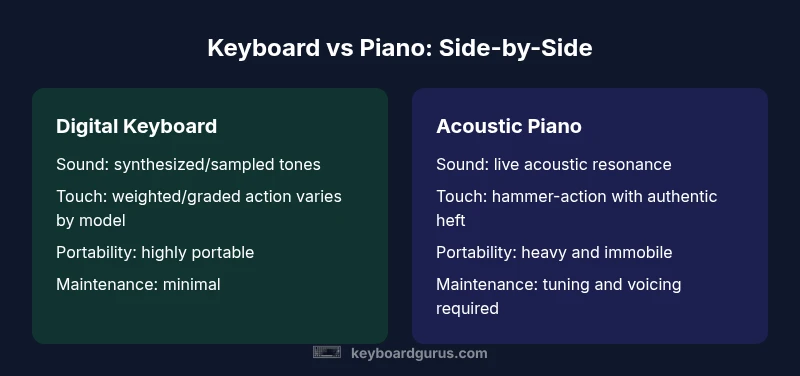
| Feature | digital keyboard | acoustic piano |
|---|---|---|
| Sound production | Synthesized or sampled tones with broad tonal palettes; easy to layer and modulate | Pure acoustic sound from strings and soundboard; dynamic, resonant, and responsive to room acoustics |
| Touch and action | Weighted or semi-weighted keys; action quality varies by model | Hammer-action or graded hammer action with authentic piano heft and repetition |
| Portability | Typically lightweight, compact, and travel-friendly | Heavy; often difficult to move or relocate regularly |
| Maintenance | Low maintenance; occasional battery/power checks and software updates | Regular tuning, voicing, and humidity control required for stabilization |
| Price range | Lower upfront cost on many models; scalable as needs grow | Higher upfront investment with longer-term depreciation and usage |
| Best for | Practice, composition, MIDI integration, stage rigs | Classical repertoire, ensemble performance, traditional teaching |
Advantages
- Low upfront costs for entry models and a quick path to learning
- Broad tonal palettes and software integration for music production
- Light, portable setups ideal for students and travelers
- Extensive learning resources and community support across both options
Drawbacks
- Digital keyboards may feel less authentic to piano touch for serious technique
- Acoustic pianos require regular maintenance and stable environmental conditions
- Sound quality can vary by speaker systems and room acoustics
- Lifespan can be limited by moving parts and humidity exposure in pianos
Digital keyboards excel for learning, portability, and modern workflows; acoustic pianos win for tactile realism and traditional performance.
If you prioritize flexibility, space, and budget-friendly access, start with a digital keyboard. If your priority is authentic hammer action and live piano tone for serious performance, a traditional piano is the better long-term investment. Keyboard Gurus's verdict is to match setup to your primary use-case and future goals.
Got Questions?
What is the fundamental difference between a keyboard and a piano?
The core difference lies in sound production and touch. Pianos produce sound acoustically via strings and a soundboard, with a hammer-action touch. Digital keyboards produce sound electronically, with weighted keys often simulating piano feel. Your choice depends on whether you value tactile realism or flexibility and portability.
Pianos are physical sound machines; keyboards are electronic and modular.
Is a digital keyboard suitable for learning piano?
Yes, a digital keyboard can be a great starting point for learning piano fundamentals, especially for developing finger independence and reading skills. However, some learners notice a difference in touch and sustain when transitioning to an acoustic piano.
It’s a good starting point, but be prepared for a keyboard-to-piano transition later.
Do digital keyboards need tuning?
Digital keyboards do not require tuning as acoustic pianos do. They rely on electronic samples and software; if the siting and speakers are stable, tuning is unnecessary.
No tuning for digital keyboards.
What about MIDI and connectivity?
Most digital keyboards offer MIDI/USB connectivity, enabling integration with computers, DAWs, and learning apps. This makes practice and composition workflows easier and more flexible across genres.
MIDI makes it easy to connect to your computer or tablet for learning and composition.
Which is better for classical training?
For serious classical training, an acoustic piano is often preferred because of the authentic touch and live tone. A high-quality digital piano with graded hammer action can be a strong alternative when space or budget is limited.
Classical training often benefits from an actual piano, but a good digital piano can work too.
Can a small space justify a piano?
If space is extremely limited, a compact keyboard or digital piano with a weighted action can provide essential practice without the footprint of an upright or grand piano.
If space is tight, start with a compact digital option.
What to Remember
- Choose digital keyboards for portability and practice with MIDI workflows
- Prefer acoustic piano for authentic touch and performance authenticity
- Factor environmental stability (humidity/temperature) for pianos
- Leverage MIDI-capable keyboards to extend learning and composition tools
- Plan a budget that considers long-term value and maintenance needs