Keyboard vs Digital Piano: Understanding Key Differences
Explore the core differences between a keyboard and a digital piano, including action, sound, and use cases. Keyboard Gurus breaks down what matters for learners, gamers, and professionals to choose wisely.


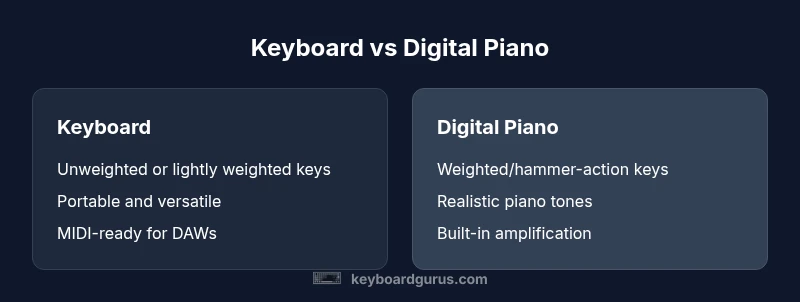
When you compare the difference between a keyboard and a digital piano, the deciding factors are action, sound realism, and intended use. A keyboard prioritizes portability, versatility, and MIDI connectivity, often with unweighted or semi-weighted keys. A digital piano emphasizes piano-like touch, authentic tones, and built-in amplification for practice and performance. This quick contrast helps you pick based on goals, budget, and setting.
Introduction to the Difference Between a Keyboard and a Digital Piano
Understanding the difference between a keyboard and a digital piano starts with purpose. Keyboardists, educators, and casual players value portability and flexible sound palettes, while pianists and performers seek tactile realism and acoustically convincing tones. According to Keyboard Gurus, recognizing these core distinctions early saves time and money, especially when you are balancing practice routines with live performance needs. In this guide, we’ll examine how each instrument is built, how it feels under the fingers, and what that means for practice, recording, and stage use. The term difference between a keyboard and a digital piano is more than branding—it reflects distinct design goals and audience needs that influence everything from action to outputs. Throughout this article, you’ll see practical comparisons, real-world scenarios, and actionable steps to choose the right tool for your setup.
Action and Keyboard Feel: The Core Distinction in Touch
The action of a keyboard versus a digital piano is the most visible difference. Keyboards often feature unweighted or lightly weighted keys that prioritize rapid, agile playing and comfort for long sessions on the go. In contrast, a digital piano typically uses weighted or hammer-action keys intended to replicate a grand piano’s tactile response. This contrast is central to the difference between a keyboard and a digital piano because touch response directly affects technique, dynamics, and expressive control. For learners, starting on a keyboard can build finger independence quickly, but progressing to more realistic weighted keys is a common next step if your goal is serious piano technique. Keyboard Gurus notes that the quality of key action varies widely across models, so hands-on testing is essential when you’re evaluating options.
Sound Realism: From Clicky Voices to Concert Hall Tone
Sound realism is another pivotal factor in the difference between a keyboard and a digital piano. Keyboards often offer a broad sound palette, including synths and mallet percussion, with voices that are ideal for pop, film scoring, or experimentation. Digital pianos focus on piano tone, with samples designed to emulate a concert grand and, in higher-end models, advanced layering and pedal resonance. The goal is to minimize the “electric keyboard” artifact and deliver a voice that responds to velocity, aftertouch, and sustain like an acoustic instrument. In practice, this means a digital piano will usually have a more convincing piano spectrum, while a keyboard can adapt to genres that demand a diverse sonic toolkit.
Pedals and Sustain: What Really Changes with Each Instrument
Pedal behavior is a telling indicator in the difference between a keyboard and a digital piano. Many keyboards offer a basic sustain pedal with optional half-pedal features on higher-end models, but they rarely replicate the nuanced sustain of a piano. Digital pianos often ship with one, two, or even three pedals, with sophisticated sensing and pedal resonance modeling. If you’re aiming for realistic piano practice, the digital piano’s higher pedal fidelity can be a deciding factor. For chordalist or EDM-focused players, a keyboard’s flexible pedal options can support creative effects and sustain control within a broader sound set.
Amplification, Speakers, and Output Options
Built-in amplification and speakers heavily influence the user experience, and this is another key point in the difference between a keyboard and a digital piano. Many keyboards are self-contained, with speakers calibrated for casual practice or classroom use, plus lightweight outputs for headphones or small amps. Digital pianos often provide higher-quality audio systems suitable for stage monitoring and recording, including balanced line outs and sometimes Bluetooth audio. The trade-off is size and weight; digital pianos tend to be bulkier but offer richer, more consistent tonal output for repeated practice sessions and performances.
Connectivity and MIDI Capabilities: How Each Instrument Interfaces with Tech
Connectivity defines how you integrate your instrument with software and hardware. Keyboards usually emphasize MIDI over USB, with compatibility to DAWs and virtual instruments, plus line or headphone outputs. Digital pianos also support MIDI, but they frequently include more robust options like dedicated USB ports, Bluetooth, and external audio interfaces. If you’re building a studio rig or performing live with a computer, prioritize models that offer reliable MIDI, audio interfaces, and easy integration with your preferred software. The difference between a keyboard and a digital piano here is not just if it can connect, but how easily and with what latency the connection behaves in real-world sessions.
Portability and Size: Travel-Friendly vs. Home-Station Fortitude
Portability is a practical concern that highlights the difference between a keyboard and a digital piano. Keyboards tend to be compact, lighter, and easier to transport, making them popular for travel, gigs, and classrooms. Digital pianos emphasize stability and a closer-to-piano feel; they’re heavier and often designed to sit on a stand in a home studio or rehearsal space. If you travel frequently or rehearse in small spaces, a compact keyboard can be a better fit. If your priority is piano practice with less compromise on feel, a digital piano can be worth the extra weight.
Pricing, Value, and What You Get for Your Money
Price is often a decisive factor in the difference between a keyboard and a digital piano. Keyboards span a broad spectrum—from budget models with essential features to mid-range devices offering better touches and more voices. Digital pianos usually sit at a higher base price, reflecting better key action, piano samples, and built-in amplification. Buyers should consider ongoing costs such as maintenance and potential upgrades when comparing models. While you shouldn’t chase the cheapest option to the detriment of your goals, you should avoid overspending on features you won’t use regularly. Keyboard Gurus suggests evaluating whether you need piano-like touch and tone or a versatile instrument for production and performance.
Use-Case Scenarios: Who Should Buy Each Instrument
Consider your primary use case when resolving the difference between a keyboard and a digital piano. Beginners and hobbyists who value portability and a wide sound set may lean toward a keyboard. Students and professionals who require authentic piano practice, stage reliability, and a refined touch will often prefer a digital piano. For recording and production, neither option is strictly superior; it depends on how well the instrument integrates with your DAW and your workflow. A balanced setup might even pair a keyboard for experimenting with sounds alongside a digital piano for serious practice and performance.
Step-by-Step Checklist for Choosing
To avoid misjudging the difference between a keyboard and a digital piano, follow a practical checklist: (1) define your primary use case (practice, performance, or production), (2) test key action across several models (unweighted vs weighted), (3) compare tones and pedal behavior, (4) verify connectivity options and compatibility with your DAW, and (5) assess portability and durability for your environment. If possible, demo both types side-by-side and bring headphones to judge sound reproduction. Keyboard Gurus recommends a hands-on approach to ensure the instrument aligns with your goals and budget.
Common Myths Debunked: Misconceptions About These Instruments
A common myth is that all keyboards are merely toys with synth sounds. In reality, many modern keyboards offer serious motion control, expressive voices, and robust MIDI features. Another misconception is that digital pianos are only suitable for classical players; in practice, modern digital pianos can handle a wide range of styles, from pop to film scoring, especially when layered with realistic sustain and pedal behavior. By debunking these myths, you can make a more informed decision about the difference between a keyboard and a digital piano that matches your artistic goals.
Care, Maintenance, and Longevity: Keeping Your Instrument in Top Shape
Longevity is affected by how well you maintain your instrument. Keyboards require relatively simple care: keep keys clean, protect from dust, and check power supplies. Digital pianos, with more advanced components, benefit from periodic servicing of the action mechanism and electronics, particularly if you use the device intensively in a professional setting. Regularly updating firmware (where available), using proper power adapters, and avoiding extreme temperature exposure extend lifespan. As with any instrument, routine maintenance preserves resale value and performance quality, ensuring the difference between a keyboard and a digital piano remains clear over years of use.
Comparison
| Feature | Keyboard | Digital Piano |
|---|---|---|
| Key action | Unweighted or lightly weighted keys common on budget or portable models | Fully weighted or hammer-action replicating piano feel |
| Sound source | Diverse voices and synths; broad sonic palette | High-quality piano samples and realistic tone modeling |
| Polyphony | Typically lower to mid-range (e.g., 16–128 notes on many models) | High polyphony (often 128–256 notes or more) for complex passages |
| Pedals | Usually 1–2 pedals; some models offer more | 2–3 pedals with advanced sensing and resonance modeling |
| Connectivity | MIDI/USB, basic audio outputs, headphone jacks | Advanced MIDI, USB, line out, headphone, Bluetooth often available |
| Portability | Lightweight and portable; designed for travel and classrooms | Heavier and more studio/stage-oriented; less portable |
| Best for | Beginners, portability, versatile sound options | Serious piano practice, authentic feel, live performance |
Advantages
- Clarifies the key decision factors (action, sound, price, portability)
- Helps map real-world needs to instrument type
- Assists educators in choosing training setups
- Provides a value-focused view for budget planning
Drawbacks
- Can oversimplify wide model variations within each category
- Might underrepresent niche or hybrid instruments
- Prices vary widely; ranges can still be unclear without testing
Digital piano suits serious piano practice; keyboard suits portability and versatility
If authentic touch and piano-like tone are priorities, choose a digital piano. If you need portability and diverse sounds with budget-friendly options, a keyboard is the better fit. The decision should align with use-case, space, and budget.
Got Questions?
What is the main difference in action between a keyboard and a digital piano?
The main action difference lies in feel: keyboards typically have unweighted or lightly weighted keys, while digital pianos use weighted or hammer-action keys to mimic a grand piano. This affects finger strength, dynamics, and technique development.
Keyboards are lighter to play, but digital pianos feel more like real pianos. If you want piano-like control, go digital piano.
Can a keyboard substitute for a digital piano in practice?
For primary piano practice, a digital piano generally provides a closer touch and tone. A keyboard can supplement practice, especially for technique or production work, but may not replicate the piano experience as accurately.
A keyboard can help, but for authentic practice you’ll want a digital piano.
Do digital pianos always include high-quality sound samples?
Most digital pianos aim for strong piano voices, but the realism varies by model. Budget digital pianos may have decent tones, while high-end units use superior samples and modeling for richer sound.
Quality varies; pricier models usually sound more like real pianos.
Is portability a reason to choose a keyboard over a digital piano?
Yes. Keyboards are typically lighter and smaller, making them ideal for travel, teaching spaces, and casual settings. Digital pianos tend to be heavier but offer better tone and feel when stationary.
If you move often, a keyboard is easier to carry.
What should I test in a live performance scenario?
In live settings, test the action, volume, and pedal response, plus reliability of outputs. A digital piano often provides more consistent piano tone on stage, while a keyboard offers versatile routing for effects and sounds.
Check action, tone, and outputs in a real stage setup.
Which instrument tends to be cheaper over time?
Initial cost is usually lower for keyboards, but long-term costs depend on use. Digital pianos may require more investment up front, yet deliver higher resale value and longer practical lifespan for piano practice.
Cheaper upfront, but long-term value depends on use.
What to Remember
- Define your primary use-case before shopping
- Test key action to match your playing goals
- Prioritize piano-like touch for serious practice
- Consider connectivity for studio integration
- Balance portability against sound realism and price