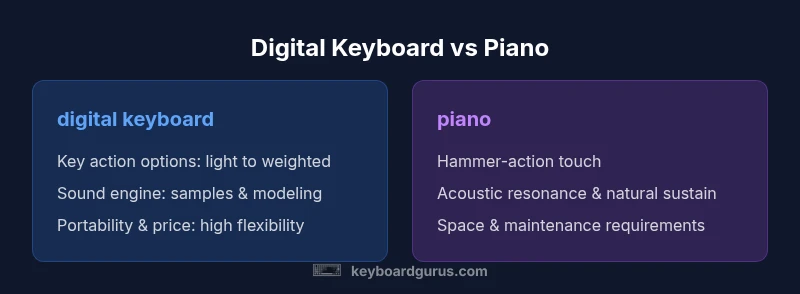
Digital keyboard vs piano: A comprehensive comparison
An analytical comparison of digital keyboards and pianos, examining touch, sound, portability, price, and ideal use cases for students, hobbyists, and professionals.


For most players, a digital keyboard offers portability, built-in sounds, and budget-friendly practice, while a true piano delivers authentic touch, dynamic range, and long-term value. If you prioritize realism and performance, a piano is often the better choice; if you need versatility and travel-friendly gear, a digital keyboard wins. Keyboard Gurus analysis suggests the decision should hinge on touch, setting, and space.
Defining the comparison: digital keyboard vs piano
In discussions of the digital keyboard vs piano, the core distinction lies in how each instrument produces sound and how the keyboard responds to your touch. A digital keyboard is an electronic instrument that emulates piano tones through sampling or modeling and typically includes a range of built-in voices, effects, and MIDI connectivity. A piano—whether upright or grand—produces its sound acoustically via strings and a wooden action and requires regular tuning and maintenance. For many keyboard enthusiasts, the keyword to keep in mind is tone realism paired with tactile feedback. The question isn’t merely which instrument sounds better; it’s which one aligns with your goals, available space, and long-term practice or performance plans. According to Keyboard Gurus, the digital keyboard vs piano decision hinges on touch realism, stage practicality, and space considerations. In this guide, we unpack the mechanics, practice implications, and practical trade-offs so you can choose confidently.
Historical context and current landscape
The landscape for digital keyboards and pianos has evolved rapidly over the past decades. High-fidelity samples, advanced velocity sensing, and sophisticated touch modeling have narrowed the gap in expressiveness between electronic instruments and their acoustic counterparts. Today’s digital keyboards range from compact, affordable models aimed at beginners to elaborate stage pianos that rival the action of traditional uprights and grands. Acoustic pianos, by contrast, remain a benchmark for touch, resonance, and projection. The key takeaway is that both families now offer credible, versatile tools for practice, composition, and performance. The choice often comes down to balancing realism with practicality, especially for learners who need portable gear or for performers who require robust, on-the-road reliability.
Key action and tactile feel: weighted vs hammer action
Touch and action are among the most debated aspects in the digital keyboard vs piano discussion. Digital keyboards vary from light action to fully weighted keys, with some models offering hammer-action simulations that attempt to mimic an acoustic piano’s feel. However, even premium digital actions seldom reproduce the exact inertia and repetition resistance of a true hammer mechanism. Acoustic pianos feature a complex mechanical system where each keystroke drives a hammer that strikes strings, producing a nuanced, dynamic response. For advancing players, the subtleties of key weight, rebound, and pedaling require careful evaluation. If you frequently perform classical repertoire or aim to build technique transferable to an upright or grand, a weighted digital keyboard can be a practical stand-in, but many players eventually note a sensory gap compared with an actual piano.
Sound design and expressiveness: sampling, modeling, and tone shaping
Digital keyboards rely on sound engines that combine sampling and physical modeling to reproduce piano tones and other voices. The expressiveness of these sounds depends on velocity sensitivity, polyphony, and the ability to layer multiple voices. In contrast, an acoustic piano’s sound is generated by string vibration, harmonics, and the resonant body of the instrument, which responds with natural sustain and sympathetic resonance. The result is that a piano typically provides more natural tonal balance and a broader dynamic range from pianissimo to fortissimo. That said, modern digital keyboards offer highly convincing piano tones and the flexibility to shape tone with equalizers, effects, and layering for genres outside classical performance.
Pedals and sustain, polyphony, and performance specs
Pedal configurations differ notably between digital keyboards and acoustic pianos. Digital models often include 1–3 pedals with half-pedal sensing and programmable functions, which can simulate sustain, soft, and sostenuto actions while enabling per-voice control and MIDI mappings. Acoustic pianos usually provide three standard pedals with consistent mechanical action. Polyphony—the number of simultaneous notes a keyboard can produce—varies widely in digital keyboards, influencing how densely you can layer sounds without cutoffs. For home practice and sequencing, higher polyphony is advantageous; for duo or ensemble performance, a reliable pedal and response system becomes equally important. When comparing digital keyboard vs piano, these factors mark important limits for repertoire and performance style.
Portability, setup, and space considerations
One clear advantage of the digital keyboard is portability. Lightweight boards, built-in stands, and compact footprints are common, making travel practice and small living spaces viable options. Acoustic pianos demand significant space, heavier weight, and a fixed placement, which can complicate room layout and relocation. Setup time also differs: digital keyboards may require a simple power source, a stand, and possibly a small amplifier or speaker system, whereas pianos require proper tuning, humidity control, and sometimes professional regulation of action over time. For students in dorm rooms or performers who move between rehearsal spaces, digital keyboards offer practical flexibility that a piano cannot easily match.
Connectivity, MIDI, and software integration
Digital keyboards shine in connectivity. Many models include USB MIDI, Bluetooth, and multiple audio outputs that integrate with learning apps, DAWs, and virtual instruments. This opens opportunities for transcription, composition, or music production right away. Musicians who work with notation software, looping environments, or sampling kits will find digital keyboards especially valuable. Acoustic pianos, while capable of MIDI with external interfaces, do not inherently offer the same level of plug-and-play connectivity. The choice here depends on whether your workflow emphasizes digital composition and learning software or a traditional, purely acoustic practice space.
Practice, learning, and technique transfer
For beginners, the decision often centers on affordability and ease of access. A digital keyboard with built-in metronome, lesson modes, and recording functions can accelerate initial progress and help maintain regular practice. However, technique learned on an electronic keyboard may not perfectly transfer to a traditional piano, where touch and pedaling behavior demand refinement. Many teachers advise starting on a keyboard with weighted keys if possible, yet ensuring you also spend time on a true piano to refine technique that carries into live performance settings. The balance between practice convenience and transferability should guide your equipment choice.
Cost, depreciation, and maintenance
Cost considerations for digital keyboards span a wide range from budget models to premium stage pianos. In general, you can expect lower upfront costs and minimal ongoing maintenance for digital options, with occasional speaker or battery replacements as potential expenses. Acoustic pianos incur ongoing maintenance, including tuning, regulation, and occasional repairs, which adds to total ownership cost but can preserve value if well cared for. The depreciation curve for digital keyboards tends to be steeper with rapid model turnover, while high-quality acoustic pianos may retain or appreciate value over time when treated well. Pricing bands are broad, and you should plan for the long term when evaluating investment in either path.
Use-case scenarios: student, performer, composer
If you are a student with limited space and funds, a digital keyboard often makes the most sense, especially with built-in learning modes and portability. For a recitalist or studio musician, a high-quality piano gives authentic touch and projection essential for auditions and performances, even if it requires a larger investment and space commitment. Composers and producers may lean digital due to integration with software and MIDI workflows, enabling rapid experimentation and sound design. The right choice depends on your primary activities: practice, performance, or production, as well as your ability to accommodate physical space and budget.
Comparison
| Feature | digital keyboard | piano (acoustic) |
|---|---|---|
| Key action | Range from light/standard to weighted; hammer-action simulations exist but differ from true hammer mechanics | Hammer-action with authentic weight and recoil; superior for classical technique |
| Touch sensitivity | Velocity-sensitive with adjustable or fixed response; some models offer aftertouch on select voices | Consistent, natural dynamic response from the instrument’s action |
| Sound engine | Sampled/modeling tones; built-in voices; extensive onboard effects and recording | Acoustic resonance from strings and body; natural tonal balance without digital processing |
| Pedals | Typically 1–3 pedals; often programmable with per-voice control and half-pedal support | Standard 3 pedals with well-established feel; consistent mechanical operation |
| Portability/size | Compact, lightweight designs; easy to transport and set up in small spaces | Bulkier footprint; heavier and requires dedicated space |
| Maintenance | Low ongoing maintenance; tuning not required; occasional speaker/amp replacements | Periodic tuning and regulation; action adjustments over time; potential structural needs |
| Price range | Broad range; typically more affordable upfront; value varies by features | Higher upfront cost; long-term value influenced by touch and tone quality |
| Best for | Practice, travel, genres requiring portability and diverse voices | Serious classical repertoire, stage performance, and room-filling tone |
Advantages
- Greater portability and lower upfront cost
- Wide range of built-in voices and learning features
- Low ongoing maintenance and tuning needs
- Strong MIDI and software integration for practice and production
Drawbacks
- Less authentic touch and dynamic range compared to a real piano
- Sound and action may not perfectly replicate acoustic piano at all price points
- Digital models can depreciate as new technology arrives
- Speaker quality can limit auditioning the full piano feel without external gear
Digital keyboard offers practical versatility; piano provides authentic touch and tone
Choose a digital keyboard for portability and software integration. Choose a piano for authentic feel and performance-proven tonal character; align choice with space, budget, and musical goals.
Got Questions?
What is the main difference between a digital keyboard and a piano?
The digital keyboard recreates piano sounds electronically and often includes multiple voices and features, while a piano produces sound acoustically via strings and a wooden action. The choice affects touch, tone, and maintenance needs.
Digital keyboards use electronics and samples; pianos rely on strings and hammers. If you want one instrument for many sounds and apps, digital works well; for authentic touch, a piano is better.
Can a digital keyboard replace a piano for beginners?
A digital keyboard is a practical starting point for beginners due to lower cost and space needs. However, beginners should eventually practice on a keyboard with weighted keys if possible to ease the transfer to real pianos later.
It’s a good starter, but plan for time on a real piano to build authentic touch.
Do all digital keyboards have hammer action?
Not all digital keyboards have true hammer action. Some offer graded-weight or simulated hammer feel; true piano action remains the benchmark for realism at the keyboard.
Some digital keyboards feel like a piano, but real hammer action is unique to acoustic pianos.
Which is better for stage performances?
Stage needs often favor digital pianos or stage keyboards for reliability, footprint, and sound consistency in venues. Acoustic pianos require careful placement and transportation, which can be a hurdle on tour.
For stage, digital options usually win on consistency and transport.
Is regular maintenance required for a piano?
Yes. Acoustic pianos require tuning, regulation, humidity control, and occasional repairs to maintain optimal touch and tone. Digital keyboards demand far less ongoing maintenance.
Pianos need tuning and care; keyboards mostly just need power and occasional updates.
How do I decide when space is the deciding factor?
If space is tight, a compact digital keyboard can fit where a piano cannot. For larger rooms or dedicated studios, a piano offers superior tone, but you must ensure you have the space and climate control to protect its wooden components.
If space is tight, go digital; otherwise, consider room and climate for a piano.
What to Remember
- Prioritize touch realism if you aim for classical repertoire on a piano
- Choose a digital keyboard for portability and learning features
- Assess space and budget before buying
- Consider long-term needs: performance, production, and practice