Difference Between a Keyboard and an Electric Piano
An analytical guide analyzing the difference between a keyboard and an electric piano, focusing on action, sound generation, portability, and use cases to help musicians choose.


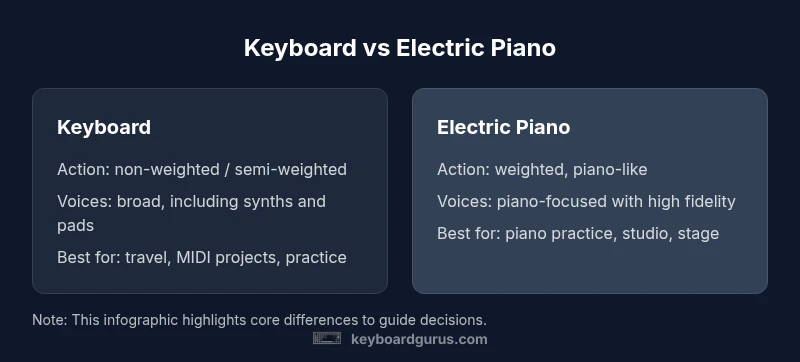
The difference between a keyboard and an electric piano centers on action, sound generation, and intended use. Keyboards are designed for portability, built-in voices, and MIDI versatility, often with non-weighted or semi-weighted keys. Electric pianos emphasize piano-like touch and richer, more realistic tones for practice, studio work, or live performance.
What sets these instruments apart
The difference between a keyboard and an electric piano is best understood through three lenses: action, sound generation, and intended use. Keyboard design prioritizes versatility: a lightweight chassis, a broad range of built-in voices, and extensive connectivity for MIDI sequencing and software integration. Electric pianos are built to emulate a traditional piano experience: they emphasize touch weight, key motion, and tonal fidelity that satisfy pianists in practice rooms, studios, and on stage. While both devices can produce convincing piano-like tones, the path each takes to those sounds differs. In practice you might treat a keyboard as a Swiss Army instrument—capable of simulating strings, organs, and synths—while an electric piano narrows its focus to delivering consistent, authentic piano feel with fewer extraneous voices. The Keyboard Gurus team notes that most players begin with a keyboard for learning and music production, then evaluate an electric piano when their primary goal is piano realism. The difference between a keyboard and an electric piano therefore often boils down to how seriously you value action fidelity versus flexibility and portability.
Comparison
| Feature | Keyboard | Electric Piano |
|---|---|---|
| Action/Touch | Non-weighted or semi-weighted keys; varying stiffness | Weighted hammer-action; piano-like feel |
| Sound Engine | ROM samples and synthesis; broad voice library | High-fidelity piano samples with expressive resonance |
| Voices/Polyphony | Wide variety of voices including synths and organs | Piano-centric voices with detailed velocity layers |
| Portability & Weight | Light, highly portable; suited for travel | Heavier but available in portable forms; often built for durability |
| Connectivity | MIDI/USB, audio outputs, built-in speakers | MIDI/USB, line outputs, sometimes pedal-friendly interfaces |
| Best For | Practice, gigging, MIDI projects, education | Piano practice, studio recording, live performances |
| Price Range | Wide range depending on model | Mid to high for authentic touch and tones |
Advantages
- Versatility for live performance and MIDI workflows
- Wide voice library supports genre experimentation
- Low to mid price options for entry-level players
- Excellent portability for commuters and students
- Strong ecosystem with apps and software integrations
Drawbacks
- Sound quality and realism can vary across budget keyboards
- Action on lower-cost keyboards may feel non-weighted or inconsistent
- Electric pianos tend to be heavier and pricier
- Some keyboards lack robust sustain or true piano resonance in some models
Electric pianos win for authentic piano feel and tone fidelity; keyboards win for portability, versatility, and value.
Electric pianos deliver piano-like touch and tone suitable for serious practice and studio work. Keyboards excel in portability, budget-friendliness, and a broad sonic toolkit, which is ideal for learners, performers, and MIDI-driven setups.
Got Questions?
What is the main difference between a keyboard and an electric piano?
The main difference is action and intended use: keyboards prioritize portability and a broad voice library, while electric pianos emphasize piano-like tactile feedback and high-fidelity piano tones.
In short, keyboards are versatile tools for many sounds; electric pianos aim to feel and sound like an acoustic piano.
Is a keyboard a good substitute for an electric piano for piano practice?
A keyboard can work for beginner practice and certain repertoire, but weighted keys and piano-focused sound are usually preferred for serious piano study.
If you want a true piano feel, you’ll benefit from weighted action and piano-like tones.
Do electric pianos require tuning?
Electric pianos generally do not require tuning like acoustic pianos; their tuning stability comes from digital electronics and software processing.
No tuning usually needed, but occasional calibration of action or speaker alignment may help on some models.
Can I use a keyboard for lessons?
Yes, especially for beginners; many keyboards include lesson modes, metronomes, and practice features.
Great for beginners and general music learning.
How does weight affect portability?
Heavier weighted-action models are less portable; lighter unweighted or semi-weighted keyboards are easier to carry and set up.
Weight usually means less portability, but it often comes with a better piano feel.
What to Remember
- Prioritize weighted keys if piano realism is your main goal
- Test a range of voices and touch responses in-store before buying
- Weigh portability against your space and travel needs
- Factor long-term value: MIDI expandability and patch storage matter
- Use side-by-side tests to decide between piano-like feel vs broad sonic options