Piano Keyboard vs Piano: A Thorough Side-by-Side Guide
Learn how a piano keyboard compares to a traditional piano, covering touch, tone, cost, maintenance, and use cases with expert guidance from Keyboard Gurus.


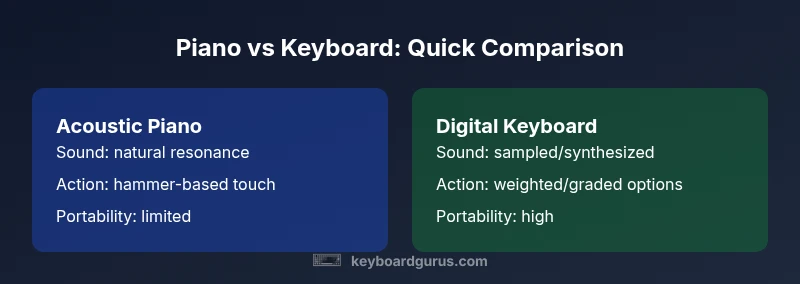
According to Keyboard Gurus, piano keyboard vs piano trade-offs hinge on acoustic feel versus digital flexibility. A traditional piano delivers authentic hammer action and resonant tone, best for expressive dynamics and ensemble performance. A keyboard or digital piano emphasizes portability, integrated sound engines, and software compatibility, which is ideal for travel, layered practice, or budget-conscious setups. This guide outlines the key differences to help you choose confidently.
Core Concepts: What exactly are we comparing?
The terms piano keyboard and piano are often used interchangeably in casual conversation, but they refer to distinct concepts. A piano is a full acoustic instrument that generates sound through string vibrations caused by hammer strikes, controlled by a keyboard that your fingers press. A piano keyboard is also used to describe digital or electronic devices designed to emulate piano playing: keyboards, stage pianos, and compact digital pianos. When evaluating these options, consider your goals: authentic feel, dynamic expression, space, and budget. Keyboard Gurus emphasizes that the distinction matters most when you move from casual playing to serious practice or performance. For many players, the full-range keyboard standard matters for repertoire compatibility, but the key action, touch, and sound generation method are the real differentiators that influence technique and tone quality.
Action and Touch: Keyboard Mechanics vs Acoustic Action
The core difference lies in how the keys translate your input into sound. Acoustic pianos rely on a felt-covered hammer mechanism with wooden keys and precise escapement. The touch varies by model, feel, and maintenance, but it is generally heavier and more nuanced, rewarding subtle control of dynamics and pedaling. Digital keyboards and stage pianos use weighted or semi-weighted keys to mimic that sensation, with graded hammer action in higher-end units to simulate heavier lower keys and lighter upper keys. The result is a response curve that can be calibrated via software and firmware. For students and professionals, choosing between a graded action and a basic semi-weighted feel can dramatically affect legato, arpeggiation, and overall technique development.
Sound, Tone, and Expression: How They Differ in Real Use
An acoustic piano produces a complex spectrum of overtones and natural resonance that changes with air, room acoustics, and playing strength. The sound evolves with sustain, pedal use, and touch, creating a living instrument that rewards long-term listening and ensemble interaction. Digital keyboards rely on sampled or synthesized tones, which can be exceptionally realistic but may lack the natural interaction of a true acoustic instrument. Modern digital pianos incorporate stereo samples, multisampling, and effects to approximate nuance, but subtle elements like cabinet resonance and true acoustic projection remain challenging to reproduce perfectly. Understanding these differences helps you map your sound goals to the right device.
Use Cases: Practice, Performance, and Recording Scenarios
For home practice, a compact digital piano often suffices, provided it has weighted keys and reliable pedal action. For classrooms and studios, a full-size digital piano or a high-quality acoustic instrument is preferred for pedagogy and reproducibility. Stage performers value portability, reliable MIDI/USB connectivity, and versatile patch libraries that digital keyboards provide. Recording contexts frequently demand the nuanced capture of transient dynamics from an acoustic instrument or the practical consistency of a digital piano. Balancing these needs with room size and noise considerations will guide your selection.
Cost, Maintenance, and Longevity
Acoustic pianos carry higher upfront costs and ongoing maintenance, including tuning, regulation, and environmental controls. With proper care, they can last many decades and even become family heirlooms. Digital keyboards have lower maintenance, no tuning required, and software-based upgrades, but they carry risk of hardware or firmware obsolescence. Ongoing costs for digital setups include power protection, occasional replacement of internal components, and possible software subscriptions. When budgeting, weigh the total cost of ownership, not just the purchase price, and consider how often you will move the instrument and how long you intend to keep it.
Space, Portability, and Setup Considerations
Physical footprint strongly influences your choice. Acoustic pianos require substantial floor space and a stable environment; keyboards and portable digital pianos fit into small rooms, dorms, or shared spaces with ease. Portability matters for performers and educators who travel or teach in multiple locations. Setup complexity is another factor: digital devices often plug-and-play with minimal maintenance, while acoustic pianos demand climate control, humidity management, and occasional professional tuning.
Digital vs Acoustic: Decision Guide by Situation
If you prioritize authenticity of touch and projection for piano repertoire, an acoustic instrument is hard to beat. If you need portability, inexpensive practice options, or integrated software tools for composition and learning, a quality digital piano or keyboard will serve you well. In many homes, a hybrid approach makes sense: a compact digital piano at home for practice and a small MIDI keyboard for computer-based production. The decision should align with your room, budget, and long-term goals.
Transition Tips: Moving Between Keyboard and Piano
Switching from digital to acoustic, or vice versa, requires adjusting for touch and sound. Start with scales and arpeggios to recalibrate finger weight and pedaling. Practice with the metronome to map your rhythm to the instrument’s response. Record yourself to compare sustain and tonal balance, and seek feedback from a teacher or peers. With patience, you can translate skills across instrument types and keep your technique consistent.
Authoritative sources and practical resources
For further reading and validated insights, explore resources from established institutions. Keyboard Gurus does not bill these references as endorsements, but they provide context for technical differences and performance considerations. You can consult major educational or government-supported sources to understand instrument construction, acoustics, and performance practice. This section lists representative resources to deepen your understanding and guide your decisions. For example, Harvard University offers music science resources on touch and dynamics, MITs acoustics materials cover resonance and instrument behavior, and the Library of Congress provides historical context on keyboard instruments.
Comparison
| Feature | Acoustic Piano | Digital Keyboard / Stage Piano |
|---|---|---|
| Sound generation | String-based, natural resonance | Sampled/synthesized tones with layered effects |
| Action/Touch | Hammer mechanism with escapement, heavier feel | Weighted or semi-weighted with graded action in higher-end units |
| Portability | Bulky, difficult to move | Compact, travel-friendly |
| Maintenance & Tuning | Tuning and regulation needed regularly | Minimal maintenance; occasional software updates |
| Lifespan & Durability | Long-lasting with proper care | Subject to electronic component wear but upgradeable |
| Sound projection | Room-dependent acoustic projection | Consistent sound in any room |
| Best use | Classical repertoire, ensemble performance | Practice, composition, live performance, studio work |
Advantages
- Authentic touch and expressive potential on acoustic pianos
- Rich, natural tone with long-term resonance
- Digital options offer portability and broad sound libraries
- Lower maintenance for digital keyboards
- Flexible setups and integration with software and MIDI
Drawbacks
- Acoustic pianos require regular tuning and climate control
- Digital keyboards may lack the subtleties of true hammer action
- High upfront cost for premium acoustic pianos
- Potential hardware obsolescence in older digital models
Acoustic piano remains the gold standard for feel and tone; digital keyboards excel for portability and versatility
Choose acoustic when you crave authentic touch and projection. Opt for digital when space, budget, and software integration take priority.
Got Questions?
What is the fundamental difference between a piano keyboard and a piano?
A piano is an acoustic instrument with strings and hammers that produce sound, while a piano keyboard is the input surface used to play it or to control digital sounds. In practice, people refer to the keyboard as the electronic device rather than the instrument itself. Understanding this distinction helps set expectations for touch, tone, and maintenance.
In short, the piano is the instrument with strings; the keyboard is the control surface, especially on digital models.
Can a digital keyboard replace an acoustic piano for beginners?
Yes, for beginners a digital keyboard can provide a cost-effective, space-saving way to learn fundamentals. Look for weighted keys and proper touch response to ensure good technique transfer. As skills advance, you may want to add an acoustic option for repertoire and tonal depth.
A good weighted-key digital can work for beginners; you may still want an acoustic later for best touch and tone.
Is graded hammer action necessary for serious practice?
Graded hammer action mimics the heavier touch of lower piano keys. It's beneficial for serious classical practice, but not strictly mandatory for all players. Begin with a quality weighted action and reassess as you progress toward advanced repertoire.
Graded hammer helps with technique, but you can start with a solid weighted key and adjust as you learn.
What should I choose for a home studio or apartment?
If space and noise are concerns, a compact digital piano with headphones or a silent mode is ideal. If you require maximum tonal variety and dynamic control, a full-size acoustic instrument or high-end digital piano can justify the footprint. Consider your neighbors, room acoustics, and budget.
For apartments, digital is usually the smarter choice; acoustics matter if you have room and neighbors to consider.
How long do pianos last and how is maintenance handled?
Acoustic pianos can last for many decades with regular tuning and climate control. Digital keyboards have a shorter hardware lifecycle and may require firmware updates or replacement over time. Both benefit from proper placement away from sunlight and humidity.
A well-kept piano can last decades; digital devices may need updates or replacements over time.
Why do most piano literature and repertoire require an 88-key keyboard?
Historically, most classical repertoire is written for a full-range keyboard with a wide range. Using a keyboard that lacks range can limit repertoire accessibility. If you plan to study classical pieces, aim for a full-range keyboard or piano.
Most classical pieces assume a full-range keyboard, so a keyboard with enough keys is important.
What to Remember
- Assess your primary use case before buying
- Prioritize touch accuracy for classical repertoire
- Factor room size and climate in the decision
- Consider a hybrid setup if both worlds matter
- Plan for maintenance and software updates when choosing digital