Difference Between Keyboard and Piano: An Analytical Guide
A rigorous, analytical comparison of keyboard vs piano, covering design, touch, sound, pedagogy, and use‑cases to help learners and professionals choose the right instrument.


The difference between keyboard and piano comes from intent, action, and sound. A piano is a stringed instrument with a hammer mechanism that physically strikes strings, producing a rich, dynamic tone. A keyboard is a keyboard interface that triggers various sounds—often piano samples—via internal or external sound engines. For beginners, the choice depends on touch feel and long-term goals.
What Sets the Keyboard and Piano Apart
The core distinction between the keyboard and piano is rooted in design intent, sound production, and playing experience. According to Keyboard Gurus, the keyboard is primarily a surface for triggering sounds, while a piano is a complete acoustic instrument with strings, a soundboard, and a hammer action that translates touch into sound. The keyword difference matters for learners and professionals who want a long-term path in keyboard-based music. The piano rewards expressive control through weight, velocity, and pedal interaction, whereas a modern keyboard or digital piano emphasizes versatility, portability, and expanded sound palettes. In practical terms, this means beginners often start with a keyboard to practice finger technique without the commitment of space or tuning, then decide whether to pursue acoustic piano study or continue with a weighted-action digital instrument. When assessing options, consider touch responsiveness, pedal behavior, intended repertoire, and how often you’ll move the instrument between rooms or venues. Ultimately, the choice should align with musical goals and real-world constraints, not just brand or performance fantasies.
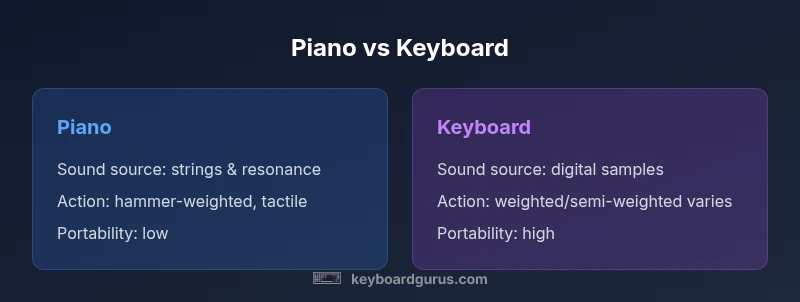
- Sound production: pianos rely on strings and a soundboard; keyboards rely on digital samples or synthesis.
- Action: pianos use hammer action with weighted keys; keyboards vary from non-weighted to weighted action depending on model.
- Pedaling: pianos use real pedals with physical mechanics; keyboards simulate pedaling with electronic implementation.
- Portability and maintenance: pianos are large, require tuning and maintenance; keyboards are portable and low-maintenance.
This initial framing helps readers set expectations: if you want authentic acoustic tone and technique, a piano is the benchmark; if you value portability and diverse sounds, a keyboard or digital piano is the practical starting point.
Historical Context and Design Intent
Pianos originated in the early 1700s as fully acoustic instruments designed to maximize dynamic expression and resonance. The keyboard, by contrast, is the interface used to access a range of sounds—on organs, harpsichords, and later modern electronic keyboards. Keyboard Gurus notes that the modern term keyboard encompasses devices that can imitate piano tone while offering countless other voices, rhythms, and effects. The historical design intent mattered: pianos were built to produce a singular, high-fidelity musical instrument with a robust physical touch; keyboards were engineered to be portable input devices capable of controlling various sound engines. Digital pianos and workstation keyboards later combined sampling, modeling, and effects, allowing players to switch instantly between grand piano tone, electric piano, strings, pads, and more. For students, this lineage matters because it explains why technique, touch, and pedagogy feel different when transitioning from a keyboard to a piano. The result is a pedagogical path where initial exploration with a keyboard can mature into serious piano study, or continue with a versatile electronic instrument for broader musical work.
- The piano’s aural identity comes from acoustic resonance, string interaction, and soundboard amplification.
- The keyboard’s identity centers on control surfaces, voices, and digital sound engines.
- Digital pianos blur lines by offering weighted action and authentic piano tones while remaining portable and adaptable.
This historical perspective helps players understand why touch, tone, and technique diverge between the two – and why many musicians choose one path over another based on goals and environment.
Physical Differences You Can Observe
One of the most immediate differences is physical scale and hardware design. A traditional acoustic piano is a tall, weighty instrument with a large cabinet, a heavy keyboard assembly, and three pedals at the base. A keyboard or digital piano is compact, often flat or slightly angled, and designed for transport. Key size is similar, but travel and resistance vary: pianos feature a weighted hammer action that provides substantial resistance and nuanced velocity response; many keyboards employ non-weighted or semi-weighted action, which affects how hard you press and how quickly you can react. The presence of a soundboard and acoustic strings on a piano is a defining feature, whereas a keyboard relies on electronic sound generation and speakers or headphones. Build quality matters: high-end pianos use precise action regulation and high-grade wood, while premium digital pianos seek gravity and key feel close to acoustic instruments through substantial weights and graded hammer action. Pedals differ as well: pianos have three pedals with dynamic functions, while keyboards typically include a sustain pedal and perhaps soft or sostenuto functions, often with digital substitutions. Finally, maintenance diverges: tuning and regulation define piano upkeep; keyboards demand firmware updates, cable management, and power considerations. Vision and feel are the clues you need when assessing options in a shop or studio.
- Pianos: heavy, tall, tuned, and mechanically intricate.
- Keyboards: portable, electronically driven, power and speaker dependent.
- Pedal systems: mechanical in pianos; digital or simulated in keyboards.
- Action fidelity: piano action is deeply tactile; keyboard action is model-dependent with variable weight and travel.
When evaluating touch, look for graded hammer action and key weighting in digital pianos to approximate an acoustic feel; this is essential for developing classical technique.
Playing Technique and Touch
Technique on a piano and a keyboard diverges in how touch translates to sound. On a piano, velocity-sensitive hammer action translates finger pressure into a wide dynamic range; pianists develop a sense of arm weight, finger shape, and release to shape tone. The keyboard, even when weighted, may not fully replicate all these subtleties because the sound engine may limit the degree of true acoustic response. Nevertheless, modern digital pianos with weighted keys and graded hammer action can approach the feel of an acoustic instrument, enabling proper technique practice in spaces where a real piano is impractical. Pedaling on a piano involves real dampers and sustain curves, while digital systems simulate pedal effects, sometimes with half-pedal recognition, which matters for legato phrasing and pedal technique in Romantic repertoire. For learners, the key is to practice with consistent dynamics and articulation, then adjust to the instrument’s action as you advance. Teachers emphasize consistent finger independence, correct wrist alignment, and controlled arm movements, whether playing a grand piano or a weighted-digital model. In short, you can build solid technique on either, but true piano technique generally requires an instrument that closely matches a real hammer action and true acoustic responsiveness.
- Piano touch: heavy, nuanced, relies on arm weight and velocity.
- Keyboard touch: varies by model; graded or uniform, often less nuanced than a grand piano.
- Pedaling: authentic on piano; digital pedals aim for realism but may differ in sustain behavior.
- Practice strategy: start with proper alignment, then adapt to your instrument’s action as you progress.
Sound Production and Tone Color
Sound on a piano is born of physics: strings vibrate, resonate with the soundboard, and interact with each other in rich, natural ways. The resonance of the soundboard and the sympathetic vibrations create a complex tonal bouquet that many musicians describe as warm, earthy, and immediate. A keyboard or digital piano, by contrast, uses internal sound engines—samples, synthesis, or modeling—to generate tone. The tone color can be highly varied, allowing you to switch between grand piano, electric piano, strings, and many other voices. This flexibility is a strength of keyboards, especially for genres requiring diverse timbres. However, achieving authentic piano tone and spatial resonance requires high-fidelity sampling, careful speaker design, and, in the case of digital pianos, impedance-matched amplification. The sustain of a piano is a function of the instrument’s physical strings and dampers; on keyboards, sustain depends on the engine and the quality of samples or modeling. For performers, deciding between a realistic piano tone and a wide palette of sounds is a matter of repertoire and context. Both instrument families can offer compelling musical journeys when matched to the musician’s goals and setting.
- Acoustic piano tone: natural, resonant, and nuanced.
- Digital tone: versatile, varied, and stylable but dependent on samples and engine quality.
- Sustain and resonance: physical vs digital mechanisms.
- Best use: piano for classical and chamber music; keyboard for crossover genres and studio work.
Practical Implications for Learners and Musicians
Choosing between a piano and a keyboard depends on practical constraints as much as music goals. For students with limited space, a compact digital piano or keyboard with weighted action can provide a realistic practice environment without the upkeep costs of an acoustic instrument. For gigging musicians, portability and the ability to access multiple voices quickly can justify a keyboard or digital stage piano; a real piano remains ideal for home studios and concert stages where authentic acoustic tone is non-negotiable. Budget is another decisive factor: a high-quality upright piano can be a long-term investment but costs more upfront and requires ongoing maintenance; a mid-range digital piano with graded hammer action can deliver close-to-piano touch without large space commitments. Pedal accessibility matters too: expressive repertoire often requires proper pedal control; ensure your chosen instrument offers the right pedal configuration and half-pedal sensitivity if you pursue advanced pedaling. In addition, consider future trajectory: if you plan to pursue concert piano or scholarly classical repertoire, gradually transitioning to a real piano might be part of your path. If you prioritize versatility, studio use, teaching, or multi-genre playing, a weighted keyboard or digital piano could be the smarter all-around choice. The decision should align with your environment, schedule, and long-term artistic aims.
- Space and budget: digital options suit smaller rooms and entry costs.
- Repertoire goals: classical focus favors the piano; diverse styles favor keyboards.
- Maintenance: pianos require regular tuning; keyboards require firmware updates and care for electronics.
- Education path: plan growth from beginner keyboard to piano study if desired.
Common Confusions and How to Resolve Them
Many players use the word keyboard to refer to both a piano-like instrument and a broader family of electronic sound-producing devices. Digital pianos, electronic keyboards, stage pianos, and synthesizers all sit under the same umbrella, yet their capabilities differ significantly. A common misconception is that all keyboards sound like pianos; while many digital pianos aim to simulate piano tone closely, other keyboards emphasize electric, analog, or orchestral voices. Likewise, some people assume that a heavy, weighted keyboard equals a piano; in truth, weight and key travel vary by model, and the acoustic piano’s scale and resonance cannot be perfectly replicated by all digital instruments. To resolve these confusions, focus on three criteria: touch (do the keys feel weighted or semi-weighted, and how does velocity respond?), tone (does the instrument deliver an authentic piano sound in expected dynamics?), and context (do you need portability, a live stage setup, or an at-home practice tool?). If possible, test both instrument types side-by-side, preferably with the same repertoire, to experience the real differences in touch, sustain, and tonal quality. This practical testing will illuminate where your preferences truly lie and help you choose the instrument that best aligns with your musical journey.
Comparison
| Feature | Piano | Keyboard (digital) |
|---|---|---|
| Primary sound source | Strings and soundboard (acoustic resonance) | Electronic samples/sound engine (digital) |
| Action and touch | Hammer-action, graded weighting; very expressive | Weighted/semi-weighted or light action; velocity varies by model |
| Portability | Heavy, large footprint; not easily moved | Compact, portable, can be battery-powered (depending on model) |
| Maintenance | Tuning and regulation; professional upkeep | Low maintenance; firmware updates occasionally required |
| Pedals | Sustain, soft, sostenuto; mechanical operation | Often sustain pedal; some models simulate half-pedal via software |
| Price range | High upfront cost with long lifespan | Wide range; usually more affordable upfront |
| Best for | Classic repertoire, authentic acoustics, studio tone | Versatile sounds, portability, and multi-genre use |
Advantages
- Rich, resonant tone from strings (piano)
- Authentic touch with weighted action on many pianos
- Long-term value for dedicated piano players
- Diverse sound palette and portability on keyboards
- Easier maintenance and space efficiency with keyboards
Drawbacks
- High upfront cost and large footprint for pianos
- Ongoing maintenance (tuning, regulation) for pianos
- Digital keyboards may not perfectly replicate acoustic touch
- Sound engine quality varies across keyboard models
Piano remains unmatched for authentic tone and touch; keyboard/digital piano offers portability and versatility
Choose piano if authenticity and traditional technique matter most. Choose a keyboard or digital piano if you need portability, a broad sound palette, and lower upfront costs.
Got Questions?
What is the key difference between a keyboard and a piano?
The piano is an acoustic instrument with strings, hammers, and a soundboard, producing sound via physical resonance. A keyboard is an input device that triggers various sounds through an internal engine, often including piano samples. The difference arises from design intent: acoustic vs electronic sound production.
A piano is acoustic and tactile; a keyboard is electronic and flexible in sound options.
Can a keyboard replace a piano for serious classical study?
Keyboard or digital pianos with weighted action can support technical development, but some nuance and touch response of an acoustic piano are difficult to fully replicate. For serious classical study, many players still transition to an acoustic piano eventually.
It can help early on, but authentic piano technique benefits from an instrument with true hammer action.
Are digital pianos the same as keyboards?
Digital pianos emphasize weighted action and high-fidelity piano tones, aiming to mimic an acoustic piano. Keyboards offer a broader range of voices and features, often with lighter action and more portability. The main difference is intended use and action fidelity.
Digital pianos are closer to real pianos; keyboards are more versatile and portable.
Is maintenance cheaper for keyboards than pianos?
Yes, generally keyboards and digital pianos have lower maintenance costs since there is no tuning required. Pianos require regular tuning and occasional regulation, which adds to long-term costs.
Keyboards are cheaper to maintain overall.
Which should a beginner buy?
A weighted-action keyboard or digital piano with a good touch is a practical starting point. It supports proper technique while remaining portable and affordable. You can graduate to an acoustic piano later if your goals require it.
Start with weighted keys that feel like a piano, then decide if you’ll move to an acoustic instrument.
What about piano pedagogy differences?
Piano pedagogy emphasizes touch, pedaling, and tonal control developed on an acoustic instrument. Keyboard pedagogy often focuses on versatility, rhythm, and digital sound management. Both journeys share fundamentals but diverge in tool-specific techniques.
Techniques differ mainly in touch and pedal behavior across instrument types.
What to Remember
- Evaluate your goals before buying
- Choose piano for authentic touch and tone
- Opt for weighted-action keyboards to bridge the feel
- Consider space, budget, and maintenance needs
- Test multiple models to compare touch and sound