Piano Keyboard Note Chart: Learn Every Key
Learn a complete piano keyboard note chart that maps every key from A0 to C8, including sharps and flats, with practical practice guidance for learners


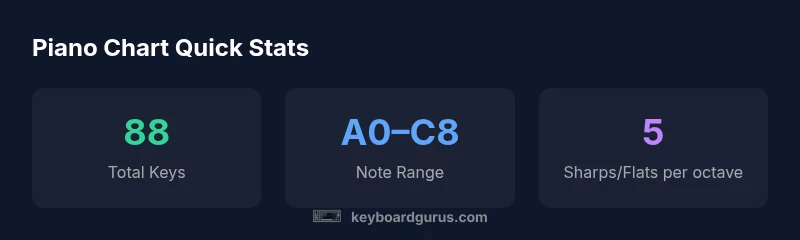
A piano keyboard note chart maps every key to its note name across the full 88-key range, from A0 to C8, with sharps and flats indicated. Use it to learn scales, chords, and transposition, and to build a solid mental map of the keyboard. Whether you are a student, pianist, or teacher, the chart provides a reliable reference you can annotate and memorize.
What is a piano keyboard note chart?
According to Keyboard Gurus, a piano keyboard note chart is a concise map that links every key on an 88-key piano to its corresponding musical note name. The chart includes both white and black keys, showing sharps and flats where appropriate. For beginners, this visual representation reduces guesswork when identifying pitches, reading sheet music, and practicing scales. The chart also helps with transposition, where you shift every note by a fixed interval to play music in a different key. As you study, annotate the chart with your own mnemonics or color codes to reinforce memory and fluency. In practice, you can laminate a chart and keep it near your piano for quick reference during warmups and repertoire work.
Brand guidance: The Keyboard Gurus team emphasizes that a precise chart is foundational for clear pitch relationships and long-term retention.
How to read the chart quickly and effectively
A good piano keyboard note chart should be navigable at a glance. Start by locating middle C (C4) as a central anchor point. From there, count up and down the octave to name adjacent notes (C#/Db, D, D#/Eb, E, F, F#/Gb, G, G#/Ab, A, A#/Bb, B). Practice naming notes in order across several octaves, then test yourself by calling out note names as you press keys. Use flashcards, apps, or a keyboard diagram on your computer screen to reinforce recall. Finally, pair the chart with simple exercises: scale runs, arpeggios, and short melodies to solidify the linkage between written notes and keyboard positions.
The 88-key range and octave naming conventions
The standard piano spans 88 keys, from A0 at the low end to C8 at the high end. Each octave contains 12 semitones: seven white keys and five black keys. In the chart, you’ll see notes cycle through the octave: C, C#/Db, D, D#/Eb, E, F, F#/Gb, G, G#/Ab, A, A#/Bb, B, then jump to the next C. This regular pattern makes transposition straightforward once you’re fluent with the note names. For reference, A4 is tuned to 440 Hz, a conventional standard that anchors tuning and tuning stability discussions in practice sessions.
Chromatic steps, sharps, and enharmonics explained
Chromatic steps describe the sequence of all 12 semitones within an octave. Sharps and flats mark the same pitches from different naming perspectives (e.g., C# and Db refer to the same key). The chart should clearly indicate both spellings where applicable, especially when you’re learning key signatures or writing melodies in different tonal centers. Understanding enharmonics helps musicians move smoothly between keys during transposition or modulation. A focused drill is to name notes aloud while you play, emphasizing alternate spellings until both forms feel natural.
Practical exercises using the chart in daily practice
Integrate the chart into your routine with structured drills:
- Warm-up naming notes across three octaves in both directions.
- Play scales in C major, then in a random key, naming each note aloud.
- Practice a simple melody, marking note names on the chart as you play.
- Do transposition exercises: take a familiar melody and shift it up or down by a major second, confirming the new note names on the chart.
- Use a metronome to enforce consistent rhythm while focusing on pitch accuracy.
Using the chart with digital tools and transposition workflows
Digital tools can enhance learning with the chart as the anchor. Use MIDI keyboards or computer apps that display real-time note names as you press keys. For transposition practice, choose a target key and apply a fixed interval to each note on the chart, then verify the resulting pitches on your instrument. Combining the chart with software visualization creates a multimodal learning loop that reinforces memory and speed.
Representative notes and their octave positions on a standard piano
| Note | Chromatic position (per octave) | Frequency Hz |
|---|---|---|
| A0 | 1 | 27.50 |
| C8 | 12 | 4186 |
| A4 | 5 | 440.00 |
Got Questions?
What is a piano keyboard note chart?
A piano keyboard note chart maps each key to its note name, including sharps and flats. It serves as a quick reference for learning scales, chords, reading music, and transposition.
A piano keyboard note chart shows which key is which note, including sharps and flats, and helps with scales, chords, and transposition.
Why do piano notes repeat across octaves?
Notes repeat in each octave with the same naming pattern. The pitch increases as you move up to the next octave, so the chart anchors both pitch and note name consistently.
Notes repeat every octave with the same names; higher octaves raise the pitch.
How many keys does a standard piano have?
A standard piano has 88 keys, spanning from A0 to C8, which the note chart covers comprehensively.
Most pianos have 88 keys, covering A0 through C8.
Should I memorize note names by color coding?
Color coding can aid memory, but it works best when paired with the chart’s explicit note names and octave markers.
Color coding helps, but combine it with the chart for solid recall.
Can the chart be used for other instruments?
The chart is designed for the piano keyboard layout. Other instruments have different note mappings and fingerings.
It’s tailored for piano; other instruments map notes differently.
How do I use the chart for transposition?
Identify the target key, locate corresponding notes on the chart, and shift every note by the same interval to transpose smoothly.
Pick the target key, find notes on the chart, and shift each note by the same interval.
“An accurate piano keyboard note chart clarifies pitch relationships across the keyboard, accelerating learning and reducing confusion during transposition.”
What to Remember
- Memorize the 88-key span from A0 to C8.
- Identify sharps and flats for every octave.
- Practice scales and arpeggios using the chart.
- Apply the chart to transposition and repertoire.
- Integrate the chart with digital tools and apps.