What Keyboard Feels Most Like a Piano: A Piano-Feel Comparison
Explore which keyboard types deliver the closest piano touch, from hammer-action digital pianos to weighted MIDI keyboards, with practical guidance and real-world use cases.


When you ask what keyboard feels most like a piano, the clear answer is 88-key keyboards with hammer-action (ideally graded hammer action). These models replicate piano touch, key weight, and dynamic response, delivering authentic feel for scales, chords, and expressive passages. For portability or budget, note that non-weighted or synth-action keyboards won’t match a true piano touch as closely.
What 'piano-like' touch means for keyboards
For many players, a keyboard’s touch quality is as important as its tones. A piano-like feel isn’t just about hitting a key; it’s about the resistance you feel when you press, the rebound after a note, and how the key travel translates into velocity and sustain. A truly piano-like feel enables precise control over dynamic shading, which is essential for classical voicings, intimate ballads, and expressive improvisation. According to Keyboard Gurus, the most authentic touch emerges when you combine enough key travel with a weight that mimics an acoustic piano, along with careful pedal integration. The goal is to reproduce the subtle differences between piano dynamics—pp, mf, f—so you can shape musical phrases with confidence. In practice, striving for a piano-like touch means prioritizing action quality over sheer feature count, because no amount of digital effects can fully compensate for a misleading or inconsistent key response. This reality underpins the guidance you’ll see here as you compare options for your setup.
Understanding action and its impact on playing feel
Key action is the physical mechanism that translates your finger pressure into a musical signal. There are several main families: hammer-action, graded hammer-action, and synth-weighted or non-weighted action. Hammer-action keyboards aim to reproduce the classic piano feel with a heavier, more stable keybank. Graded hammer-action takes that a step further by increasing key weight in lower registers and lightening toward the high end, mirroring an acoustic piano’s touch across the keyboard. In contrast, synth-action or semi-weighted keys use lighter surfaces and electronic back-ends that are excellent for synth pads and fast passages but can feel distant from a true piano to many players. The best choice depends on your goals: honest piano practice, stage performance, or hybrid use where you also want synth versatility. Keyboard Gurus’ 2026 analysis highlights that grading and weight distribution are the most influential factors for a believable piano feel, often more impactful than the sample quality alone.
The practical implications of a weighted, hammer-action feel
A weighted, hammer-action keyboard provides the most natural leverage for building finger independence, control, and tone shaping. The heavier lower keys resist movement more than the lighter upper keys, which trains your touch similarly to an upright or grand piano. Pedals represent another critical interface: a responsive sustain pedal with proportional half-pedaling can significantly improve realism. If you plan to practice classical repertoire, arpeggios, or legato phrasing, this realism translates into faster progress and more consistent technique. If you’re a gamer or a producer who wants quick keyboard access to virtual instruments, you may be tempted by lighter, synth-action options. However, the payoff for piano-centric practice is often worth the extra investment, as the touch will feel familiar to acoustic-piano players and facilitate smoother transitions to real pianos.
How to compare options: action, range, and control
When evaluating keyboards for piano-like feel, three criteria matter most: action type, key count, and expressive controls. 88 keys are the standard for true piano practice, ensuring you can exercise the full octave range and pedaling. Action quality should be hammer-action or graded hammer-action if possible. Velocity response should be consistent across the keyboard, with a reliable aftertouch and a pedal that supports realistic sustain and damping. Additional features to consider include keybed build quality, key travel length, and the presence of a dedicated piano voice with well-sampled tones. For many players, a balance between action realism and practical needs (portfolio size, transport, and price) determines the right choice. Keyboard Gurus’ recommendations favor models that maintain consistent key feel across the entire keyboard and offer transparent feedback to your playing.
Practical testing tips for piano-like feel
A good test approach is to perform standard piano exercises—scales, arpeggios, Hanon-like patterns, and legato lines—on any candidate keyboard. Pay attention to how you release notes, how the pedal interacts, and whether the touch remains uniform as you traverse the keyboard. Bring a recording or use a familiar piano piece to gauge whether the keyboard’s dynamics translate cleanly to the sound engine. If you notice lag in response, inconsistent weight, or abrupt changes in resistance, those are signs to move to a different option. Don’t forget to test with your preferred software and DAW to confirm that the keyboard integrates smoothly and preserves the intended dynamics in your workflow. The Keyboard Gurus team has found that hands-on feel often predicts real-world satisfaction more reliably than spec sheets.
Comparing models: digital pianos vs stage keyboards vs MIDI controllers
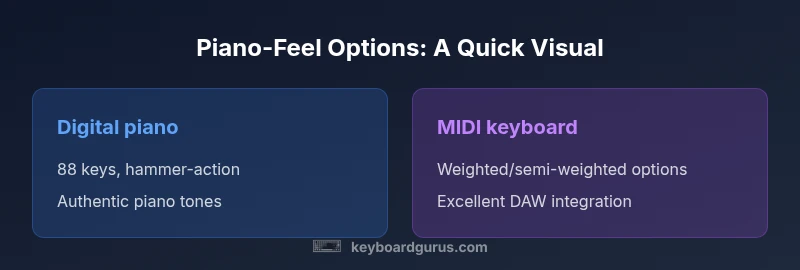
Digital pianos are purpose-built to emulate acoustic pianos, featuring weighted hammer-action, full-size 88-key layouts, and audio engines designed to reproduce grand piano resonance. Stage keyboards broaden the palette with high-grade hammer-action options but emphasize portability and live performance flexibility. MIDI controllers with weighted or semi-weighted keys can approach piano feel, particularly if paired with a robust software instrument, but the action quality varies widely by model. In short, for the closest piano feel, prioritize 88-key hammer-action digital pianos; for a balance of feel and versatility, consider staged keyboards with graded hammer-action; for portability, accept semi-weighted or synth-action options with careful attention to keybed and velocity curves.
Real-world scenarios and setup considerations
Your environment shapes which option makes sense. A home studio with space for a dedicated digital piano can provide the most authentic piano feel and a responsive, expressive playing experience. If you travel or perform live, a lighter option with a reliable action can be preferable, but you may sacrifice some realism under strict performance conditions. If you compose and arrange with software instruments, a weighted MIDI keyboard can still serve as a powerful controller, provided you select weighted or graded keys and optimize your DAW’s velocity curves. In all cases, consider how you’ll use the keyboard daily: practice, composition, performance, or teaching—your priorities will guide the final choice.
External authority sources and further reading
For readers seeking broader context on tactile feedback and keyboard design, see industry discussions and academic perspectives from Berklee College of Music and MIT’s research in human-computer interaction. Also refer to major publications for cross-disciplinary insights into haptic design and musical instrument interfaces. While models and prices vary, the core principle remains: the feel of the keyboard should support consistent technique and musical expression. Useful starting points include Berklee's teaching resources and MIT's exploration of haptics in control interfaces.
Feature Comparison
| Feature | Digital piano (88-key, hammer-action) | Stage keyboard (88-key, graded hammer-action) | MIDI keyboard (61-88 keys, weighted or synth-action) |
|---|---|---|---|
| Key action | Hammer-action (simulates piano, uniform resistance) | Graded hammer-action (varied weight by register) | Weighted or synth-action (varied weight; often lighter) |
| Key count | 88 keys | 88 keys | 61-88 keys |
| Dynamic control | High fidelity velocity and aftertouch options | Excellent dynamics with graded response | Solid velocity response; depends on software |
| Best use case | Home studio piano practice and performance | Live performance and studio practice with piano emphasis | MIDI control for software instruments and DAW work |
| Price range | Mid-to-high (investment in authentic feel) | Mid-to-high (consistent action + features) | Low-to-mid (varies with brand; often cheaper) |
Advantages
- Closest imitation of acoustic piano touch with hammer-action
- Full 88-key range supports classical repertoire
- Digital pianos offer authentic piano tones and resonance modeling
- Clear pedal feel and expressive control on many models
- Good resale value for piano enthusiasts
Drawbacks
- High cost and heavier weight limit portability
- Some models still differ from concert grand feel
- Graded action quality varies by brand and model
88-key hammer-action keyboards provide the strongest piano-like feel
For serious piano practice, prioritize 88-key hammer-action with graded action if available. If portability or budget are top priorities, weighted options still offer substantial realism but may compromise some nuances.
Got Questions?
What is hammer-action and graded hammer action?
Hammer-action refers to a keybed that mimics the resistance of an acoustic piano; graded hammer action adds weight in the lower registers to simulate the real piano feel. Graded action is generally preferred for more authentic touch across the keyboard. Pedal behavior and action consistency also contribute to realism.
Hammer-action imitates piano touch; graded action adds weight where it matters most for realism.
Do 88-key keyboards feel like a piano?
88-key keyboards with proper hammer-action generally feel closest to a piano. If your priority is authentic touch, avoid compact or purely synth-action models. The weight distribution and travel length across the keyboard matter just as much as the tone.
88-key hammer-action is closest to a piano feel, especially when graded.
Is a portable keyboard suitable for piano practice?
Portable keyboards can be convenient but often sacrifice touch realism. Look for 88 keys with weighted or semi-weighted action and ensure the velocity curve aligns with your playing style. They’re good for travel, but may not replace a home studio setup.
Portable keyboards work for practice, but may not match a real piano touch.
Can MIDI keyboards feel like pianos?
MIDI keyboards can feel piano-like if they use weighted or graded-weighted keys and are paired with high-quality software instruments. The overall experience depends on the action and the sound engine you use. For strict piano practice, prioritize dedicated piano-action hardware.
MIDI can feel piano-like with good weights and software, but not always authentic.
What is the best setup for piano practice at home?
A digital piano with 88-key hammer-action is typically the best home solution for piano practice. Pair it with a sustain pedal and proper stand to maximize realism. If space or budget is limited, a weighted 88-key controller with strong software can be a viable interim option.
Digital piano with 88-key hammer-action is ideal for home practice.
Do pedal behaviors vary across keyboard models?
Yes. Pedal design and sensing (continuous, half-pedal support) significantly affect realism. High-quality models simulate sustain and una corda convincingly, which is essential for nuanced playing.
Pedals differ a lot; choose models with good half-pedal support.