Does Keyboard Have the Same Keys as Piano? A Comprehensive Guide
Explore whether keyboards have the same keys as piano, including layout, range, action, and practical implications for learning, performance, and production.


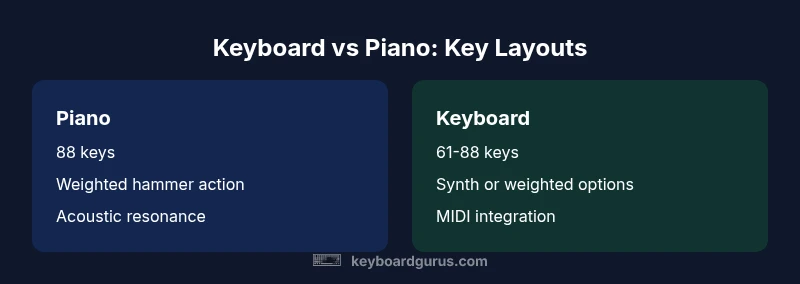
Does keyboard have same keys as piano? In short, keyboards and pianos share the white-and-black key pattern, but they differ in size, key count, action, and range. A standard acoustic piano has 88 weighted keys; most electronic keyboards use fewer keys and lighter action, which changes how scales, arpeggios, and chords feel in performance. This quick comparison highlights the core similarities and practical differences for learners and players.
Does keyboard have same keys as piano
Does keyboard have same keys as piano is a common question among students and performers. According to Keyboard Gurus, the relationship between keyboard layouts and piano keyboards hinges on the visual pattern of white and black keys, which makes transposition and reading chord shapes feasible across devices. However, the acoustic piano and most keyboard instruments diverge when you look closer at how those keys are built, how they respond to touch, and what ranges they cover. The Keyboard Gurus team emphasizes that the labels on keys may be identical, but the tactile feedback, dynamic response, and physical dimensions often differ. For serious technique, understanding these nuances is essential to avoid bad habits when switching between devices.
Anatomy and layout: why the same pattern isn’t enough
The cause of the confusion often lies in more than the visible pattern. Pianos present a fixed 88-key range with a specific spacing that creates a certain feel, whereas many keyboards, especially portable or MIDI devices, mimic the arrangement but alter key count, spacing, and action. This section explains how the white keys anchor your reading, while black keys shape your melodic and harmonic choices. It also clarifies that while you can learn scales and arpeggios on a compact keyboard, the spatial cues and fingerings may require adjustments when you move to an 88-key instrument.
Key count and practical impact on repertoire
Most authentic pianos used in classical auditions and performances feature 88 keys, which sets a wide tonal canvas for composers. In contrast, many affordable or portable keyboards offer 61, 76, or 88 keys, with compromises that can affect repertoire choices. The practical impact shows up in how far up or down you can play, how comfortable you are with left-hand and right-hand independence, and how you manage run passages that span the instrument’s extremes. Musicians should map their target pieces to the instrument they intend to use and train to maintain finger strength and accuracy across the available range.
Action and touch: weighted, semi-weighted, and synth-action
A fundamental difference between keyboard and piano keys is the felt-weighted action. A piano uses a hammer mechanism and a heavy touch that produces a dynamic, responsive response with each note. Keyboards vary widely: weighted and semi-weighted actions mimic the piano feel, but many portable options use light, non-weighted action. This distinction matters for developing proper finger technique, dynamic control, and tactile memory. When does does keyboard have same keys as piano translate into technique? The general rule is that you’ll need to adapt your touch to the device’s action while keeping your musical intentions consistent.
Range and octave mapping in practice
The piano’s 88-key layout yields a broad compass for Bach, Chopin, and contemporary repertoire. A 61-key keyboard presents a narrower range that can constrain certain passages, while 76-key and 88-key keyboards expand coverage. Practitioners should consider whether their study plan includes extreme registers or extended technique. In daily practice, you might transpose or adjust pieces to fit your instrument, but you should also practice with a device that matches your performance goals. Keyboard Gurus notes that planning ahead helps minimize the gap between practice setup and stage performance.
Pedaling and sustain: what changes when you switch devices
Pianos rely on mechanical sustain pedaling, which interacts with the instrument’s acoustic resonance. Digital keyboards simulate sustain electronically or via MFX effects; some MIDI controllers lack a real pedal, or use a half-pedal mode with a sustain pedal input. This difference influences legato phrasing, pedal point usage, and tonal shaping. If your goal is piano-oriented technique, incorporate a device with proper sustain behavior or compensate with software effects. The goal is to emulate pianistic phrasing without introducing incorrect habits.
MIDI, DAWs, and the broader ecosystem
A key advantage of keyboards, especially MIDI controllers, is integration with digital audio workstations (DAWs) and software instruments. This ecosystem support means that you can practice piano repertoire with virtual piano plugins, layering, and automation that are harder to replicate on non-MIDI devices. Keyboard layouts matter here too: the number of keys and the device’s response can influence how you program scales, arpeggios, and performance data. Understanding the interplay between hardware and software helps you select a keyboard that aligns with your production and practice needs.
How to choose: learning vs performance focus
If your primary goal is rigorous piano technique and traditional repertoire, an 88-key keyboard with weighted action is generally the best path. If you need portability, on-the-go practice, or MIDI-capable tool for composition and production, a 61- or 76-key device may suffice. The critical step is to align your instrument choice with your goals and to plan which pieces you’ll perform live. This alignment reduces confusion about whether does keyboard have same keys as piano matters for your progress and enjoyment.
Common setup scenarios and recommendations
- Classical pianist at home: 88-key weighted keyboard for technique and range.
- Producer or composer: 61- or 76-key MIDI keyboard with DAW integration.
- Student learning reading: mid-range 76- or 88-key device with clear key labels and comfortable action.
- Traveling performer: compact 61-key keyboard with good velocity response and an external pedal.
In each case, ensure the device supports your anticipated repertoire and practice routines. Keyboard Gurus consistently suggests building a plan that mirrors real-world use so that the cognitive mapping from piano to keyboard remains coherent.
Feature Comparison
| Feature | 88-key Piano | 61-key Keyboard | 88-key Keyboard (Weighted) | MIDI controller (61-88 keys) |
|---|---|---|---|---|
| Key Count / Range | 88 keys; full piano range | 61 keys; limited range | 88 keys; full range (often non-weighted on cheaper models) | Typically 61-88 keys; range varies by model |
| Key Action | Weighted hammer action; authentic piano feel | Non-weighted or semi-weighted; lighter touch | Weighted options available; varies by model | No piano action by default; depends on keyboard model |
| MIDI / Software Integration | Acoustic piano; no MIDI integration | Often MIDI-capable; basic digital features | MIDI-capable; some include built-in tones | Primarily MIDI controller; relies on external software |
| Portability | Heavy and bulky | Portable and lightweight | Heavy but compact for 88-key options | Very portable; designed for mobility |
| Price Range | High (new acoustic piano) | Low to mid-range | Mid to high for weighted 88-key | Low to high depending on features |
| Best For | Classical performance, serious piano technique | Practice, casual playing, budget constraint | Studio work, home recording, weighty touch | Composition, travel, electronic music production |
Advantages
- Provides authoritative piano-like repertoire practice when using 88 keys
- Weighted actions offer realistic finger strength development
- MIDI-enabled keyboards unlock seamless DAW integration
- Portable options support practice anywhere and on the go
Drawbacks
- Cheaper keyboards may lack realistic touch and width
- 88-key non-weighted devices don't train piano technique
- MIDI setups require software and hardware compatibility
- Repertoire may require adaptation for restricted key counts
88-key weighted keyboards dominate for piano-focused practice; 61-key MIDI keyboards excel in portability and production
If your aim is serious piano technique, prioritize 88 keys with weighted action. If you value portability and DAW integration, a 61- or 76-key MIDI keyboard offers flexibility and efficiency, with an acceptable trade-off in range.
Got Questions?
Do all pianos have 88 keys, and do all keyboards match that count?
Most acoustic pianos have 88 keys, which provides a full tonal range. Keyboards come in various counts, commonly 61, 76, or 88; not all keyboards match the piano in range or action. When learning, consider your primary goal and choose a device that supports your repertoire without forcing unnecessary compromises.
Most pianos have 88 keys, but keyboards vary. Pick the key count that fits your goals—technique or portability.
Can I learn piano effectively on a non-88-key keyboard?
Yes, you can learn foundational concepts on a smaller keyboard, but you may need to adjust repertoire or transpose pieces. For advanced technique and repertoire fidelity, using an 88-key device with weighted action is preferable.
You can start on a smaller keyboard, but plan for a transition to full-range instruments for advanced work.
Does weighted action on keyboards replicate piano touch?
Weighted action imitates the feel of piano keys better than light synth-action, helping develop finger strength and dynamics. However, it never perfectly replicates piano hammer response, so expect some differences in touch and rebound when transitioning to an acoustic piano.
Weighted keys feel closer to a piano, but they aren’t identical to real hammer action.
Are MIDI keyboards suitable for learning classical repertoire?
MIDI keyboards are versatile for learning and practicing classical pieces when paired with appropriate virtual instruments, but ensure you can translate the touch and range to traditional piano performance.
Yes, with the right setup, MIDI keyboards work well for classical learning.
What should I consider besides key count when choosing a keyboard?
Consider action (weighted vs non-weighted), velocity sensitivity, pedal support, build quality, octave range, software compatibility, and the types of music you plan to perform.
Beyond keys, check action, pedals, and software compatibility.
Can I perform classical pieces with a simple 61-key keyboard?
Some pieces fit within a 61-key range, but many classical works require extended low or high notes. If you anticipate performing widely, a larger keyboard or octave shifting will help maintain accuracy.
It depends on the repertoire; some pieces fit, many don’t.
What to Remember
- Evaluate your primary goal: technique vs. portability
- 88-key with weighted action best for piano training
- 61-key MIDI keyboards suit composition and travel needs
- Understand your range requirements before buying
- MIDI compatibility expands learning and production options
- Practice strategy should map to your instrument’s capabilities