Are Keyboard and Piano Notes the Same? A Practical Guide
Explore whether keyboard notes and piano notes share the same pitch, with practical guidance for learners, players, and educators on mapping notes across instruments.


Are keyboard notes the same as piano notes? In practice, the pitch values align across instruments, but the playing experience diverges due to layout, touch, and timbre. The Keyboard Gurus team notes that the same note names correspond to the same frequencies on a piano and a keyboard, but the way those notes are produced—through hammer action on a grand, or via digital samples on a synth—shapes listening and playing feel. Understanding this helps learners transfer knowledge with minimal friction, while acknowledging instrument-specific nuances that affect technique and expression.
Are keyboard notes the same as piano notes?
Are keyboard notes the same as piano notes? If you’ve been asking 'are keyboard and piano notes the same,' the short answer is that the pitch values align: A4 on a piano matches A4 on a keyboard. The longer answer hinges on how those notes are produced and heard. Pitch is a physical property (frequency) that remains constant across instruments, but context—how the sound is generated, how you touch the keys, and what you hear in the room or through headphones—changes the perceptual experience. According to Keyboard Gurus, the fundamental concept is pitch equivalence; the instrument’s design then shapes difficulty, expressiveness, and the ease of learning transfer. The takeaway is practical: you can map notes across instrument types, but expect differences in feel and tone that influence playing technique and musical interpretation.
Pitch and frequency: the core idea
At a scientific level, notes correspond to specific frequencies, with standard tuning anchored around A4 = 440 Hz. Whether you are on a piano or a digital keyboard, the same note names occupy the same positions in the chromatic scale when the instrument is tuned to concert pitch. This core alignment is what makes transcribing, reading, and ensemble playing feasible across instruments. Keyboard Gurus Analysis, 2026, clarifies that while frequencies align, not every keyboard offers the same octave range or the same degree of tonal fidelity, which can influence perceived pitch accuracy during performance.
Visual layout and octave mapping
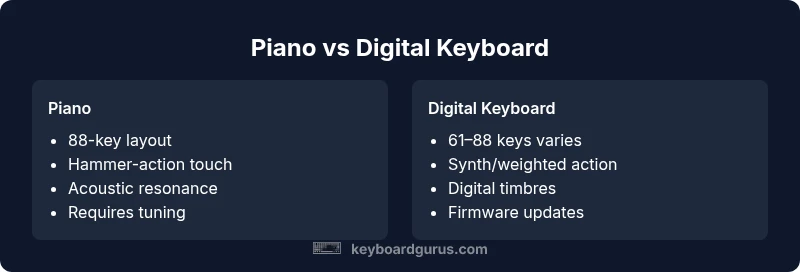
Pianos present a wide, fixed layout: 88 keys spanning seven and a quarter octaves, with white and black keys arranged in a consistent pattern. Digital keyboards vary, commonly offering 61, 76, or 88 keys. Note names and staff positions map to the same pitch classes, but octave numbering can become a practical source of confusion for beginners who switch between instruments. The crucial skill is internalizing the staff-to-key correspondence and recognizing that the same letter name (C, D, E, etc.) represents the same pitch class on both devices, adjusted for octave range.
Velocity, touch, and expressive differences
Even when two instruments render the same pitch, the way that pitch is produced changes. Piano notes respond to velocity via hammer dynamics; expressive control arises from how hard you press a key and how long you hold it. Digital keyboards rely on electronic samples and synthesis with varying velocity curves, aftertouch, and layering. This affects articulation, attack, decay, and sustain, which in turn shapes how a note feels and sounds. For learners, this means that muscle memory built on one instrument will require adaptation when performing on another—though the pitch itself remains consistent.
Timbre matters: hearing the note, not just the pitch
Notes are more than their frequency. The same pitch on a piano has a distinct resonant character and harmonic content driven by strings, soundboard, and lid position. A keyboard’s notes may emulate this timbre but will never perfectly reproduce the acoustic properties of a grand or upright. Vocals, pedal interactions, and room acoustics further color the experience of a note. Recognizing this helps students read scores accurately while adjusting for timbral differences when performing on different instruments.
Pedals and sustain: shaping note perception
Sustain and resonance extend the effect of a note beyond its initial attack. A piano maintains sustain through the damper mechanism and ambient resonances; keyboards simulate this with digital processing but can differ in the perceived length and color of the note. Pedal use adds another layer of nuance that can influence legato and phrasing. When comparing keyboard and piano notes, anticipate divergence in how long a note lingers and how smoothly transitions occur between adjacent notes.
The practical implication for learners
For students, the central takeaway is that note names and relative pitch are portable between keyboard and piano. Skill transfer hinges on adjusting to action, touch sensitivity, and pedal behavior. Start with a clear focus on pitch identification and staff reading, then gradually incorporate instrument-specific technique. If your goal is general music literacy or ensemble readiness, practicing on both instruments will deepen your versatility and improve your ability to translate musical ideas across contexts.
Historical context and instrument design
Acoustic pianos and modern electronic keyboards diverged from the outset in engineering goals. The piano’s acoustic design creates a unique envelope for each note, while digital keyboards prioritize portability, programmability, and a wide variety of timbres and effects. This historical divergence explains much of the practical difference in how notes are perceived and enacted. Learners should honor the strengths of each instrument and recognize that pitch identity endures even as hardware changes influence technique.
Reading music: staff notation and note names
Reading standard notation ties directly to pitch, regardless of instrument. Staff lines, ledger lines, treble and bass clefs assign each note to a pitch class. On both piano and keyboard, the same note letter appears in the same octave position if transcribed properly. When you move between devices, keep a consistent reference for octave designation (for example, C4 near middle C) to avoid slipping into octave misreadings. This consistency is essential for effective practice and performance.
Transferable skills: from keyboard to piano and back
Transferring skills relies on recognizing the universality of pitch naming and staff reading, while also adapting to instrument-specific physical demands. The most reliable approach is deliberate cross-training: practice scales and arpeggios on both keyboards and pianos, compare tonal responses, and adjust fingerings as needed. Musicians who master the perceptual cues of pitch while acknowledging tactile differences will move fluidly between instrument types and rehearsal settings.
Common myths and clear-eyed realities
A frequent myth is that keyboard notes are entirely different from piano notes. In reality, while timbre, touch, and pedal response differ, the pitch names and the underlying frequencies align. Another misconception is that learning on a keyboard automatically makes you proficient on a piano; this ignores hammer action, dynamic range, and acoustic resonance. A third misconception is that octave ranges are irrelevant when switching instruments; in practice, accurate octave reading remains crucial for correct pitch placement. By separating pitch identity from instrument-specific technique, you’ll better leverage your training.
Practical implications for students and professionals
For students, choosing an instrument should align with goals: piano for touch and piano technique; keyboard for portability, versatility, and technology-enhanced practice. Professionals who perform across genres or settings benefit from proficiency on both, enabling flexible rehearsal and performance options. The critical skill is establishing a reliable mental map of notes in pitch space, then adapting articulation, phrasing, and pedaling to fit the instrument at hand. Keyboard Gurus emphasizes deliberate practice and note mapping as foundational to success across contexts.
When to choose piano vs keyboard for different goals
If your aim is classical piano mastery, an acoustic or weighted action keyboard with hammer-like feel helps cultivate precise dynamics and pedaling. If your goal is studio work, composition, or learning on the go, a digital keyboard or lightweight controller can expedite practice and music theory study. In ensemble settings, the ability to lock in pitch with reference tunings and shared notation becomes essential, regardless of instrument. The best approach blends both tools to build transferable musical fluency.
Practical exercises to reinforce note equivalence
Begin with audial-target exercises: pick simple melodies you know by ear and play them on both a piano and a keyboard, noting any differences in timing, attack, and sustain. Next, practice identifying note names on a staff and translating them to fingerings on each instrument. Use a tuner to verify that A4 remains consistently at 440 Hz on both devices. Finally, perform scales in both hands across the instrument’s range, focusing on consistent pitch accuracy while adapting to touch and dynamic differences.
Final considerations and transferable skill development
Ultimately, the concept of pitch consistency across keyboards and pianos underpins many aspects of music learning. By internalizing that notes retain their identity while instrument-specific features shape how they are produced and perceived, you can develop a flexible, transferable skill set. The takeaway is practical: map notes across instrument types, practice technique with appropriate touch, and leverage each tool’s strengths to build a robust musical foundation.
Comparison
| Feature | Piano (88-key) | Digital keyboard (61-88 keys) |
|---|---|---|
| Key count | 88 keys spanning seven octaves + a minor extension | 61–88 keys, model dependent |
| Action/feel | Hammer action with graded touch on most pianos | Synth-weighted or semi-weighted action on many keyboards |
| Sound production | Acoustic soundboard and strings create natural resonance | Digital samples and synthesized tones via built-in speakers or via MIDI |
| Tuning and maintenance | Requires periodic tuning by a technician | No mechanical tuning; maintenance is typically firmware-based |
| Pedal behavior | Sustain and una corda pedals affect resonance and sustain | Digital pedals emulate sustain; some models provide multiple pedal inputs virtually |
| Learning implications | Tactile feedback and acoustic response reinforce precise touch | Portability and feature-rich practice modes support theory and ear training |
Advantages
- Notes and pitch names transfer quickly between instruments
- Pianos offer tactile feedback that strengthens technique
- Digital keyboards provide portability and diverse timbres for practice
- Cross-instrument practice strengthens overall musicianship
Drawbacks
- Touch and pedal differences complicate direct skill transfer
- Not all keyboards accurately mimic piano hammer action
- Acoustic pianos require ongoing maintenance and space
Notes are pitch-identical across piano and keyboard, but instrument-specific feel matters
The Keyboard Gurus team recommends recognizing pitch equivalence while training for instrument-specific touch and pedaling. Transfer is natural for theory and notation, but expect adaptation for hammer action and acoustic resonance. A balanced approach—learning on both formats—maximizes versatility and performance readiness.
Got Questions?
Are keyboard notes the same as piano notes?
In essence, pitch values (frequencies) align on both instruments. The names of notes and their relative positions on the staff are consistent, but the way they are produced—hammer action versus digital samples—and the resulting timbre and response differ.
Pitch is the same on both, but how the note feels and sounds changes with the instrument.
Can I read piano music on a keyboard?
Yes. Notation is independent of instrument in theory. You may need to adjust for the keyboard’s range and fingerings, but the staff-to-pitch mapping remains valid.
Yes—read the notes, then map them to the keyboard's layout.
Do digital keyboards reproduce piano notes accurately?
Digital keyboards can closely approximate piano timbres, but acoustic nuances and hammer action are unique to pianos. Realism depends on sample quality and device design.
They can be very close, but not identical to a real piano.
Is octave numbering the same on keyboards and pianos?
Octave numbering uses standard pitch notation on both. However, instrument range may affect which octaves you use most often; keep consistent labels to avoid confusion.
Octaves follow the same naming, but range matters.
Should a student start on piano or keyboard?
Start with your goals in mind. Piano builds touch and pedaling technique; keyboards are portable and theory-friendly. Many learners benefit from exposure to both over time.
If your goal is classical technique, start with piano; for versatility, add keyboard practice.
Do pedals work the same on keyboards and pianos?
Pianos use physical dampers and sustain properties; keyboards simulate pedal effects digitally. The musical outcome can feel similar, but the mechanics and acoustic responses differ.
Pedals feel different, even if the effect is similar.
Can keyboard skills transfer to other instruments?
Yes, especially in reading notation, intervals, and rhythm. Transfer of touch and articulation may vary, so plan instrument-specific practice to bridge gaps.
Reading and rhythm transfer well; technique may need adaptation.
What to Remember
- Note names map identically across instruments
- Touch, dynamics, and pedaling create distinct playing experiences
- Practice both piano and keyboard to build transferable skills
- Use consistent octave labeling to avoid confusion
- Choose the instrument that best fits your goals while training theory on both