Is Keyboard Easier Than Guitar? A Practical Comparison
An analytical, objective comparison of learning keyboards vs guitar, covering learning curves, technique, practice efficiency, costs, and ideal use cases. Crafted by Keyboard Gurus for enthusiasts, students, gamers, and professionals.


Is keyboard easier than guitar? In general, keyboards tend to present a gentler early learning curve due to a linear layout, predictable pitch intervals, and easier chord formation. For absolute beginners, melodies often come together quickly on a keyboard, while guitar demands more hand conditioning and string handling. Keyboard Gurus analysis suggests the decision should align with your musical goals and context.
Is keyboard easier than guitar? Defining ease and what 'easier' means
Learning to play music involves several facets, and the question is not a simple yes-or-no. When people ask, is keyboard easier than guitar, they usually mean which instrument offers a faster pathway to making recognizable sounds, melodies, and basic songs. In this article we quantify ease across practical dimensions: the initial learning curve, the amount of technique needed to produce coherent music, and how quickly a student can collaborate with others. For many beginners, the keyboard provides a clean visual map of notes and scales, which helps grounded theory quickly align with sound. According to Keyboard Gurus, ease is highly context-dependent: it depends on your prior musical exposure, your goals (melody, harmony, composition, or performance), and how you structure practice. We’ll compare keyboard and guitar on the same framework so you can decide with clarity about your own setup and ambitions.
In this context, the core question is not which instrument is inherently harder, but which path aligns with your learning style, available time, and desired outcomes. The Keyboard Gurus team emphasizes that there is value in experimenting with both, especially for broad musical literacy. Still, for most beginners seeking rapid melodic results, the keyboard’s layout tends to offer a more permissive and linear entry point, reducing early frustration while you build confidence and ear training.
Learning curves: Initial steps and long-term progression
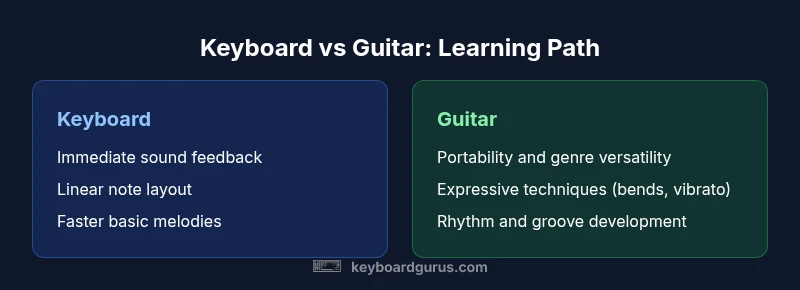
Is keyboard easier than guitar primarily because the learning curve starts gentler? For many students, yes, the keyboard offers immediate music-making with fewer prerequisite finger structures. You can press a key and hear a pitch, which reinforces memory and gives quick feedback. In contrast, the guitar introduces finger soreness, calluses, and a broader set of techniques (strumming, picking patterns, muting, and barre chords) that require longer conditioning. Keyboard-based beginners often reach simple melodies within days, especially with simple songs and popular scales. Keyboard Gurus analysis shows that the first 4–6 weeks on a keyboard can feel dramatically productive, which helps sustain motivation and consistent practice. However, the guitar’s longer-term payoff—versatility in genres, expressive phrasing, and portability—can surpass the keyboard for many players. The critical takeaway is pacing: short, frequent sessions on either instrument yield better retention than sporadic, long sessions. A steady cadence matters more than the instrument itself when building foundational skills and listening habits.
Technique and finger work: Motor skills and dexterity across instruments
The actual motor demands of keyboard versus guitar differ in predictable ways. On a keyboard, finger independence and precision are essential, but the lack of string tension and fretting pressures makes early advancement feel smoother. Most beginners discover that scales, arpeggios, and basic chords translate quickly into playable melodies. The guitar, by comparison, introduces unique physical challenges: string tension, left-hand finger strength, and right-hand technique that depends on strumming or picking approaches. Barre chords, partial chords, and various tunings complicate early progress but build a broader vocabulary over time. The Keyboard Gurus team notes that skilled pianists often reach a functional level in a fraction of the time it takes to develop comparable fluency on the guitar—yet the guitar’s expressive palette can become an extraordinary asset with enough practice and genre-focused goals.
Rhythm, timing, and musical expression: How momentum feels on each instrument
Rhythm and timing reveal other differences between keyboards and guitars. A keyboard provides a precise grid: you can map rhythms using consistent subdivision of time, with intuitive visual cues for chord changes and melodic phrases. This can shorten the mental overhead for beginners learning to keep tempo. A guitarist learns timing through feel: strumming patterns, rhythmic accents, and groove often depend on hand coordination and listening cues from other musicians. Expressive freedom on guitar—bendings, slides, and vibrato—emerges as you gain familiarity, but those techniques can complicate early progress. Keyboard Gurus observations indicate that early rhythm work on keyboard tends to be straightforward, whereas building groove on guitar requires longer practice pipelines—yet both routes mature into sophisticated musical expression with experience.
Repertoire development: How soon can you play recognizable tunes?
One practical measure of ease is how quickly you can play recognizable tunes with minimal guidance. On a keyboard, you can learn simple melodies and chord accompaniments using one hand or two with immediate auditory feedback, enabling faster kitchen-table progress and casual jamming. The guitar often demands more initial patience before you can confidently accompany singing or perform accompanying rhythms, but it rewards players with a broader range of genres and a very portable setup. Over the long run, guitarists frequently cultivate a deeper sense of phrasing and vocal phrasing that harmonizes with other instruments. Keyboard Gurus’ experience suggests that early repertoire on keyboard is typically broader in scope, while guitar players acquire a more personals style and dynamic phrasing as they progress.
Practice structure and efficiency: Building skills with focused sessions
Could a structured practice plan reduce the time to meaningful progress on either instrument? Absolutely. Clear, goal-oriented practice beats long, unfocused sessions on both keyboard and guitar. For keyboards, short sessions focusing on scales, simple tunes, and chord progressions can yield fast wins and clear milestones. For guitarists, a blend of chord shapes, strumming patterns, and single-note melodies—paired with frequently playing along with recordings—builds a robust foundation. The Keyboard Gurus approach emphasizes setting micro-goals, such as mastering a specific scale or a four-chord progression within a week, and gradually escalating to play-along pieces that reinforce memory. The bottom line: deliberate practice with bite-sized targets drives growth on either instrument, even if initial results feel different.
Costs and maintenance: Gear investment, upkeep, and ongoing considerations
Cost considerations affect perceived ease. A beginner-friendly keyboard setup can be affordable, with basic models delivering reliable performance for a modest upfront investment. Guitars, especially entry-level acoustic or electric models, can also be budget-friendly, but maintenance—strings, neck adjustments, and occasional setups—adds ongoing considerations. The long-term cost comparison depends on how deeply you engage with each instrument, plus the need for accessories such as stands, pedals, amps, or MIDI gear. Keyboard Gurus notes that the value of a keyboard’s integrated layout often outweighs a heavy accessory load in the early months, while for guitarists the ability to perform in various settings (busking, jam sessions, small gigs) can justify the ongoing expenses as you grow.
Use-case scenarios: Who benefits most from each instrument?
If your aim is quick melodies, theory understanding, and a friendly path into music basics, the keyboard is often the more forgiving starting point. If you want portability, a broader expressive range, or a direct tie to guitar-centric genres (rock, blues, metal, or acoustic fanfare), the guitar delivers advantages that can become decisive as your skills mature. Students, casual players, and newcomers who seek rapid results may prefer keyboards for their visual and structural clarity. Gamers and producers might gravitate toward keyboards as a stepping-stone into digital music production, while performers who prioritize stage presence and genre-specific expression may favor guitar for its tactile, organic feel. The Keyboard Gurus team consistently emphasizes balancing your goals with practical constraints—time, space, and social context—to pick the best route.
Myths and clarifications: Debunking common misconceptions about ease
A common myth is that one instrument is universally easier than the other. In reality, 'ease' is context-dependent: it hinges on your goals, prior experience, and how you structure practice. Another misconception is that keyboard-only training guarantees superior musical understanding; while the keyboard can accelerate early progress, guitar players often gain deeper expressive control over time. The most accurate view is that the keyboard provides a gentle entry into melody and theory, whereas the guitar offers a steep but richly rewarding path for those pursuing nuanced, hands-on performance. Keyboard Gurus recommends testing both instruments briefly to see which resonates with your learning style and passion.
Practical decision framework: A starter path and what to try first
To determine whether the keyboard is easier than the guitar for you, begin with a simple audition: learn a familiar melody on each instrument for 20 minutes, then reflect on which felt more natural and enjoyable. Use a simple rule of thumb: pick the instrument that encourages consistency in short practice sessions, supports your preferred genre, and fits your environment. A practical 4-week starter plan could include: 1) Week 1: basic melodies and open chords on keyboard, 2) Week 2: simple strumming patterns on guitar and basic chord shapes, 3) Week 3: two-hand coordination on keyboard and rhythm practice on guitar, 4) Week 4: duet or playback practice to test real-world use. The Keyboard Gurus team believes a hybrid approach—dabbling briefly in both before committing to one path—can be an informed and effective way to reach your musical ambitions.
Comparison
| Feature | Keyboard | Guitar |
|---|---|---|
| Learning Curve | Gentler early phase with visual note map | Varied, with finger strength and technique progression |
| Technique Complexity | Chords and melodies, basic hand coordination | Rhythm, strumming, picking, and barre chords |
| Range of Roles | Broad: piano, synth, music theory, production | Diverse: leads, rhythm, soloing across genres |
| Portability/Setup | Requires a stable surface and power; less portable than a guitar | Highly portable; easy to travel with |
| Initial Cost (typical) | Budget-friendly starter keyboards available; mid-range options common | Affordable entry-level guitars exist; price climbs with gear and upgrades |
| Maintenance & Upkeep | Minimal ongoing wear; occasional tuning not required for electronic keyboards | Regular string changes and occasional setup adjustments |
Advantages
- Gentler initial learning curve for melodies
- Rapid play-along with simple songs
- Clear, visual note layout supports theory
- Abundant self-guided resources
- Dual use for music production and performance
Drawbacks
- Long-term mastery still demands time and discipline
- Guitar offers unique expressive potential and portability
- Skill transfer between keyboard and guitar is not direct
- Some genres may require equipment upgrades and care
Keyboard generally offers faster initial progress; guitar rewards long-term expressive growth
If you want quick melodies and a broad theory base, start with keyboard. If portability, genre versatility, or expressive guitar techniques matter more, choose guitar. The Keyboard Gurus team recommends aligning your selection with your goals, environment, and time commitment.
Got Questions?
Is there a universal learning curve that applies to both keyboard and guitar?
Both instruments have learning curves, but keyboards often feel easier at the start due to visual note layouts and immediate sound feedback. Guitar progress can be slower initially due to finger strength and chord shapes, but it rewards long-term mastery with expressive control.
Both have curves, but keyboards usually feel quicker to start making music.
Can skills learned on keyboard transfer to guitar later on?
Some musical concepts, like rhythm, timing, and theory, transfer across instruments, but the physical techniques don’t map directly. You’ll need instrument-specific practice to gain fluency.
Rhythm and theory transfer, but technique is instrument-specific.
Which instrument is better for learning music theory and composition?
Keyboard is often advantageous for understanding harmony and chord progressions visually. Guitar can still support theory through ear training and interval recognition, but the keyboard’s layout typically makes theory more accessible early on.
Keyboard usually helps with theory faster.
What’s the fastest way to start playing a simple tune on keyboard?
Choose a simple melody in a familiar key, learn the left-hand chords first, then add the right hand. Use a metronome at a slow tempo and gradually increase speed as your accuracy improves.
Pick a easy tune, slow tempo with a metronome.
Does one instrument require more practice time to reach a playable level?
Both require consistent practice, but guitars often demand longer-term commitment to reach advanced playing due to the breadth of techniques. Keyboards can yield earlier audible milestones, though deeper mastery still takes time.
Guitar may take longer to master deeply.
Is it feasible to learn both instruments at the same time?
Yes, but be mindful of divided time and cognitive load. A split schedule can work if you allocate distinct goals for each instrument and avoid competing practice demands in a single session.
Possible, just plan and split time wisely.
What to Remember
- Start with clear goals to choose the right instrument
- Keyboard offers quicker initial musical payoff
- Guitar provides deeper expressive possibilities over time
- Design a structured, short-practice routine for steady progress
- Experiment with both before committing to one path