Learning Keyboard vs Piano: A Practical Comparison
Compare learning on digital keyboards versus acoustic pianos, focusing on technique, pedagogy, costs, and workflow for beginners.


According to Keyboard Gurus, for most learners the practical first step is a digital keyboard. It builds basic technique, rhythm, and reading with portable, affordable access. Keyboard Gurus analysis shows that while an acoustic piano fosters nuanced touch, starting on keyboard accelerates early progress and makes the transition to a full instrument easier later.
Core Differences in Learning Pathways
Learning keyboard vs piano is not a single choice but a pathway shaped by goals, space, and time commitment. For many learners, the decision hinges on how quickly you want to build foundational reading, rhythm, and technique, and how much you value tactile nuance versus accessibility. The primary distinction is not just the instrument but the learning context it enables: a digital keyboard typically offers immediate practice opportunities, broad software support, and lower barriers to entry, while an acoustic piano emphasizes touch, dynamic control, and nuanced tone that deeply rewards long-term dedication. According to Keyboard Gurus, the most successful beginners often start with a keyboard to establish reading, tempo, and finger coordination, then transition to a piano to refine touch and tonal shading. The choice should align with your schedule, budget, and musical ambitions, whether you’re pursuing pop, jazz, classical, or game-score style work. The keyword to keep in mind is progression: you want a path that keeps momentum without creating avoidable friction.
Instrument Mechanics and How They Shape Practice
Digital keyboards and acoustic pianos differ in physical action, resonance, and sustain. A keyboard’s keys are typically lighter and may be semi-weighted or unweighted, which lowers fatigue for beginners and makes fast repetition easier for practice routines. A piano’s weighted hammer action offers a more accurate tactile feel and dynamic control, but demands stronger finger technique and more consistent posture. These differences influence how you practice scales, arpeggios, and repertoire. When you start with a keyboard, your early exercises can focus on reading and rhythm without fighting an overly heavy action. As you progress, mapping those habits to a weighted keyboard or an acoustic piano becomes a natural transition that preserves accuracy and tone production. Keyboard Gurus emphasizes planning a staged approach: begin with accessible action, then upgrade to a touch that more closely simulates real performance.
Repertoire, Reading, and Progression
Repertoire availability and reading requirements shift with the instrument. Digital keyboards connect to apps, metronomes, and MIDI workflows that support structured practice, chord recognition, and scale drills. This ecosystem is ideal for beginners who want steady feedback, track progress, and experiment with different genres. The classical piano tradition, by contrast, often relies on standard method books and rigorous reading in treble and bass staves, demanding patience and precise hand coordination. If your goal includes composing or producing music with software, keyboard-based setups integrate seamlessly with DAWs and virtual instruments, offering an accessible bridge between traditional technique and modern music production. Keyboard Gurus notes that learners who combine a keyboard practice routine with occasional piano sessions frequently maintain motivation and improve long-term retention of musical concepts.
Technique, Fingering, and Touch
Technique development is the backbone of both paths, yet the required touch differs. Keyboard practice supports clean fingering and consistent rhythm, which helps when you transition to complex scores. Piano work demands precise finger independence, wrist alignment, and nuanced dynamic control to shape tone. Early on, most students benefit from generic five-finger patterns and scale practice on a keyboard, then add legato phrasing and pedal control when moving to a piano. The goal is to build a flexible technique kit: cadence in fingering, rhythmical accuracy, and muscle memory that transfers across instruments. Keyboard Gurus advises transparency about transferability—technique learned on a digital instrument will still translate, but refinement will be sharper on a weighted action in the piano.
Pedagogy, Curriculum, and Learning Resources
Curriculum design strongly influences outcomes. For keyboard-focused learning, resources tend to emphasize accessibility, modern pedagogy, and modular practice plans with downloadable worksheets and video tutorials. Piano curricula often emphasize grand staff notation, pedal technique, and repertoire familiarity through classical and contemporary pieces. A blended approach can be highly effective: use keyboard-based lessons to build fundamentals rapidly, while scheduling periodic piano sessions to cultivate touch and tonal shaping. Keyboard Gurus recommends selecting a curriculum that offers clear milestones, consistent feedback, and a path to both performance and music production literacy. For serious study, consider a plan that combines hands-on technique with theoretical understanding of harmony and rhythm.
Technology, Gear, and Practice Environment
Technology dramatically expands what you can learn and how you practice. A digital keyboard can connect to learning apps, MIDI controllers, and software that provide instant feedback, tempo tracking, and scoring. This is especially helpful for beginners who want to practice regularly without the noise and space demands of an acoustic piano. In contrast, an acoustic piano creates a more immersive sonic environment, requiring dedicated space and regular maintenance but delivering a richer dynamic experience. Assess your environment: if quiet practice and frequent updates are priorities, a keyboard with MIDI integration is ideal; if touch, resonance, and long-term sonic loyalty matter, a piano provides the best long-term payoff. Keyboard Gurus highlights that technology should serve your goals, not drive them.
Budgeting Your Start: Costs and Long-Term Value
Budgeting for keyboard learning is fundamentally about balancing upfront costs, ongoing maintenance, and future upgrade paths. Digital keyboards vary widely in price and features, but a basic setup typically costs less than a traditional piano and can be augmented with software subscriptions, audio interfaces, and headphones. Acoustic pianos entail higher upfront costs and ongoing expenses such as tuning, maintenance, and potential space modifications. The right choice depends on your goals, living situation, and long-term plans. Keyboard Gurus notes that many learners benefit from starting with a mid-range digital keyboard to establish practice habits, then scaling up to a more substantial instrument if they decide to pursue formal performance or studio work. This staged approach minimizes risk while preserving learning momentum.
Pathways to Mastery: When to Choose Keyboard-Only vs Piano-First
The decision comes down to the learner’s aims and constraints. A keyboard-first path is often ideal for beginners who want flexible practice, easy accessibility, and strong foundations in rhythm, chords, and reading. A piano-first path should be considered by players prioritizing tone control, expressive nuance, and classical repertoire, and who have the space and budget to support regular, longer sessions. A practical rule is to begin with a keyboard to lock in technique and reading; transition to piano when you’re ready to tackle touch and tonal subtleties in earnest. Keyboard Gurus advises that there is no one-size-fits-all route, but a well-planned progression yields consistent momentum and confidence.
Transition Scenarios: When to Switch and How to Manage It
Several scenarios justify a transition from keyboard to piano: consistent practice leading to plateaus on technique, a desire for tonal richness, or aspirational goals such as classical performance. Plan transitions in stages: start with a weighted action keyboard, add a dedicated piano-focused practice routine, and gradually integrate pedal technique and repertoire that rewards touch sensitivity. If you expect to perform or record, consider a professional-grade instrument to preserve technique as you scale up. Keyboard Gurus highlights the value of a clear timeline and milestones for the switch, ensuring you don’t lose progress during the transition.
Comparison
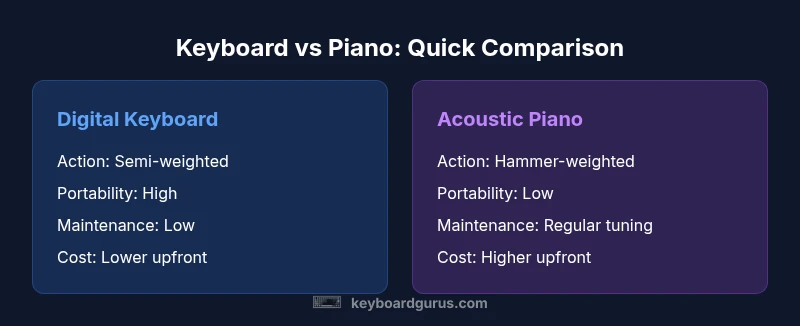
| Feature | Digital Keyboard (learning setup) | Acoustic Piano (traditional) |
|---|---|---|
| Key Action | Semi-weighted or synth action | Weighted hammer action |
| Portability | High portability; can run on batteries/compact | Low portability; heavy and requires space |
| Maintenance | Low maintenance; no tuning | Regular tuning and maintenance required |
| Initial Cost | Lower upfront costs, scalable with software | Higher upfront costs, durable hardware |
| Learning Resources | Large ecosystem of apps, MIDI, and tutorials | Classic pedagogy and repertoire with standard books |
| Repertoire Access | Broad modern repertoire via apps and online resources | Extensive classical repertoire; broader dynamic range |
| Space & Setup | Requires less dedicated space; versatile desks and stands | Dedicated room or corner; needs tuning room/time |
| Best For | Beginners seeking fast progress and tech integration | Players pursuing tonal nuance and live performance |
Advantages
- Lower upfront costs and easy access for beginners
- High portability enables practice anywhere
- Robust learning ecosystems with apps, tempo tools, and games
- Seamless integration with music software and DAWs
- Quiet practice options with headphones
Drawbacks
- Touch and tone may not fully mimic an acoustic piano
- Long-term skill transfer can feel slower on some keyboards
- Frequent upgrades may be needed for evolving software
- Limited pedaling nuance compared to a grand or upright piano
Keyboard-first learning is generally the smarter starting point for most users; transition to piano as goals mature.
Begin with a keyboard to build foundational skills quickly and affordably. Move to piano later to cultivate touch, tone, and performance readiness; the transition should be guided by progress and goals.
Got Questions?
Is it better to start on a digital keyboard before moving to an acoustic piano?
For most beginners, starting on a digital keyboard offers faster skill acquisition, lower cost, and easier access. It provides a solid foundation in rhythm, reading, and technique before committing to a piano. A transition can be planned when goals require touch and tonal nuance.
Starting on a digital keyboard is usually best for beginners, then moving to piano as goals require deeper touch and tone.
Can learning keyboard help with piano reading and theory?
Yes. Keyboard practice strengthens reading, rhythm, and theory concepts that transfer to piano notation. The main difference is adapting finger technique and pedal control later. A blended approach often yields the strongest overall musical literacy.
Yes. Keyboard work builds reading and theory that translates to piano notation.
What key action differences impact technique the most?
Weight and inertia of keys shape tone and fatigue. Semi-weighted keyboards support quick passages but lack hammer feel, while weighted hammer action on pianos encourages expressive dynamics, but can require stronger technique.
Action differences change tone and technique; plan practice accordingly.
Are there specific piano skills transferable to keyboard practice?
Yes. Good rhythm, reading, and muscle memory transfer well. The main gap is touch control and pedal technique, which are more nuanced on a piano and require dedicated practice when you switch.
Rhythm and reading transfer; touch and pedal work needs piano practice.
Is weighted-action necessary for beginners?
Not strictly. Many beginners start with lighter action to build basic technique. Weighted action becomes important when you aim for expressive piano performance or classical repertoire.
Weighted action isn’t mandatory at first, but helpful for serious piano work.
How much space do I need for a full-size piano?
A full-size piano requires substantial floor space and a stable environment. If space is limited, a compact keyboard on a stand can be a practical alternative with future upgrades as needed.
Pianos need more space; keyboards fit smaller rooms.
What to Remember
- Assess goals, space, and budget before choosing.
- Start with keyboard for fast wins and gradual progression.
- Plan a staged transition to piano to refine touch.
- Leverage hybrid setups for best of both worlds.
- Use curriculum milestones to stay on track.