Is Keyboard Better or Guitar? A Practical Comparison
An analytical, data-informed comparison of keyboards and guitars, detailing playability, learning curves, costs, genres, and contexts to help learners decide which instrument fits their goals.


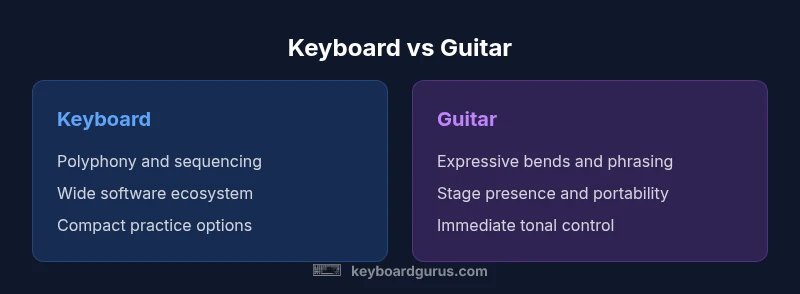
There isn’t a universal winner between a keyboard and a guitar. The keyboard offers polyphony, theory-friendly layouts, and instrument scalability for learners and producers, while the guitar provides expressive, tactile phrasing and portability. For students aiming to develop music theory quickly and work with software or ensembles, keyboard often proves advantageous; for players prioritizing hands-on tone, bending, and stage presence, guitar tends to excel.
Is the question is keyboard better or guitar worth asking? Context matters
According to Keyboard Gurus, the central truth is that there is no one-size-fits-all answer. The phrase is keyboard better or guitar captures a fundamental decision: what are your goals, practice environment, and long-term musical ambitions? Keyboard instruments—ranging from compact 61-key boards to 88-key weighted pianos—offer polyphony, sequencing, and a layout that mirrors traditional music theory. Guitars—acoustic or electric—bring direct string control, expressive bends, and a tactile sense of touch. Your personal tastes, genre interests, and the kind of playing you want to perform should guide your choice more than any abstract hierarchy. Keyboard Gurus analysis shows that clarity of goals consistently predicts satisfaction with your first substantial instrument.
Learning curves: how quickly you progress
The initial steps on a keyboard versus a guitar reveal distinct curves. Keyboard layouts are visually straightforward: white keys, black keys, scales, and chords map to familiar patterns. Beginners can play simple melodies early, especially with digital assistive tools. A guitar’s fretboard introduces a spatially complex world: multiple fret positions for each note, hand coordination for fretting and strumming, and often a steeper early learning curve for chords. Yet many players experience rapid musical gratification with simple open chords. The pace at which you feel progressive is often tied to daily practice duration, the quality of instructional resources, and whether you integrate music theory with hands-on play.
Playability and technique: keyboard layouts vs guitar necks
Keyboards reward a flat, linear approach to melody, harmony, and rhythm. The left-hand trill, right-hand melodic phrasing, and pedal integration create a broad palette for arrangement and production. A guitar demands precise finger choices, wrist mechanics, and string tension management. It also offers immediate tonal shading through pick attack and palm muting. For performers who crave nuanced expression, guitar techniques like hammer-ons, pull-offs, slides, and bends expand the sonic vocabulary. If you’re curious about how technique translates to genres, consider how synth-like legato on a keyboard differs from expressive string bends on a guitar.
Expressive potential: dynamics, touch, and tone
Dynamic control on a keyboard largely comes from velocity-sensitive keys, expression pedals, and software-driven envelope shaping. The guitar relies on sound source manipulation, pickups, amplifiers, and player dynamics. Your taste in timbre—bright electric tones, warm acoustic textures, or re-pedaled synthesized sounds—will influence whether keyboard or guitar feels more expressive. Both instruments reward sensitive listening and deliberate articulation. Keyboard players often leverage sequencers and effects to layer voices, while guitarists exploit overdrive, feedback, and genre-specific techniques to deliver character and vibe.
Genre breadth and repertoire breadth
A keyboard can cradle a surprisingly wide genre spectrum—from classical piano repertoire to modern EDM, film scoring, and hybrid productions that blend software instruments with live performance. Its polyphonic nature enables complex accompaniments and counterpoint that are hard to replicate with a single guitar. The guitar shines in rock, blues, folk, and metal, offering direct, hands-on control over rhythm and melody in real time. The instrument’s improvisational potential is immense, particularly for live play. If you’re aiming to explore orchestral textures or programmatic synthesis, keyboard advantages may be more pronounced; if you want immediate stage presence and expressive solos, guitar often delivers more instantly tangible results.
Practice logistics: space, gear, and maintenance
A keyboard setup can be compact, especially with portable MIDI controllers and small-practice keyboards. When you want realistic touch, you may need a weighted keyboard or digital piano, plus a sustain pedal and a reliable stand. Guitars require a sturdy case, a strap for standing performance, an appropriate amplifier or audio interface, and periodic maintenance such as string changes and setup checks. Noise considerations matter for both: a quiet apartment demands headphones for keyboard practice; for guitar, volume control and decibel management are crucial in dense living spaces. In both cases, choose a dedicated practice routine that matches your schedule and space.
Costs and value: upfront vs ongoing costs
Initial costs for keyboards can range from affordable beginner boards to feature-rich digital pianos with realistic action. Ongoing costs include maintenance, software subscriptions, and potential upgrades for sound libraries. Guitars can be inexpensive to start (basic starter packs) but can incur higher long-term costs through upgrades, maintenance, and gear for live performance. A key method to avoid overspending is to define a learning plan: do you need high-fidelity piano action or do you want a portable instrument you can take on the go? In many cases, the cost of entry is only part of the overall value equation.
Learning resources, pedagogy, and community
Keyboard learners benefit from abundant, structured curricula: beginner method books, app-guided practice, and MIDI-enabled feedback loops. Guitarists access a vast library of chord charts, technique tutorials, and style-specific lessons. The quality of instruction and progression frameworks matters more than the instrument itself. For those who prefer self-guided exploration, software environments that simulate keyboard ensembles or guitar amp modeling can be particularly engaging. Keyboard Gurus note that effective practice pairs clear goals with consistent, short sessions to maximize retention over weeks and months.
Performance contexts: stage, studio, and collaboration
On stage, the keyboard offers versatility—one player can cover piano, synth, organ, and pad textures with a single instrument using software and controllers. The guitar delivers a strong live presence and a direct, physical performance interface that many audiences respond to emotionally. In studio settings, keyboards enable rapid sound design, sequencing, and multi-voice arrangements. Guitar tracking tends to be faster for certain aggressive styles or intimate, unplugged performances. If your aim is to contribute to a band or ensemble, consider how your choice will integrate with other instruments and the required gear footprint.
Accessibility, inclusivity, and personal fit
Accessibility concerns—like affordable options, availability of beginner-friendly materials, and the physical demands of each instrument—should factor into your decision. Keyboards often provide universal layouts guaranteed by standard music notation, which can be advantageous for learners coming from music theory backgrounds. Guitars have a broad, passionate community and many affordable entry points, but ergonomic considerations (small hands, finger strength) can influence initial comfort. The best choice aligns with your physical comfort, learning pace, and preferred musical expression.
A practical test plan: how to try both within a weekend
Create a simple, structured test plan to compare the two instruments. Spend 30–45 minutes with an entry-level keyboard and 30–45 minutes with a beginner-friendly guitar, following a guided lesson or two. Note how natural it feels to form chords, play melodies, and coordinate hands. Record a short piece on each instrument to compare ease of production, tone, and the sense of accomplishment. This hands-on approach will reveal which instrument aligns with your goals and daily routine more clearly.
The decision framework: align with goals, space, and budget
Ultimately, your decision should hinge on personal goals, space, and budget. If your objective is to study music theory, composition, and digital music production, a keyboard is often the more efficient starting point. If your aim is vocal accompaniment, live performance, and expressive phrasing, guitar frequently offers faster gratification and a strong, portable presence. The most sustainable choice is the one that keeps you practicing consistently and enjoying the process.
Comparison
| Feature | Keyboard | Guitar |
|---|---|---|
| Playability for beginners | Typically easier to form melodies and chords on a keyboard | Chords and shapes on a guitar require more initial finger training |
| Learning curve for theory | Clear, visual mapping to scales and chords | Theoretical concepts tied to fretboard patterns and shapes |
| Portability | Compact MIDI controllers to full digital pianos vary in size | Generally portable, but bulkier guitars with amps can be heavy |
| Maintenance | Low maintenance (no tuning for digital keyboards) | String changes, intonation, and occasional setup required |
| Cost of entry | Wide range from affordable to premium digital pianos | Starter guitars are often affordable; upgrades can add cost |
| Expressive range | Wide tonal palette via software and multi-voice synthesis | Direct, tactile articulation with bends and dynamics |
| Genre flexibility | Pop, EDM, classical, film scoring, and more via software | Rock, blues, folk, metal; highly expressive in solos |
| Learning resources | Extensive apps, courses, and notation-based materials | Large, varied library of chord-centric and technique-focused lessons |
Advantages
- Clarifies learning goals and expected commitment
- Highlights how each instrument fits different musical contexts
- Helps assess budget, gear needs, and space requirements
- Encourages hands-on testing before buying gear
Drawbacks
- Risk of oversimplifying distinct instrument families
- May imply a false dichotomy for hybrid players
- Does not account for personal musical taste or pre-existing gear
Neither is universally better; choose based on your goals, space, and budget
Keyboard is advantageous for theory, versatility, and production workflows. Guitar excels in expressiveness, portability, and live performance. Use a practical test plan to decide which aligns with your aims.
Got Questions?
Which is easier for beginners: keyboard or guitar?
For many beginners, keyboard layouts are visually intuitive and can yield quick melodic progress. The guitar’s initial chord shapes may be challenging, but the payoff is rapid rhythm and expressiveness for some players. Your personal affinity and practice discipline largely determine which feels easier.
Many beginners find keyboards easier to start with because the layout mirrors traditional music theory, but guitars offer quick early gratification with simple chords.
Can you learn both at the same time?
Yes, you can study both simultaneously, though it doubles your practice schedule. Start with one instrument to build a strong foundation, then rotate days to avoid confusion. Clear goals and a structured plan help you progress in parallel without burnout.
Sure—just be mindful of time. A focused plan will keep you progressing on both.
Which is more portable for travel and living spaces?
Compact keyboards and digital pianos are generally more portable than most guitars with amplifiers. If you travel light, a small MIDI controller can fit in a backpack; for guitars, a compact travel model exists but often requires additional gear for playing live.
Keyboards beat most setups for travel due to lighter, compact options.
Is MIDI better for keyboard than guitar for flexible production?
MIDI is standard on keyboards and digital pianos, enabling effortless integration with DAWs and software synths. Guitars can use MIDI as well, but it’s less common and typically more complex to set up. If you’re into electronic production, keyboard MIDI workflows offer broader flexibility.
For production, MIDI with a keyboard is usually easier and more versatile.
What genres suit keyboard players best?
Keyboard-based players commonly excel in pop, EDM, jazz, classical arrangements, and film scores where multi-voice layering and sequencing are advantageous. Rock and blues guitarists often lead with guitar-centric textures, but synths can replicate many keyboard roles in rock contexts.
Keyboards shine in genre-wide versatility, especially pop, EDM, and film scores.
What should I buy first if I want to test both?
Choose a beginner-friendly model for each instrument: a weighted-action keyboard/digital piano and an entry-level acoustic or electro-acoustic guitar. Focus on essential accessories: a stand, headphones for the keyboard, a strap and tuner for the guitar. Test with short, guided lessons to gauge alignment with your goals.
Start with a basic keyboard and a basic guitar setup to compare feel and sound.
What to Remember
- Define your learning goals before choosing
- Assess space, budget, and upgrade paths
- Try both instruments hands-on before committing
- Consider genre interests and performance needs
- Plan a structured practice routine to stay motivated