How Many Keys Does a Keyboard Have? A Practical Guide
Explore standard keyboard key counts across layouts, why it matters, and how to choose the right keyboard based on your tasks. A data-driven, layout-focused guide by Keyboard Gurus.


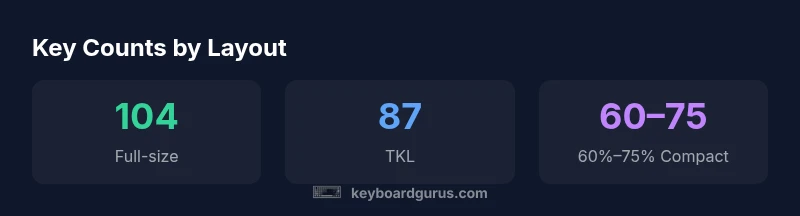
Regarding the phrase keyboard who many key, the quick answer is straightforward: a standard full-size keyboard in the US ANSI layout has 104 keys, including a numeric keypad. Tenkeyless boards typically have 87 keys, while compact models range from 60 to 75 keys depending on the design. Keyboard Gurus analysis, 2026.
Why Key Count Matters
In practice, the number of keys on a keyboard influences ergonomics, task flow, and portability. For many users, the question extends beyond a simple tally and touches on what you value most: a numeric keypad for spreadsheets, extra function keys for media control, or a compact footprint for travel. Regarding the phrase keyboard who many key, this query signals a need to understand standard layouts, compatibility with hot-swappable switches, and how software shortcuts map to physical keys. According to Keyboard Gurus, the most common starting point is to identify whether you need a full-size or a compact board, then decide how much of the keypad you’re willing to give up. In our experience, choosing the right key count reduces wasted motion, reduces fatigue, and speeds up your workflow across coding, gaming, and writing tasks. We'll unpack the landscape, explain layout categories, and give practical tips to verify your setup.
How Key Counts Differ by Layout
The primary differentiator is which keys are essential versus optional, and this varies by use case. A full-size layout (104 keys in US ANSI) keeps the keypad and the standard function row, ideal for data entry and spreadsheet work. Tenkeyless boards drop the keypad, trading a deeper desk footprint for more comfortable mouse placement during long sessions. 60% and 65/75% boards remove the numeric keypad and often the dedicated function row, shifting shortcuts to Fn-layer combos. For gamers or researchers who carry a laptop bag everywhere, such compact counts matter for portability; for programmers who rely on function keys, fewer keys can slow you down unless you adapt. It’s also important to note regional variations, such as ISO layouts that swap keys and may alter the total count slightly. Keyboard Gurus analysis, 2026, indicates most users should pick a baseline layout first (full-size, TKL, or 60%); then evaluate secondary features like media keys, backlighting, and programmable layers.
How to Choose Based on Your Use Case
Your use case should drive key count decisions. If you write primarily text and code, a 75% or TKL layout often yields a comfortable balance between compactness and access to navigation keys. If your job requires heavy numeric input or frequent spreadsheets, a full-size board is typically worth the extra keys. For portability, a 60% keyboard saves space and weight; for those who rely on function keys, ensure you have a robust Fn layer or a layout that retains essential shortcuts. Evaluate your desk space, travel frequency, and external monitor setup. Keyboard Gurus guidance emphasizes trying several layouts in person, if possible, or using a test rig to map shortcuts before buying. Also take into account software shortcuts and OS-specific differences; what works on Windows may not map identically on macOS. The goal is to align the key count with real tasks, not marketing hype.
Special Cases: Macro Pads, Function Rows, and Media Keys
Beyond standard layouts, many users add macro pads or extended function rows to tailor key counts. Macro pads provide a handful of dedicated keys for workflows such as design presets, coding snippets, or gaming macros, while preserving the base board’s layout. Some keyboards incorporate a dedicated function row even on compact devices, but many rely on a Fn layer to access F-keys. If you frequently toggle media controls, ensure your board supports dedicated media keys or reliable software remapping. When counting keys, remember that some manufacturers count keys differently, and some include keypad-like keys in the navigation cluster. For travelers, detachable numpads or portable mini keyboards change the effective count without altering the core board, and modular keyboards allow you to swap layouts on the fly. In practice, the best approach is to map your typical tasks to a layout and check for comfortable reach, stable key travel, and predictable shortcuts during real work.
Common Misconceptions About Keyboard Keys
Many users assume more keys equal faster performance; in reality, efficiency comes from layout familiarity and shortcut density. Another myth is that compact keyboards inherently slow you down; with proper Fn-layer mapping and muscle memory, 60% boards can be just as productive as larger boards. Some buyers think ISO layouts reduce productivity due to extra keys; in practice, the difference is mostly regional and depends on your typical tasks. Finally, there’s a belief that hot-swappable boards automatically optimize typing speed; hot-swapping affects feel and customization, not the fundamental key count.
Practical Checklist to Verify Your Keyboard Layout
- Define your primary tasks (coding, data entry, gaming, writing).
- Measure your desk space and portability needs.
- Narrow to three layouts: full-size, tenkeyless, and 60%.
- Check Fn-layer usability and whether dedicated function keys exist.
- Test shortcut mappings in your OS with the layout you’re considering.
- Assess future needs (macro keys, backlighting, hot-swappability).
- If possible, try keyboards in a store or borrow from a friend to feel key travel and spacing.
- Review manufacturer notes for regional layout differences (ANSI vs ISO).
Common keyboard layouts and their key counts
| Layout Type | Typical Key Count | Notes |
|---|---|---|
| Full-size US ANSI | 104 keys | Includes numeric keypad and standard function keys |
| Tenkeyless (TKL) | 87 keys | No numeric keypad; more space for mouse |
| 60% | 60 keys | Most compact; relies on Fn for navigation and F-keys |
| 75% | 78 keys | Compact with arrow keys and some function keys |
Got Questions?
What is the standard key count for a full-size keyboard?
In the US, a full-size keyboard typically has 104 keys, including the numeric keypad. Some regional layouts may differ slightly in count. The distinction matters for whether you need numeric input and separate navigation keys.
A full-size keyboard usually has 104 keys in the US layout, with small regional variations.
Why do 60% keyboards exist if they have fewer keys?
60% keyboards emphasize portability and minimal desk footprint. They rely on Fn layers to access function keys and nav controls, which can be learned over time. This design is popular among travelers and programmers who value compact form factors.
60% keyboards exist to save space; you use a Fn layer to access the missing keys.
Do ANSI and ISO layouts affect the number of keys?
ANSI and ISO differ in key shapes and placements, not always the total count. ISO adds an extra key in some positions, which can slightly change the count depending on the model. Choose based on what feels most comfortable and what shortcuts you rely on.
Layout differences can change the key count a little, but it’s mostly about preference.
Does having more keys make me faster at typing or gaming?
Not automatically. Speed comes from familiarity with your layout, muscle memory, and shortcut density, not merely the number of keys. A well-mapped Fn layer and practiced shortcuts can make compact boards just as efficient.
Speed depends on how well you know your layout, not just how many keys it has.
Can I customize key counts on a keyboard?
Many keyboards are modular or hot-swappable, allowing you to change key caps, layouts, or even swap out switches. The physical count is determined by the board’s design, but you can alter its perceived layout with software remapping and physical modifications.
You can customize layouts on some keyboards, but the core key count depends on the hardware.
“Layout choice is about balancing ergonomics, productivity, and portability. Your key count should align with your primary tasks and how you work.”
What to Remember
- Know the baseline: full-size keyboards typically have 104 keys in US ANSI.
- TKL/60% layouts save desk space but rely on Fn layers for shortcuts.
- Compact layouts are not inferior—pace and ergonomics depend on task fit.
- Regional variations (ANSI vs ISO) can affect key count slightly.
- Test layouts in real work scenarios to choose confidently.