Which Keyboard for Beginner Piano: A Clear Guide
Learn how to choose the right keyboard for beginner piano players. Compare keyboard types, key actions, and essential features to build solid technique and lasting progress.


Choosing the right keyboard for a beginner pianist sets the foundation for future progress. In this guide, you’ll learn how to pick between 61-key controllers, 88-key digital pianos, weighted-action keys, and budget-friendly options that still support proper technique. According to Keyboard Gurus, prioritize touch sensitivity, portability, and durable build to ensure steady practice and long-term growth.
Why the right keyboard matters for beginner pianists
Choosing the right keyboard is more than a budget decision; it shapes how you learn, how consistently you practice, and how smoothly you progress over time. For many students, the first instrument becomes a foundation they carry forward for years, so selecting wisely is essential. According to Keyboard Gurus, beginners should prioritize touch sensitivity, portable design, and durable construction to establish solid technique from the start. This emphasis isn’t about chasing the latest gadget; it’s about picking a model that rewards daily practice and grows with your skills.
When you ask which keyboard for beginner piano, you’re really asking for a tool that makes learning feel natural. A keyboard with responsive keys invites you to explore dynamics—softly whispering chords and loudly expressing melodies—without fighting the instrument. Portability matters because consistent practice often happens outside a formal studio: at a dorm room, on a kitchen table, or in a shared living space. A sturdy build reduces fuss during setup and breakdown, so you spend more time playing. The best starter instruments maintain reliability across sessions and transport, so you don’t pedal back to a less suitable option mid-learning.
Beyond feel and portability, consider how the instrument handles technique that matters early on. A model with predictable key bounce helps you build finger independence, while dependable power and headphone outputs remove common stressors like stray echoes or noisy neighbors. In practice, a well-chosen starter keyboard lowers friction to practice and supports correct habit formation. If you’re considering which keyboard for beginner piano, aim for a device that mirrors the acoustic piano’s touch and dynamic range, even if you pay a bit more upfront. This aligns with the idea that comfort-bred technique yields faster, more confident progress over time.
From a learning perspective, there’s a simple rule: the smoother your interaction with the keys, the quicker you’ll translate what you hear into muscle memory. A good starter keyboard also serves as a gateway to future upgrades; it should feel like a reliable partner that you won’t outgrow within a few weeks. In short, the right beginner keyboard is not just a price tag—it’s a foundation that makes regular practice feel rewarding and sustainable.
wordCountNote": null
altText": null
Tools & Materials
- Keyboard or digital piano (beginner-friendly, with keyboard action)(Choose a model with touch sensitivity and a reasonably natural feel.)
- Sustain pedal (optional but recommended)(Useful for practicing legato and common piano voicings.)
- Headphones (optional but recommended)(Helpful for private practice and late-evening sessions.)
- Stand or sturdy surface(Ensure a stable playing height that matches your optimal posture.)
- Power adapter or reliable batteries(A stable power source reduces performance issues.)
- Music stand or tablet holder (optional)(Keeps lesson sheets or apps at eye level.)
Steps
Estimated time: 60-90 minutes
- 1
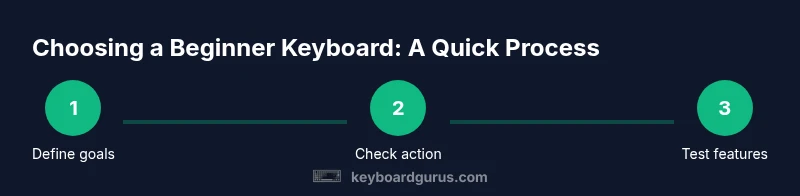
Define your goals and space
Identify whether portability, budget, or a more piano-like feel is your priority. Measure practice space and account for power outlets, noise considerations, and possible furniture placement. A clear goal helps you pick the right keyboard type and features.
Tip: Draft a short list of must-haves (touch sensitivity, portability, price range) to guide model selection. - 2
Compare key action and touch
Test keys for weight, resistance, and rebound. Favor keyboards with touch-sensitive keys that respond to velocity, so soft and loud playing feels natural. If possible, try both semi-weighted and fully weighted actions to feel the difference.
Tip: If you can’t try in person, read user reviews focusing on feel and consistency across octaves. - 3
Check essential features
Ensure the keyboard has a metronome, headphone output, and reliable power. Built-in lesson modes or Bluetooth connectivity can help with guided practice, but aren’t strictly required for beginners.
Tip: Prioritize a model with a solid, stable stand and reliable connections to avoid mid-practice interruptions. - 4
Set a realistic budget
Balance price with required features. Entry-level models can be surprisingly capable, while mid-range options often provide better key feel and longevity for ongoing learning.
Tip: Avoid paying for features you won’t use; focus on touch, reliability, and basic practice tools first. - 5
Test the user experience
Assess how easy it is to navigate the controls, adjust volume, and access practice modes. A friendly user interface reduces cognitive load during practice.
Tip: Create a short practice routine to test how intuitive the instrument feels during a real session. - 6
Make a final decision and set up
Choose a model you can commit to for several months. Assemble it on a sturdy stand, connect to power, and set up headphones or speakers for your preferred practice environment.
Tip: Keep the box and manual handy for warranty and setup questions.
Got Questions?
What is the best keyboard for beginners?
The best keyboard for beginners balances touch sensitivity, reliability, and ease of use. Look for models marketed for beginners that offer a natural-feeling action, a stable stand, and essential practice features.
For beginners, choose a keyboard with touch-sensitive keys and a simple interface to keep practice consistent.
Should I buy a keyboard with weighted keys?
Weighted keys more closely resemble an acoustic piano. They help develop finger strength and dynamics, but can be heavier and more expensive. If your goal is classical piano technique, weighted keys are beneficial; otherwise, a good semi-weighted action is often sufficient for beginners.
Weighted keys feel like a real piano, which helps technique, but start with what fits your budget and space.
How many keys do I need as a beginner?
For beginners, a common recommendation is a full-size keyboard with 88 keys if you plan to progress seriously; many learners start with 61 or 76 keys and upgrade later as they advance. The key is to have enough range to practice scales and music without constantly transposing.
88 keys provide full range, but 61 or 76 keys can work well for starting out and save space.
Is a digital piano better than a keyboard for learning?
Digital pianos typically emphasize a piano-like feel and stronger dynamics, which can be advantageous for beginners focused on classical technique. Keyboards may be lighter and cheaper but often lack the same touch response.
If you want a piano-like feel, a digital piano is usually the better start; for portability, a keyboard can be a good stepping stone.
Do I need a sustain pedal from the start?
A sustain pedal is highly recommended early on as it helps you practice legato and chord transitions. It’s inexpensive and can be used with most beginner keyboards.
Yes—keep a sustain pedal handy to practice common piano techniques.
Watch Video
What to Remember
- Choose a keyboard with touch sensitivity for realistic playing.
- Prioritize portability and durability to support daily practice.
- Ensure essential features (metronome, headphones, stand) are available.
- Test action feel to avoid outgrowing your starter model quickly.