Is a Keyboard a Good Way to Learn Piano? A Comprehensive Comparison
Explore whether starting on a keyboard is a good path to piano mastery, weighing touch, pedagogy, and long-term goals across keyboard setups and traditional pianos.


Is a keyboard a good way to learn piano? The short answer is yes, but only if you select the right model and commit to a piano-centric practice plan. For beginners, a weighted, 88-key keyboard can closely mimic piano touch and help build technique, repertoire, and reading skills. However, if repertoire fidelity and authentic touch are your core goals, you should plan a deliberate upgrade to a proper piano over time.
Is a Keyboard a Good Path to Piano? The Quick Reality Check
Is a keyboard a good way to learn piano? The concise answer is that it can be an effective starting point, provided learners treat the keyboard as a stepping-stone rather than a substitute for piano technique. A keyboard offers access to the fundamentals—note names, rhythm, scales, and chords—without the immediate expense or bulk of an acoustic instrument. The real question is whether your goals align with how a keyboard simulates or diverges from a real piano. Keyboard Gurus analysis emphasizes that the most productive approach is to design a structured transition plan: begin on a keyboard that feels as close as possible to a piano’s touch (preferably 88 keys with weighted action), build a gradual repertoire, and schedule a timeline to shift to a piano when skill, performance needs, or repertoire demands it. For casual practice, experimentation, or tech-infused learning, a keyboard can be an excellent entry point while still keeping long-term piano readiness in view.
In practical terms, beginners should ask: Do I want to perform classical pieces, or am I more interested in pop, jazz, or gaming soundtracks? Do I value tactile nuance, pedal control, and dynamic shading, or is portability and cost more important? Your answers will determine whether a keyboard will be a good long-term learning tool or a bridge instrument. Importantly, any plan should involve consistent tempo work, ear training, and sight-reading practice beside technique work on the keyboard. This approach aligns with the broader pedagogy Keyboard Gurus endorses: clear goals, progressive difficulty, and timely transition when appropriate.
The takeaway is that a keyboard can be a sound starting point for piano learning, but the path should be intentional and future-focused. The endgame matters as much as the beginner steps, and the right instrument choice early on can reduce friction when you approach more demanding repertoire later on.
The Roadmap to Effective Keyboard Learning
The road to piano proficiency with a keyboard hinges on several factors: tool quality, disciplined practice, and a clear plan for progression. Begin with a keyboard that offers at least 88 keys and a weighted or semi-weighted action to approximate the feel of a real piano. This choice makes the transition smoother, particularly for scales, arpeggios, and dynamic contrasts. Throughout your journey, pair technique work with repertoire that will transfer to piano settings—think classical studies for touch and phrasing, combined with simpler contemporary pieces to reinforce rhythm and articulation.
From Keyboard Gurus’ perspective, a hybrid strategy works best: combine conventional practice (C major scales, Hanon-style routines, Bach-style exercises) with digital aids (MIDI-enabled software, metronome apps, and repertoire databases). The keyboard’s portability should also be leveraged for varied practice environments—practice in different rooms, at different times, and with different tempos to develop fluidity and musical memory. Importantly, track progress with affordable measurements: tempo stability, consistent dynamics, and accurate articulation at prescribed metronome marks. The quantitative improvements are less about raw numbers and more about consistent, measurable gains in technique and musicality.
In short, if your long-term goal is piano mastery, treat the keyboard as a reliable starting point that scales with your ambitions. With a strong plan and the right instrument, you can build a robust foundation that transfers to real piano performance.
Key Differences: Weighted Action, Keys, and Pedals
Understanding the core differences between a keyboard and a piano is essential when deciding whether to start on a keyboard. The most consequential distinction is touch: pianos have hammer-action keys that respond to subtle touch and dynamic range, whereas many keyboards offer unweighted or semi-weighted actions that can feel lighter and smoother but less faithful to piano touch. If you intend to play classical repertoire or develop nuanced phrasing, weight and touch sensitivity become critical; a keyboard with graded hammer action is the closest approximation to a real piano experience.
Another difference is key layout and count. Full-size pianos use 88 keys, a standard you should aim to mirror when possible. Some portable keyboards offer fewer keys (61 or 76), which can impede repertoire that spans the full range. Pedal availability is also a practical divide: many keyboards come with 0-2 pedals or rely on pedal simulations, while traditional pianos typically include 2-3 pedals with varied functions such as sustain, soft, and sostenuto. Language and pedagogy also diverge: some learning resources assume piano-like tactile feedback, others emphasize digital workflows, MIDI integration, and app-based practice.
Finally, maintenance and reliability differ. Pianos require regular tuning and regulation to maintain tonal accuracy and action consistency, while modern keyboards are largely maintenance-free beyond occasional software updates or battery changes. For learners, this means you must weigh not only initial feel but future upkeep and the scope of your repertoire when choosing between keyboard and piano in a learning plan.
In practice, the best option is often a keyboard that prioritizes piano-like action (88 keys with weighted touch) within a learning path designed to culminate in a real piano. This ensures the positive aspects of portability and affordability do not come at the expense of long-term piano readiness.
Learning Outcomes on a Keyboard vs Piano
From a cognitive and technical perspective, learning on a keyboard versus a piano yields overlapping outcomes but different emphases. On a keyboard, beginners can rapidly acquire note-reading fluency, chord shapes, and basic rhythm with lower cost and less space. Keyboard-based practice can accelerate initial familiarity with scales, arpeggios, and basic dynamics, especially when combined with software that provides instant feedback. However, the subtle ear training and touch memory developed on a real piano—where each dynamic shade translates to a specific physical action—are often more robust after extended, authentic touch exposure.
A well-structured keyboard program should prioritize three pillars: technique, repertoire, and musicality. Technique includes scales, arpeggios, and Hanon-like drills tailored to touch sensitivity. Repertoire should gradually introduce pieces that demand strong pedal use, finger independence, and phrasing control. Musicality emphasizes listening, phrasing, articulation, and tempo stability. In line with Keyboard Gurus recommendations, learners should consistently pair technical exercises with pieces that require expressive touch, and schedule practice blocks that explicitly connect keyboard actions to piano outcomes. This approach ensures that the skills cultivated on a keyboard translate into real piano performance when the time comes to perform on a traditional instrument.
By aligning practice with the realities of piano playing, learners avoid getting stuck in a keyboard-only comfort zone and maintain motivation through tangible progress toward a goal that authentically reflects piano technique.
How to Bridge from Keyboard to Real Piano
Bridging from keyboard to real piano is a staged process that minimizes friction and maximizes retention. Start by updating the instrument to fully resemble a piano’s action: invest in an 88-key keyboard with graded hammer action and a realistic touch. Maintain a dedicated transition timeline that gradually increases the complexity of pieces chosen for practice on both instruments. For example, master a Bach two-part invention on the keyboard and then accession to the same piece on a real piano to compare touch dynamics and pedal usage. Use the keyboard as a proven rehearsal space for technique while reserving repertoire that demands authentic pedal control and nuanced touch for the piano.
Tempo and rhythm transitions are critical. Practice slow, precise passages on the keyboard with a metronome, then perform them at tempo on a piano to gauge control under more demanding acoustics. Pedal coordination should be re-evaluated in the piano context: the same phrase benefits from different pedal timing depending on instrument weight and action. A practical bridging plan often includes weekly milestones: one week of pure technique, two weeks of repertoire transfer, and a final assessment where you perform a selected piece on both instruments to detect progress and remaining gaps.
A disciplined bridging approach is essential for success. The Keyboard Gurus framework suggests documenting your progress via a practice log that captures tempo consistency, dynamics, and articulation across both instruments, enabling data-driven decisions about when to upgrade or switch to a piano-focused routine.
Choosing a Keyboard for Piano Learning
Choosing the right keyboard is foundational to your piano-learning outcomes. Prioritize 88 keys with weighted action or graded hammer action to approximate the touch and dynamic range of an acoustic piano. If full-weighted action is unavailable, aim for semi-weighted keys with velocity sensitivity and a robust sustain mechanism. Pedal support matters: look for at least a single sustain pedal with support for pedal effects like half-pedaling if possible, and ensure the pedal action feels authentic enough to simulate piano phrasing. Connectivity is also important: USB-MIDI, Bluetooth MIDI, and compatibility with learning software and apps will expand your practice options, track progress, and provide real-time feedback. The build quality, keybed stability, and key return consistency are telltale signs of a well-suited instrument for piano learning. Brand ecosystems and service support matter as well, as you want to avoid frequent model changes that disrupt your familiar technique.
Finally, consider your space and budget. Portable 88-key keyboards are convenient and often suffice for early stages, but if space and budget permit, investing in a higher-quality, slightly larger instrument with realistic action will pay dividends as you advance. Your goal is to minimize the friction of the transition to real piano, ensuring your technique and musicality translate cleanly across both instruments. A thoughtful selection process is a key determinant of long-term success.
Practice Plans: Sample Week-by-Week Outline
Structured practice is crucial for converting keyboard work into piano proficiency. A well-designed plan combines technique, repertoire, rhythm, and ear training, with clear weekly objectives. Week 1 focuses on posture, hand position, and a controlled touch on the keyboard, using simple scales, five-finger patterns, and short arpeggios. Week 2 introduces dynamic shading and two-voice independence, maintaining accuracy at a moderate tempo. Week 3 adds pedal coordination on the keyboard and introduces beginner-level repertoire that leverages sustain for legato phrasing. Week 4 aligns keyboard technique with short pieces on the piano, focusing on consistent touch and pedaling. Weeks 5-8 systematically escalate repertoire complexity, while ensuring that the technique remains transferable to piano performance. In Weeks 9-12, learners consolidate their skill set by performing on both instruments, refining dynamics, articulation, and tempo control under varied acoustic conditions.
A practical reminder: always link your technique drills to musical meanings. For instance, connect a C major scale exercise to a legato phrase in a piece you are learning, and then test the same phrase on the piano with a feel for dampened resonance and sustain. This integrated approach ensures learning transfers smoothly between instruments, preventing separate “keyboard habits” from forming. The key is consistent, purpose-driven practice rather than isolated drill work.
Tools and Apps that Enhance Keyboard-to-Piano Learning
Technology amplifies the keyboard-to-piano learning process by providing immediate feedback, structured curricula, and accessible practice communities. Begin with a solid MIDI-enabled platform that records practice tempo, accuracy, and phrasing. Leverage metronome apps with rhythm subdivisions and tempo maps to train consistent timing across scales and pieces. Many music theory apps offer interactive exercises for chord progressions, scale patterns, and ear training—crucial for developing a solid sense of pitch and harmony before approaching repertoire. Software that simulates pedal behavior helps you understand pedal timing on both keyboard and piano, making your bridge to the real instrument more predictable.
In addition to software, consider online lessons or local mentorship focused on transfer strategy. Seek programs that emphasize touch realism and pedal technique, and track progress with performance check-ins. By combining hardware with software, you create a feedback loop that accelerates your learning curve and ensures your keyboard practice aligns with real piano expectations. Keyboard Gurus recommends a balanced mix of practice modalities to keep motivation high and progress measurable.
Common Challenges and How to Overcome Them
Bridge-related challenges are common for keyboard learners moving toward piano. The most frequent hurdle is adjusting to the piano’s heavier touch and more sensitive dynamics. Regularly practicing with a weighted action keyboard helps, but you must ultimately calibrate your technique to the piano’s physical feedback. Another challenge is repertoire development that demands true pedal control and legato phrasing; you should segment practice to first develop a clean touch on the keyboard, then layer pedal technique on the piano. Mental mapping differences also appear: keyboard patterns may not transfer automatically to the piano’s acoustics, so treat transfer as a separate skill that requires deliberate practice.
To overcome these, maintain a bridging routine with explicit transfer exercises. Schedule weekly sessions dedicated to pedal timing and touch consistency on both instruments, and use slow, deliberate tempo with frequent slow-downs to verify accuracy before increasing speed. Seek feedback from teachers or peers and use recording to assess subtle differences in tone and phrasing. Keeping a growth mindset and a concrete progression plan reduces the risk of plateauing and encourages continuous improvement.
Ultimately, the key is to treat the transition to piano as a new, but interconnected, skill set rather than a different activity altogether. The more you align keyboard practice with piano goals, the smoother the transition will be.
Real-World Scenarios: Who Should Learn on Keyboard vs Piano
Different learner profiles benefit from starting to learn on a keyboard, depending on goals, resources, and contexts. Students with budget constraints or limited space often benefit from a reliable 88-key weighted keyboard as a first instrument, enabling core technique and reading without heavy investment. Teachers may prefer keyboard-based curricula for introducing basic concepts before moving students to piano, enabling an efficient progression path. Gamers and tech enthusiasts can integrate MIDI keyboards with software synths to practice music theory in a dynamic setting, while still preparing for piano technique when desired. On the other hand, performers and serious classical learners often need the tactile fidelity of a piano from the outset, because performance readiness hinges on touch, pedaling, and resonance that only a piano can authentically provide. In all cases, the decision should be guided by clear goals, a credible transition plan, and a commitment to a practice routine that bridges instruments smoothly. The Keyboard Gurus framework recommends evaluating long-term goals and scheduling cross-instrument practice to ensure sustained progress without stagnation.
Ultimately, the choice between keyboard and piano learning is not binary. A well-planned pathway utilizing a keyboard for skill-building, followed by a strategic upgrade to a piano, delivers the best of both worlds: affordability and accessibility now, with authentic touch and repertoire readiness later.
Setup Ideas for Different Budgets and Setups
Budget-conscious learners can start with a solid 88-key keyboard that offers weighted action and basic pedal functionality, paired with a simple stand and a reputable learning app. Mid-range setups might add a higher-quality action keyboard along with a dedicated pedal unit and a small practice space to simulate a real piano environment. For advanced learners with performance goals, investing in a stage-ready keyboard with fully weighted keys, a robust pedal system, and reliable sustain can be advantageous, especially when combined with piano lessons and access to a piano for transfer practice. Regardless of budget, curate a practice environment that minimizes distractions and fosters consistent daily practice. The aim is to create a stable habitat for technique-building and repertoire growth, with a clear plan for when to transition to a true piano. By setting tangible short-term targets and maintaining a long-term bridge strategy, you accelerate progress and reduce the risk of stagnation. Keyboard Gurus emphasizes that thoughtful equipment choices aligned with a concrete progression plan yield the most reliable outcomes.
The Path Forward: Long-Term Considerations for Keyboard Learners
Looking ahead, most learners who pursue piano mastery use the keyboard as a launchpad rather than a terminal instrument. The long-term value lies in the ability to maintain a steady practice habit, build a diverse repertoire, and seamlessly transfer skills to a piano when necessary for performance or audition requirements. Continuous evaluation of technique, touch, and pedal control will guide decisions about upgrading gear and adjusting practice plans. As you advance, your needs may shift toward higher-end keyboards or dedicated pianos, depending on your goals. Keyboard Gurus suggests adopting a growth mindset: treat the keyboard as a scalable tool—one that adapts as your goals evolve. Whether your aim is classical performance, jazz improvisation, or composition, a deliberate, long-horizon approach will maximize your learning and minimize regression during transitions.
Comparison
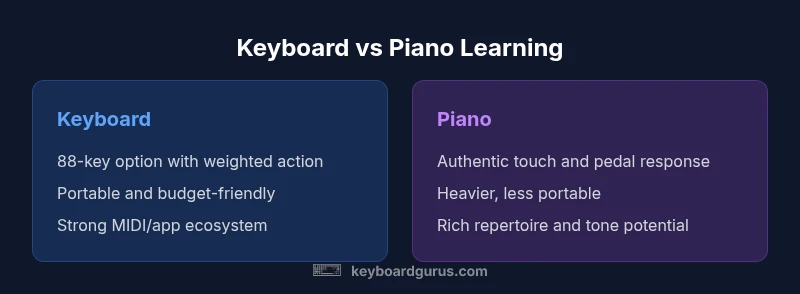
| Feature | Keyboard-based learning setup | Acoustic piano (traditional) |
|---|---|---|
| Key count | 61-88 keys on keyboards | 88 keys on most pianos |
| Action/feel | Unweighted, semi-weighted, or weighted options | Graded hammer action with authentic touch |
| Pedals | 0-2 pedals depending on model | Typically 2-3 pedals (sustain, soft, sostenuto) |
| Maintenance | Low maintenance; no regular tuning | Regular tuning and action regulation required |
| Portability | High portability; easy to move | Heavy; less portable and space-demanding |
| Learning tech | MIDI/USB, apps, software; great for modern workflows | Limited integration with learning tech without additional gear |
| Cost/value | Lower upfront cost; large model variety | Higher upfront cost; potential long-term value depends on use |
Advantages
- Lower upfront cost and flexible budgeting
- High portability enables practice anywhere
- Broad access to learning apps and MIDI-based tools
- Faster setup for home practice and quick plays
Drawbacks
- Touch and pedal fidelity may lag behind real pianos
- Some models offer limited dynamic range and sustain nuance
- Frequent upgrading may be needed to maintain transfer quality
- Less authentic piano experience for advanced repertoire
Keyboard learning with an 88-key weighted model is a strong starting point; upgrade to piano when ready
A keyboard serves as an effective bridge to piano mastery when used with a deliberate bridge plan. For serious performance goals, move to a piano to fully capture touch, dynamics, and pedal nuance.
Got Questions?
Can I learn piano effectively on a keyboard without weighted keys?
Weighted keys help approximate piano touch, but you can still learn core piano terminology and reading. For serious technique and performance, plan to upgrade to weighted action as soon as possible.
Weighted keys help, but you can still learn the basics now. If you want to perform well later, plan an upgrade to weighted action.
What features matter most when learning piano on a keyboard?
Prioritize 88 keys, weighted action, good pedal feel, and solid MIDI/learning software compatibility. Touch sensitivity and reliability of the action are crucial for transferring to piano.
Look for 88 keys, weighted action, and good pedal feel to transfer skills to piano.
Is it better to switch to an acoustic piano eventually?
Yes, for advanced repertoire and authentic touch, moving to an acoustic or high-end weighted keyboard is advisable once you reach a solid intermediate level.
Yes—switching to a real piano helps with touch and tone for advanced pieces.
How long does it typically take to transfer keyboard skills to piano?
Transfer times vary by individual but typically require several months of dedicated practice on both instruments, with explicit transfer exercises and performance checks.
It varies, but with focused practice you can transfer skills in a few months.
Do keyboards hinder or help with rhythm training?
Keyboards can support rhythm training through metronome integration and apps, but ensure metrical consistency transfers to the piano by practicing with the acoustic instrument.
Keyboards help rhythm with apps and metronomes, just remember to transfer to the piano.
What to Remember
- Start with an 88-key weighted keyboard to mirror piano touch
- Balance technique, repertoire, and build a real-piano transition plan
- Leverage MIDI apps and practice tools to track progress
- Upgrade to a piano when repertoire and performance goals require authentic touch
- Bridge practice should be deliberate and documented for consistent transfer