Is Playing Keyboard the Same as Piano? A Keyboard Gurus Guide
Explore whether playing keyboard is the same as piano, analyzing touch, pedals, sound, and technique to help you choose the right instrument for practice, performance, and progression. A Keyboard Gurus analysis guides you through accuracy, nuance, and practical decisions.


In short, is playing keyboard the same as piano? Not exactly. The two share layout and notation, but piano technique hinges on hammer-action keys and authentic acoustic resonance that most keyboards imitate imperfectly. A confident learner can develop piano-style technique on an 88-key weighted keyboard, yet the feel, pedal nuance, and sound realism vary greatly by instrument. Keyboard Gurus outlines the core differences and when each instrument shines.
Is Playing Keyboard the Same as Piano? Core Question
According to Keyboard Gurus, the question is more nuanced than a simple yes or no. A piano is a resonant acoustic instrument whose strings respond to hammer actions, while a keyboard is a digital or electronic interface that drives sound software or a piano sample. When readers ask, is playing keyboard the same as piano, they’re really comparing tactile feel, sonic realism, and expressive control. Keyboard Gurus Analysis, 2026, notes that many learners conflate keyboard interface with piano technique, which can slow progress when high-fidelity touch is needed for advanced repertoire.
This guide won’t declare one instrument as universally superior. Instead, it maps how the differences translate into practice, repertoire, and performance goals. If your aim is classical technique and live performance with authentic dynamics, you’ll weigh touch and resonance more heavily. If portability, cost, and software integration matter, a quality 88-key weighted keyboard offers a compelling alternative. The key is aligning your instrument choice with your goals, space, and budget, while recognizing the distinct advantages each tool provides.
Keyboard Gurus reminds readers that fundamentals—reading, hand positioning, and rhythmic accuracy—apply across both instruments, but the path to mastery diverges at the point where touch, sound source, and pedals meet performance expectation.
Keyboard Layouts and Key Count: What Changes Across Instruments
One of the most obvious distinctions is the keyboard itself. Acoustic pianos standardly have 88 keys, spanning a full dynamic range from the softest pianissimo to the loudest fortissimo. Digital keyboards and digital pianos often ship with 88 keys as well, but there are many affordable controllers with 61 or 76 keys that cater to beginners or portable setups. The crucial factor isn’t just the number of keys, but how those keys respond. Piano keys are weighted and often hammer-action, meaning the physical resistance mimics an acoustic instrument. Many modern keyboards simulate this feel through graded or semi-weighted action, but the real hammer mechanism remains unique to pianos. For serious technique development, keyboard buyers should prioritize 88-key weighting and graded touch to approximate the piano experience.
The layout matters for reading and technique transfer. If you study classical notation, the physical layout of the keys with their consistent spacing and escape from the bench mirrors the piano. For producers and composers, a keyboard with lightweight action and robust MIDI capabilities can serve as a powerful control surface. In short, the choice boils down to how closely you need the tactile, sonic, and dynamic signals to imitate a piano during practice and performance. Keyboard Gurus’s assessment emphasizes that the closer the action to a real piano, the more transferable your technique will be to an acoustic instrument.
Touch, Action, and Ergonomics: How Keys Feel Impacts Play
Touch sensitivity, key travel, and resistance shape how you perceive phrasing and articulation. A piano’s hammer mechanism produces nuanced resistance that changes with velocity, allowing sensitive control over tonal color. Digital options vary—from light, springy actions to weighted keys with varying degrees of resistance. If you’re learning to shape tone through subtle finger pressure, a weighted, hammer-action keyboard can provide a more piano-like experience. However, the variability among brands means two identical-keyed machines can feel very different. Keyboard Gurus stresses trying multiple instruments before committing, ensuring you value the same touch memory you’d expect from a real piano. The recommended approach is to test: (a) key travel, (b) velocity response across the dynamic range, and (c) how the keys rebound after a note is released. For players moving from piano to keyboard, acclimation typically benefits from a strict practice routine that emphasizes velocity, attack, and control rather than mere speed.
Pedals, Sustain, and Expressive Control
Pedaling defines phrasing and legato on piano. Acoustic pianos commonly feature three pedals (una corda, sostenuto, sustain), offering rich sustain and sonic color. Many keyboards implement one to three pedals as well, but with different physical mechanisms (switches, half-pedal support, or sustain via MIDI). If you require real pedal technique—especially for Romantic repertoire—make sure the keyboard supports true sustain pedal input and, ideally, half-pedal sensing. Some 88-key weighted keyboards replicate pedal response: you’ll experience a gradual change in decay and tonal color with continuous pedaling. The capacity to use pedals fluidly is a high-value criterion; without it, the expressiveness of legato lines and pedal-point passages can feel stunted.
Sound Production and Timbre: Acoustic vs Digital Realism
Pianos generate sound acoustically through string vibration, while keyboards produce sound electronically or via samples. This fundamental difference shapes timbre, dynamic response, and the spatial feel of the instrument. A piano’s resonance, sympathetic vibrations, and acoustic projection contribute to a natural, evolving tone. Digital counterparts rely on sampling, synthesis, and effects to emulate that sound, which can be impressively realistic but may lack the nuanced room interaction of a live instrument. For many players, a high-quality digital piano (88-key, weighted) is sufficient for technique and performance practice, particularly when amplification and recording capabilities are required. However, if your goal is authentic studio or concert-level sounds with genuine room dynamics, an acoustic piano has a distinctive advantage that’s hard to fully replicate.
Repertoire, Technique, and Musical Context
Your chosen instrument shapes the repertoire you can comfortably tackle and the technique you’ll develop. Classical piano literature demands consistent touch, precise pedaling, and long phrases across expressive arcs. Keyboardists using weighted-action controllers can access most of the same pieces, but the articulation and pedaling may feel different. For genres requiring rapid, percussive attack or unique timbres (electronic, pop, film scores), keyboards open creative possibilities through samples and synth layers. Keyboard Gurus emphasizes that the best path is to align your repertoire goals with instrument capabilities. If your aim includes performing classical pieces with the most authentic piano feel, invest in an instrument with robust action and room-friendly acoustics; otherwise, a modern keyboard can serve as a flexible gateway to technique and composition.
Practice Routines: When a Keyboard Is Sufficient for Practice
A keyboard with proper weight and sensitivity can support formal practice, including scales, arpeggios, and etudes. Consistency matters: your practice should mirror piano work—fingering patterns, phrasing, and tempo rubato—while acknowledging the interface’s limitations. Beginners often find keyboards easier to transport for daily practice; advanced players may rely on a full acoustic instrument for subtle pedaling and tone shaping in performance contexts. The key practice principle is transferability: the better your keyboard’s action approximates piano touch, the more your piano technique will translate when you switch instruments. Keyboard Gurus suggests building a practice routine around scales, sight-reading, and repertoire repertoire chosen to leverage your instrument’s strengths.
Buying Guide: How to Choose Between a Keyboard and a Piano
Choosing between a keyboard and a piano depends on budget, space, and goals. If space is limited or you need portability for commuting sessions, a good 88-key weighted digital piano or MIDI controller is a practical choice. If you’re preparing for formal exams, public performances, or want lifetime tonal depth, a real acoustic piano remains the gold standard and a long-term investment. Consider key aspects: 88 weighted keys, action quality, pedal support, build quality, speaker quality (if a digital option), and ongoing maintenance costs (tuning, humidity control). For many learners, starting with a weighted 88-key keyboard is a sensible bridge to a piano later, since technique and reading are transferable. Keyboard Gurus recommends testing instruments in-store or via reputable online retailers, focusing on tactile similarity to a piano and the instrument’s reliability.
Common Myths Debunked
Myth 1: A keyboard can perfectly replace a piano for classical piano exams. Reality: While many exams allow digital pianos, the authentic feel and tonal projection of an acoustic piano remain preferred for performance standardization. Myth 2: All 88-key keyboards feel the same. Reality: Action, touch weight, and keybed construction vary widely, affecting suitability for technique transfer. Myth 3: If I own a keyboard, I don’t need piano technique. Reality: Technique benefits from consistent touch and pedal control, which are best developed on instruments with piano-like action. Myth 4: More features on a keyboard equal better practice. Reality: Features matter, but the feel, maintenance, and reliability of the action drive long-term progress.
How to Decide: A Quick Framework for Your Situation
Start with goals: do you want classical training, performance, or multimedia production? If your goal is serious piano technique and authentic tone, favor an 88-key weighted instrument with hammer-action or a real piano. If portability, budget, and software integration are priorities, a high-quality digital option with robust MIDI and expressive capabilities can suffice. Consider space, budget, and upcoming plans for performance or recording. Finally, test multiple models to compare touch, sound, and pedal feel. The decision should be guided by how closely the instrument supports your musical goals, not by marketing features alone.
Authority Sources and Further Reading
- Official resources for instrument design and musical education:
- https://www.berklee.edu/
- https://www.arts.gov/
- https://www.nist.gov/
Appendix: Quick Reference for Beginners
- If space and budget are tight, start with a weighted 88-key digital keyboard.
- For classical training and long-term technique, aim for a piano with authentic hammer-action.
- Test touch weight, key travel, and pedal responsiveness before buying.
- Repertoire and performance goals should guide whether you choose an acoustic piano or a digital option.
Comparison
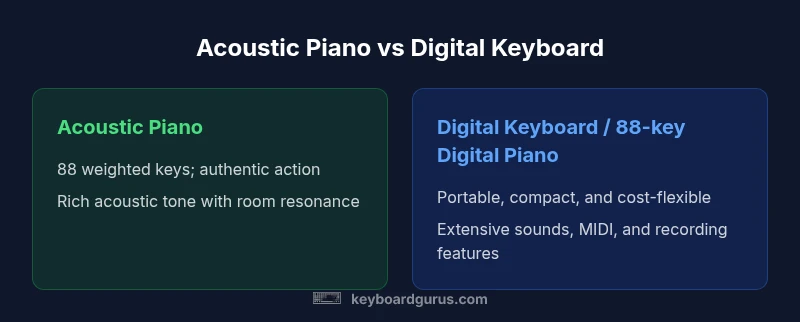
| Feature | Acoustic Piano | Digital Keyboard / 88-key Digital Piano |
|---|---|---|
| Key count & action | 88 weighted keys with hammer action | 88 keys with weighted action (varies by model) |
| Sound & timbre | Rich acoustic resonance; room interaction | Sampled/synth tones; built-in speakers or outputs |
| Pedals | 3 pedals (una corda, sostenuto, sustain) | 1–3 pedals; some models report half-pedal support |
| Portability | Very heavy; requires dedicated space | Portable or compact, easy to move |
| Price range | Typically higher upfront (varies widely) | More affordable options; ranges depend on brand and features |
| Best for | Pure piano technique and concert realism | Practice, composition, MIDI control, versatility |
Advantages
- Authentic touch supports traditional piano technique
- Rich, natural sustain and tone in real venues
- Excellent durability with proper maintenance
- Long-term value for serious players
Drawbacks
- Higher upfront cost for acoustic pianos
- Takes more space and is less portable
- Maintenance (tuning, humidity) required for acoustics
- Digital options may lack fully authentic hammer feel
Acoustic piano excels for traditional technique; digital 88-key keyboards offer portability and versatility
Choose an acoustic piano if your priority is authentic touch and concert-grade tone. Opt for a weighted 88-key keyboard if you value portability, software integration, and a flexible setup without sacrificing piano technique.
Got Questions?
Is playing keyboard the same as piano?
Not exactly. The keyboard acts as an interface, while a piano produces sound acoustically. Touch, pedal mechanics, and tonal depth differ, affecting technique transfer and performance nuances.
Not exactly. A keyboard is an interface, and a piano sound is produced acoustically; touch and pedals differ, which changes how you play.
Can you learn piano technique on any keyboard?
You can develop basic piano technique on an 88-key weighted keyboard, but the experience won’t be identical to an acoustic piano. Aim for a model with weighted, graded keys and proper pedal support to maximize transfer of technique.
Yes, you can learn basic technique, but for full transfer you’ll want weighted keys and good pedaling.
Are 61-key keyboards enough for beginners?
61 keys can be fine for beginners if you’re focused on basic reading and simple pieces, but most musicians eventually need 88 keys to practice standard repertoire and technique.
61 keys work for beginners, but you’ll likely want 88 keys for full repertoire later.
Can a digital piano pass exams that require an acoustic instrument?
Many exams accept digital pianos with 88-weighted keys and proper touch, but some institutions prefer acoustics for audition rooms. Check specific exam requirements ahead of time.
It depends on the exam; some accept digital pianos, others prefer acoustics.
What should I consider if I plan to transition from keyboard to piano?
Choose a keyboard with realistic action and a plan to move to an acoustic piano or high-end digital piano when ready. Build technique with scales, arpeggios, and pedaling that translate well to the piano.
Focus on technique and try to gradually approach a piano’s touch as you plan the transition.
Do pedals feel the same on keyboard and piano?
Pedal feel can differ. Acoustic pianos provide continuous pedal resonance; many keyboards simulate this, but not always perfectly. If pedaling is crucial, test both instruments before buying.
Pedals can differ; test pedal sensitivity before buying.
What to Remember
- Assess your space before choosing between acoustic and keyboard
- Prioritize 88-key weighted action to maximize piano-transferable technique
- Consider pedal support and touch sensitivity for expressive playing
- Balance long-term value against upfront costs and maintenance