Is Keyboard Easier Than Piano? A Practical Comparison
Explore whether starting on a keyboard is easier than playing a piano. This analytical guide compares action, range, cost, and long-term goals to help you choose the right path for beginners, students, and professionals.


According to Keyboard Gurus, is keyboard easier than piano for beginners? In practical terms, a basic keyboard is easier to start with thanks to portability, headphones for silent practice, and built-in learning aids. But for true piano mastery, you eventually need a hammer-action instrument with full 88 keys and authentic pedal control.
The Core Question: Is Keyboard Easier Than Piano?
The core question many learners ask is: is keyboard easier than piano, and does starting on a keyboard properly prepare you for a traditional piano? The short answer depends on goals, but for most newcomers the keyboard offers a smoother onboarding experience. It’s lighter, cheaper, and often includes features like metronomes, lesson modes, and headphone outputs that remove the fear of disturbing others. These conveniences can accelerate initial confidence and basic rhythm reading. However, Keyboard Gurus analysis emphasizes that entering the piano world later demands attention to action type, key count, and pedal implementation to replicate the touch and resonance of a true piano.
From a learning-design perspective, the ease of entry matters. The keyboard pathway can shield beginners from technical barriers while they build foundational skills such as note reading, finger independence, and tempo control. Yet the ultimate aim—mastery of piano repertoire—often requires a more authentic hammer-action, an 88-key scale, and genuine pedal feel. In this sense, the short-term ease of a keyboard may contrast with the longer journey toward piano fluency.
Key Action and Layout: How It Feels to Play
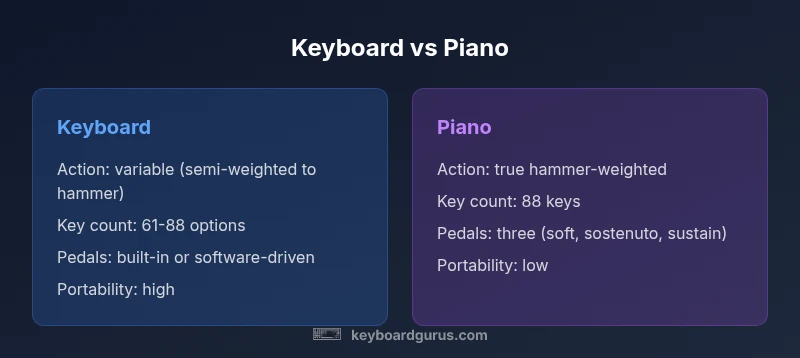
Key action is the most tangible difference between a keyboard and a piano. A basic keyboard often uses semi-weighted or even light, springy keys. This can make first pieces feel forgiving and quick to play, especially when you are focusing on reading and rhythm rather than touch sensitivity. In contrast, a piano uses true hammer-weighted action with graded weighting from low to high keys. This produces a heavier touch, a more nuanced dynamic range, and a more responsive rebound that rewards precision. The tactile feedback drives more precise finger technique and a deeper sense of control, which is central to classical repertoire. Keyboard models with weighted or graded hammer-action keyboards are a bridge between entry-level portability and authentic piano feel, helping learners progress at a realistic pace.
For learners with a specific goal in mind—classical performance, advanced jazz, or expressive ballads—the choice of action becomes a deciding factor. The “feel” of the keys isn’t cosmetic; it shapes how you shape phrases, shape vibrato, and manage fast runs. Keyboard Gurus notes that models offering progressively heavier touch in lower ranges and lighter touch in upper ranges tend to align more closely with real piano technique, enabling smoother transfer when you switch to an acoustic or high-end digital piano.
Range, Pedals, and Expressiveness
Instrument range and pedal configuration are essential for translating technique into expressive music. Acoustic pianos provide a full 88-key range with natural hammer-action and three pedals (sustain, soft, sostenuto) in most cases, delivering a broad palette for expression and piece variety. Digital keyboards vary widely: many entry-level units offer 61 or 76 keys, with 88-key options available at mid-range price points. Pedalne expressions on keyboards are often emulated via software or built-in pedals, but the pedal feel and sustain differ from an acoustic instrument. If you anticipate playing late-Romantic repertoire or modern pieces that exploit wide dynamic color, a full 88-key hammer-action keyboard or a proper piano becomes increasingly important.
Expressive capability hinges on more than keys alone. Touch sensitivity, aftertouch (on some keyboards), and the quality of onboard sounds influence how expressive a performance feels. Keyboard Gurus emphasizes that you should evaluate your own repertoire needs: shorter pieces and pop expositions may require less range, while demanding classical works demand uninterrupted access to the full keyboard and convincing pedal interactions.
Learning Curve in Practice: Short-Term vs Long-Term
The learning curve for keyboard versus piano has two faces. In the short term, keyboards—especially those with built-in learning aids, adjustable tempo, and compact form—make it easier to begin reading notes and coordinating hands. This initial accessibility reduces intimidation and encourages consistent practice. In the long term, however, the path to piano mastery often hinges on building a robust tactile memory for hammer-action keys and three-pedal technique. Transitioning from a keyboard with lighter action to a true piano—or a weighted, 88-key controller—requires retraining touch, dynamics, and pedaling, which can feel like relearning for some players. Keyboard Gurus cautions learners to plan ahead: if long-term piano goals exist, invest early in an instrument with a closer feel to piano touch to minimize transfer friction.
Another factor is volume and practice environment. A compact keyboard often allows silent practice with headphones, enabling daily routines without noise concerns. This convenience fosters consistency, which is crucial for skill development and muscle memory. Yet the absence of acoustic resonance can make early phrasing less intuitive, highlighting the trade-off between ease of entry and realistic practice conditions.
Repertoire and Technique Implications
Your repertoire determines the technical demands you will face, and this influences whether a keyboard or piano is the smarter starting point. Beginner-friendly pieces in popular styles (pop, rock, film music) frequently rely on simpler fingering and digital timbres that keyboards handle well. However, many essential piano studies—Bach, Chopin, Debussy—demand a mature touch and sustain that only hammer-action instruments can authentically provide. This distinction matters not just for sound, but for technique development: dynamics control, finger legato, and pedaling stability are easier to internalize on a piano-like action.
Quality of instrument matters: even within keyboards, weighted-action models simulate piano touch well, aiding transfer to acoustic or stage pianos. If your goal is to perform classical literature, you should prioritize the closest possible match to a piano’s touch and sustain capabilities. For non-classical genres or casual playing, a keyboard with strong sound samples and a reliable keyboard action can be perfectly adequate and more practical.
Practical Setup Scenarios: Beginners, Casual Players, Students
Three common user profiles illuminate how ease translates into choice. Beginners who want rapid entry and minimal upfront cost may start with a 61- or 76-key keyboard with weighted action. Casual players who value portability and versatility may prefer a compact digital piano or MIDI keyboard with built-in sounds and wireless connectivity. Students and performers who plan to perform publicly or pursue formal piano studies should aim for an 88-key instrument with hammer-action, robust adjustment options, and high-quality sustain and pedal functionality. Across all profiles, consider the long-term goals: if you intend to perform classical repertoire or exam-grade material, investing in a near-piano feel instrument from the outset can reduce adaptation friction later on. Keyboard Gurus emphasizes planning for growth: choose a model that scales with your ambitions rather than one that only fits present skills.
Costs, Maintenance, and Longevity
Cost is a practical barrier and a strong determinant of initial decision-making. Entry-level keyboards are usually far more affordable than acoustic pianos, and many offer a wide feature set that appeals to beginners and hobbyists. Still, the total cost of ownership isn’t just the sticker price. Acoustic pianos incur ongoing maintenance costs (tuning, regulation, occasional repairs) and higher resale values, which can offset price differences over time. A mid-range 88-key weighted keyboard can bridge the gap, offering a realistic touch while remaining portable. Maintenance for digital instruments centers on cleaning, power management, and software updates, with a longer lifespan if properly cared for. When evaluating purchase decisions, weigh upfront price against long-term needs and utility. Keyboard Gurus suggests creating a simple projection: initial cost, maintenance, and expected usage to forecast total value over several years.
How to Choose Between Keyboard and Piano for Your Goals
The decision comes down to goals, practice habits, and environment. If you are focused on quick entry, portability, silent practice, and budget-friendly exploration, a keyboard is a sensible starting point. If you aspire to classical performance, orchestral repertoire, or formal study, prioritize a true piano-like action with 88 keys and authentic pedal control. Consider a staged approach: begin with a solid weighted 61- to 76-key keyboard to build fundamentals, then upgrade to a full 88-key hammer-action instrument as you advance. Finally, ensure the instrument supports your preferred genres, has reliable keybed quality, and offers a stable software and firmware ecosystem for future learning. Keyboard Gurus recommends testing feel, sound, and response in person when possible, and consulting with instructors or experienced players to match equipment to your musical aims.
Comparison
| Feature | Keyboard (weighted/action variants) | Acoustic Piano (upright/ grand) |
|---|---|---|
| Key action | Semi-weighted to hammer-action, model-dependent | Hammer-action with graded weighting |
| Key count / range | Usually 61-76 keys on budget models (88-key options exist) | 88 keys, full range (grands and uprights) |
| Pedals | Often built-in sustain; pedal feel varies by model | Three pedals in most cases: soft, sostenuto, sustain |
| Portability | High portability; lightweight and compact | Low portability; heavy and bulky |
| Initial cost | Lower upfront cost (depends on model) | Higher upfront cost, long-term value can be favorable |
| Expressiveness | Good expression with proper touch and samples | Rich, natural expression from resonances and pedal interactions |
| Repertoire implications | Great for beginners and non-classical genres | Essential for classical repertoire and precise technique |
Advantages
- Lower entry cost for experimenting and learning
- Portability enables practice anywhere and quiet study
- Wide range of built-in sounds and learning features
- Easier to find affordable models with essential functionality
Drawbacks
- Limited hammer-action feel may hinder long-term piano transfer
- Smaller or lighter action can slow authentic technique development
- Some keyboards lack authentic pedal feel or resonance
- Maintenance costs for acoustic pianos are absent on most digital instruments
Keyboard is easier to start, but piano mastery often requires hammer-action with 88 keys
Beginners typically find keyboards easier due to cost, portability, and features. For long-term piano mastery, investing in a hammer-action, 88-key instrument is usually the smarter path. The Keyboard Gurus team recommends aligning your instrument choice with your ultimate goals.
Got Questions?
Is it easier to learn piano on a keyboard than a traditional piano?
In many cases, yes for beginners due to lower cost and portability. However, to reach advanced piano proficiency you should consider a keyboard with hammer-action and full 88 keys.
Yes, for beginners a keyboard is often easier to start with, but long-term goals matter.
Do I need 88 keys on a keyboard to learn piano?
Not immediately. Many beginners start with 61-76 keys, then progress to 88 keys as they advance and study standards repertoire requiring full range.
You can start with fewer keys, then upgrade as you grow.
What features should I prioritize if my goal is piano mastery?
Prioritize hammer-action, full 88-key range, responsive pedals, and good touch sensitivity. Sound quality and keybed stability also matter.
Hammer-action and 88 keys are key for piano mastery.
Are there long-term cost considerations between keyboard and piano?
A keyboard often costs less upfront, but you’ll save less with maintenance on acoustics. Pianos may require tuning and periodic servicing, which adds up over time.
Upfront costs are lower on keyboards, tuning adds to piano costs.
Can a keyboard replace a piano for performances?
For many genres, a high-quality keyboard or digital piano can suffice. For classical recital work and orchestral auditions, a true piano setup is usually preferred.
It depends on the repertoire and performance context.
Should a student start with keyboard or piano lessons?
Starting with keyboard lessons is common, especially for rhythm and reading basics. Transitioning to piano lessons later can be smooth with the right technique focus.
Many students begin with keyboard lessons and move to piano later.
What to Remember
- Start with a weighted keyboard for easy entry
- Plan for long-term mastery with 88 keys and hammer action
- Factor practice environment and cost into your decision
- Test key feel and pedal response before buying
- Choose a model that scales with your goals