Keyboard vs Electric Piano: A Clear, Analytical Comparison
A thorough, analytical comparison of keyboard and electric piano to help players choose between portability, touch, sound, and MIDI capabilities, with guidance for beginners and pros.


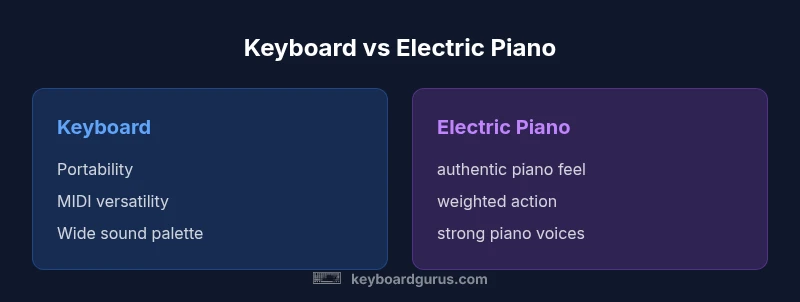
According to Keyboard Gurus, choosing between a keyboard and an electric piano depends on use-case and goals. If you prioritize portability, broad MIDI control, and affordable tones, a modern keyboard is the practical choice. If you seek authentic hammer-action feel, piano-like dynamics, and built-in acoustic-sounding tones, an electric piano better serves serious practice and performance.
Core Distinctions: Keyboard vs Electric Piano
In the world of home studios, classrooms, and stages, the phrase keyboard vs electric piano is a frequent dilemma for players at all levels. A Keyboard Gurus approach starts by clarifying definitions: a keyboard is a versatile, usually portable instrument designed for MIDI control, synthesis, and a broad range of built-in voices. An electric piano, by contrast, emphasizes piano realism with weighted or semi-weighted keys, more authentic timbres aimed at replicating the acoustic piano feel. This distinction matters because it sets expected use-cases, maintenance, and compatibility. The keyboard shines in modern music workflows—DAW integration, sample libraries, and live triggering—whereas the electric piano excels for focused piano practice, performance continuity, and tone that mirrors an acoustic instrument. For players who need both worlds, understanding keyboard vs electric piano helps narrow features such as action, polyphony, speaker quality, and connectivity. Keyboard Gurus notes that beginners often start with a keyboard for money and space reasons, then upgrade to an electric piano as practice demands grow and realistic touch becomes non-negotiable. The distinction is practical: it guides not just sound, but how you’ll interact with the instrument across genres and settings.
Key Factors: Touch, Sound, and Action
Touch sensitivity, key action, and the way the instrument responds to your playing dynamics are central to the keyboard vs electric piano decision. A keyboard usually features synth-action or light, speed-sensitive keys designed for rapid passages, sampling, and live triggering. Many models offer velocity curves, aftertouch, and ease of use with DAWs, making them ideal for programming, layering, and performance where thumb-driven parts dominate. An electric piano focuses on a feel closer to a grand piano. This often means weighted, graded weighted-action keys that simulate hammer movement and heavier touch response near the lower registers. The improvement here is tactile realism: you can develop a practice routine that maps to dynamics just like an acoustic piano. Both types can offer 88-key layouts, but the feel and rebound differ. When evaluating keyboard vs electric piano, test how chord blocks respond, how sustain behaves, and whether the action encourages or discourages a proper hand position. If you plan to record piano-centric pieces, the electric piano’s touch texture may prove decisive. For composing and producing with virtual instruments, a keyboard’s MIDI control remains a major advantage. Keyboard Gurus consistently emphasizes that the user’s workflow should drive the decision, especially for players who perform live or work with multiple DAWs.
Sound Engines and Polyphony
The sound engine—how the instrument produces tones—and polyphony capacity are core to the keyboard vs electric piano comparison. Keyboards often use digital samples and advanced synthesis to recreate a wide array of instruments, from synth pads to percussion and bass voices. They excel at versatility: you can layer sounds, split the keyboard into zones, or map different timbres to each hand. Polyphony on keyboards can be very high on premium models, ensuring sustained notes and complex chords do not drop voices during dense passages. Electric pianos, on the other hand, aim for high-fidelity piano voices. They rely on sampled pianos or carefully modeled tones that simulate harmonic overtones and dynamic response. In practice, the electric piano delivers a more consistent piano tone across the keyboard, with less concern about constructing non-piano textures. If your repertoire includes orchestral or pop arrangements with many synth lines, a keyboard’s expansive palate is a strong argument in its favor. If your focus is performing piano repertoire or piano-led arrangements, the electric piano’s tonal accuracy and dynamic response often outweigh the broader sonic catalog offered by many keyboards. Keyboard Gurus highlights that the decision hinges on whether your project requires a wide instrument palette or a faithful piano experience.
Portability, Power, and Build Quality
Portability and power are practical considerations that frequently tip the balance in the keyboard vs electric piano debate. Keyboards tend to be lighter, more compact, and easier to transport for jam sessions, gigs, and travel practice. They typically run on AC power, with some models supporting battery operation, which is a boon for buskers or students without reliable power access. In terms of build, keyboards often prioritize portability with plastic chassis, while electric pianos may adopt sturdier cases and slightly heavier frames to emulate an acoustic instrument’s heft. Weight is a real-world factor: lighter instruments enable faster setup and teardown, but may compromise speaker quality and keyboard stability in rough performance environments. If you prioritize stage friendliness and frequent repositioning, a high-quality keyboard can keep your rig agile. Conversely, if your use-case involves long practice sessions at home or on a fixed stage, an electric piano’s robust construction and louder onboard amplification might be more satisfying. Power management also matters: some electric pianos include built-in amplification and dedicated outputs, which can reduce the need for external gear but add to the overall footprint. When contrasted with keyboards, the electric piano’s structural emphasis on realism can come at the expense of portability.
Practical Scenarios: Genres, Settings, and Handedness of Use
Because the keyboard vs electric piano decision is not one-size-fits-all, practical scenarios help illuminate the best choices. A keyboard is often the best fit for bedroom producers, hobbyists, and students who need flexible tones, drum patterns, and MIDI integration with minimal gear. Its compact footprint pairs well with desks and shared workspaces, enabling rapid experimentation with different genres, from EDM to pop. For live performers and studio players who require a reliable piano-like feel under pressure, the electric piano tends to win. Its action encourages consistent fingering habits, which translates to better control during dynamically complex pieces. In terms of pedagogy, beginners frequently start with a keyboard to learn basics and rhythm, then graduate to an electric piano to develop technique and touch. For game-streamers or musicians performing keyboard-centric sets, the keyboard’s versatility and connectivity make it a practical centerpiece. Keyboard Gurus recommends mapping your instrument choice to your daily workflow and the environments where you play most often. A thoughtful comparison of your typical tasks, practice routines, and performance settings will reveal which instrument better aligns with your goals.
How to Choose: A Step-by-Step Guide
When you’re ready to decide between keyboard vs electric piano, follow this practical, step-by-step approach. Step 1: Define your primary use. Is the instrument for practice, performance, or production? Step 2: Set a realistic budget that includes accessories (stands, sustain pedals, headphones). Step 3: Test touch and weight. Try both weighted and synth-action keys, paying attention to hand fatigue and posture. Step 4: Check connectivity: MIDI over USB, sustain pedal compatibility, and DAW integration. Step 5: Evaluate built-in voices. For piano work, prioritize realistic piano samples and response; for broader production work, prioritize timbral variety and effects. Step 6: Consider future needs, such as backward compatibility with older gear or new software. Step 7: If possible, test in a real-world setting (stage, studio, or classroom) to feel the instrument’s resonance and reliability. This method keeps the keyboard vs electric piano decision grounded in your actual activity. Keyboard Gurus underscores that the best choice is the one that integrates smoothly into your creative workflow, not the one that sounds best in isolation.
Maintenance and Longevity: Caring for Your Keyboard or Electric Piano
Maintenance affects the long-term satisfaction of either option in the keyboard vs electric piano comparison. Regular cleaning helps preserve key surfaces and prevent sticky action. Use a soft brush to remove dust from the keybed and ensure no debris interferes with key movement. For electronic components, keep the device away from moisture and clear vents of dust; use a dry microfiber cloth to wipe surfaces. If your instrument has weighted action, keyboard gurus advise checking the keybed screws periodically to maintain balance and even rebound. For electric pianos with built-in amplifiers, monitor the power supply and avoid running at maximum volume for extended periods to prevent overheating. Software updates, firmware revisions, and proper firmware management also contribute to long-term reliability, especially for keyboards that rely on DAW integration and USB communication. Finally, protect your investment with a sturdy stand and an appropriate cover when not in use, reducing exposure to humidity and temperature changes that could affect electronics or wood components. Smart maintenance prolongs the satisfaction of both options and helps ensure your keyboard vs electric piano continues to meet evolving musical demands.
Comparison
| Feature | Keyboard | Electric Piano |
|---|---|---|
| Primary purpose | Versatile MIDI controller and performance keyboard | Piano-focused with authentic feel and built-in tones |
| Key action | Synth/velocity-sensitive, often lighter and faster | Weighted hammer-action or graded weighted action |
| Sound engine | Digital samples, synthesis, broad instrument library | Acoustic piano emulation or high-quality electric piano voices |
| Polyphony | High polyphony on premium models, depending on range | Sufficient polyphony for piano-centric parts |
| MIDI/connectivity | Extensive MIDI, USB, sustain/expression pedal support | MIDI via USB with varying expansion options |
| Portability | Lightweight, compact, travel-friendly | Heavier due to cabinet-like construction |
| Price range | Low to mid-range for beginners; higher with advanced features | Mid to high for authentic action and built-in speakers |
| Best for | Learning, DAW work, stage performance with MIDI control | Authentic piano practice and tonal realism |
Advantages
- Portability and light weight aid travel and setup
- Broad MIDI compatibility and software integration
- Wide range of voices, effects, and learning features
- Often more affordable entry points for beginners
Drawbacks
- Action and feel may be less realistic for piano purists
- Some models have limited onboard amplification
- High-end piano realism can be expensive on keyboards
Keyboard is best for versatility and MIDI work; electric piano excels in authentic piano feel
If you need flexible sound design and portability, choose a keyboard. If you want piano-like touch and tone, an electric piano is the better long-term choice for piano-focused practice.
Got Questions?
What is the key difference between a keyboard and an electric piano?
The keyboard emphasizes versatility, light action, and MIDI flexibility, while an electric piano focuses on piano-like touch and tones. Your choice depends on whether you need broad sound design or authentic piano feel.
The key difference is versatility versus piano realism. If you want flexible sounds and easy DAW integration, pick a keyboard; if you want touch and tone close to an acoustic piano, choose an electric piano.
Can a keyboard replace an electric piano for piano lessons?
A keyboard can cover basic piano concepts, but many teachers prefer weighted action for realistic technique. If the goal is precise finger control and pedal technique, an electric piano is typically better.
Yes for basics, but for serious technique, an electric piano is usually better.
Is weighted action essential for beginners?
Weighted action helps develop proper finger technique, but many beginners succeed on lighter-action keyboards. Start with comfort, then switch if technique demands closer piano feel.
It helps technique, but comfort matters first.
Do both require external amplification?
Many electric pianos have built-in speakers adequate for practice, while most keyboards also include speakers. For larger venues, you’ll likely rely on external amplification or PA systems.
Most have built-in speakers, but bigger gigs may need extra amps.
Which is better for stage performances?
For broad versatility, a keyboard is often preferred for live setups due to lighter weight and more sound-shaping options. If your set centers on piano pieces, an electric piano provides more authentic feel.
Stage gigs favor keyboards for versatility; piano sets favor electric pianos for realism.
What should I try before buying?
Test action, weight, keybed responsiveness, and the tone in real-time. Check DAW compatibility, MIDI features, and the quality of onboard tones. If possible, play with headphones and external speakers.
Test feel, sounds, and connections with your setup before buying.
What to Remember
- Define primary use before buying: MIDI versatility vs piano realism
- Test action types to ensure comfortable technique and posture
- Evaluate connectivity for studio or live setups
- Consider long-term value: base features now, room to grow later
- Prioritize maintenance and protective gear to extend lifespan