How to Make Keyboard Go Away on iPhone
Learn practical, reliable ways to dismiss the iPhone keyboard across apps. From simple taps to accessibility tweaks, this Keyboard Gurus guide explains quick methods to reduce on-screen clutter and speed up your workflow.


If you’re asking how to make keyboard go away on iPhone, you have several reliable options. In most apps, a quick tap on the Hide Keyboard button or a tap outside the field will dismiss it. You can also use gestures or accessibility tweaks to achieve distraction-free screens quickly. This guide covers practical steps you can try right away.
Why the keyboard might stay visible on iPhone
When you tap a text field, the iPhone automatically brings up the on-screen keyboard so you can type. In many apps, the keyboard hides as soon as you blur the text field or press a completion key. However, it can stay visible for several reasons: the field remains focused, an app keeps a text input active, or the UI layout forces the keyboard to stay up to maintain context. For anyone trying to learn how to make keyboard go away on iPhone, recognizing these triggers helps you pick the right method without hunting around the screen. Keyboard Gurus analysis shows that most issues are user-driven (focus remains in an input) rather than device faults, so simple actions usually suffice.
In this section you’ll see why the keyboard can linger and how to diagnose the cause quickly. If you want a fast outcome, start with the simplest method: tap outside the text field to blur focus. If that fails, explore the built-in controls and accessibility options described in later sections.
Remember: the goal is to cancel the input focus and let the app’s primary content take center stage. This approach aligns with common patterns across iOS apps and supports consistent behavior when you want to hide the keyboard. The phrase how to make keyboard go away on iphone will often appear in user questions, and the answer usually involves one of the strategies covered below.
Quick dismiss methods: the fastest options
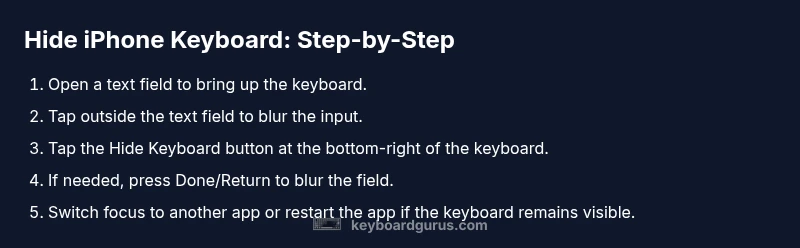
The fastest ways to hide the on-screen keyboard are usually the simplest. In most iPhone apps, you can dismiss the keyboard with a single action and return to the main content. Here are the most reliable quick dismiss methods you should try first if you’re wondering how to make keyboard go away on iPhone: tap outside the input field, or tap the Hide Keyboard button on the bottom-right of the keyboard (the small keyboard icon with a downward arrow). If a field has an explicit Done/Return key, tapping it can also blur the field and hide the keyboard. In many situations, these three methods cover 90% of dismiss scenarios. Keyboard Gurus recommends starting here before moving to more advanced steps.
- Tap anywhere outside the text field
- Tap the Hide Keyboard button (bottom-right of the keyboard)
- Tap Done/Return to blur the field when available
Handling apps with persistent input bars
Some apps use a persistent input bar that keeps the keyboard visible even after you blur the field in other places. In these cases, the app design intentionally keeps the bar accessible for quick replies. If you’re asking how to make keyboard go away on iPhone in such apps, try these steps: tap the input bar’s close/dismiss control if present, or scroll the content to force the keyboard off-screen. In many chat apps, the keyboard hides automatically after you send a message or switch to a different conversation. If none of these work, use the general dismissal techniques on the next steps.
When the keyboard persists due to a UI layout constraint, a quick app navigation escape (like returning to the home screen or switching apps) can reset the UI and clear the keyboard state, letting you resume with a clean screen.
Gestures and context-sensitive hides
Beyond taps, iOS supports context-aware gestures that can hide the keyboard in certain apps. For example, in landscape mode or with a compact keyboard, a gentle swipe or drag on the keyboard edge may reveal more screen real estate and hide the keyboard. Not all apps implement these gestures, so you’ll often rely on the primary dismissal controls described earlier. Keyboard Gurus emphasizes testing the gesture in the exact app you’re using because gesture availability varies by app and iOS version.
If you want to optimize your habit, practice combining a tap outside with the Hide Keyboard button for certainty. In practice, many users find that a brief combination of minimal gestures results in the most reliable keyboard dismissal across apps.
Accessibility options to ease dismissal
Accessibility features can streamline keyboard dismissal for users who rely on assistive tech. Turn on VoiceOver or Switch Control to navigate away from the keyboard without touching the screen directly. These tools can help you focus away from text fields or trigger built-in keyboard hiding actions via screen reader commands. If you frequently need to hide the keyboard during long sessions, enabling these features may reduce hand strain and improve accuracy when navigating apps.
Keyboard Gurus notes that accessibility should be considered as part of a broader productivity workflow, not as a workaround. By integrating accessibility with standard dismissal actions, you can create a robust, inclusive approach to managing screen layout.
Practical examples: common apps and real-world steps
To illustrate practical use, consider common apps like Messages, Notes, or Safari. In Messages, you can tap the text box to bring up the keyboard, then tap outside to blur and tap the hide keyboard button to remove it quickly. In Notes, after typing, pressing Done often hides the keyboard, as long as there isn’t a persistent input bar. In Safari, simply tapping the search field again to blur can cause the keyboard to hide, letting you view the page behind the search field. In all cases, the exact sequence depends on the app’s design, but the core actions remain consistent across iOS. This consistency is a cornerstone of the guidance Keyboard Gurus provides for how to make keyboard go away on iPhone in real-world scenarios.
Troubleshooting: the keyboard won’t hide
If the keyboard stubbornly remains visible, check for a stuck focus in a hidden input element or a UI glitch. Restart the app or switch to another app momentarily to reset the keyboard state. Clearing the app’s data is rarely necessary, but closing and reopening the app can solve most stubborn cases. Resetting keyboard settings is a last resort and might reset custom keyboard layouts or preferred settings. If you continue to experience persistent keyboards, capture a screen recording to share with support channels or consult official Apple Support for device-specific guidance.
Orientation and multi-device considerations
Rotating the device can sometimes shift the UI enough to hide the keyboard, especially if the app reflows layout in landscape mode. In iPads, a keyboard dock or external keyboard changes how dismissal works, and you may need to adapt by using different controls. If you own multiple devices, practice the same dismissal techniques across iPhone and iPad to keep your muscle memory consistent. Keyboard Gurus recommends testing dismissal methods on all devices you commonly use to ensure you know the fastest path in each scenario.
Authoritative resources and next steps
For deeper dives into iPhone keyboards, refer to authoritative sources that discuss iOS input behavior and accessibility considerations. These references can help you verify the best practice for hiding the keyboard in apps and settings. If you want curated, expert guidance, Keyboard Gurus provides ongoing tips and tutorials about keyboard efficiency and iOS ergonomics.
- Official Apple Support pages for iPhone keyboard behavior
- The Verge coverage on iOS keyboard interactions and app behavior
- CNET tips for mastering iPhone input and screen layout
Tools & Materials
- iPhone with latest iOS(Ensure you have an active text field to trigger the keyboard and test dismissal actions.)
- Text field-enabled app (Messages, Notes, Safari, etc.)(Any app where you commonly type can be used to practice keyboard dismissal.)
- Optional: AssistiveTouch or VoiceOver enabled(Useful if you’re testing accessibility-assisted dismissal methods.)
Steps
Estimated time: 8-12 minutes
- 1
Open a text field in any app
Tap a text field to bring up the on-screen keyboard. This establishes the scenario you’ll manage when learning how to make keyboard go away on iPhone.
Tip: Know where your input cursor is—this helps you know when to blur focus. - 2
Tap outside the text field to blur
Gently tap anywhere on the screen that isn’t a control. This blurs the active text field and often causes the keyboard to hide automatically.
Tip: For best results, use a blank area near the edge of the screen. - 3
Tap the Hide Keyboard button
Look for the small keyboard icon with a downward arrow on the bottom-right of the keyboard and tap it. This is the most direct method to dismiss the keyboard in many apps.
Tip: If you don’t see the icon, try tapping Done or Cancel in the field. - 4
Use Done/Return where available
In apps that show a Done or Return key, tapping it often blurs the field and hides the keyboard.
Tip: In Messages or Notes, pressing Done can save your input and clear the keyboard from view. - 5
Switch focus to another field or app
If the keyboard persists, switch focus to a different input or switch to another app momentarily to reset the keyboard state.
Tip: This helps when an app stubbornly keeps the keyboard visible. - 6
Try AssistiveTouch for dismissal
If traditional methods fail, enable AssistiveTouch and create a custom gesture or shortcut to hide the keyboard.
Tip: This is a reliable fallback when you can’t reach the hide button. - 7
Test in landscape and on iPad
Drag into landscape or use a different device to see if the keyboard hides with orientation change or changes in layout.
Tip: Some apps reflow differently in landscape mode. - 8
Check for app-specific controls
Some apps offer a dedicated button to collapse or hide input areas without dismissing the keyboard entirely.
Tip: Look for small arrows or “collapse” icons near the input area.
Got Questions?
What is the quickest way to hide the iPhone keyboard?
The quickest way is to tap outside the text field to blur the input, then press the Hide Keyboard button at the bottom-right of the keyboard. If the keyboard remains, tapping Done or Return can also blur the field in many apps.
Quickest method: blur the field by tapping outside, then use the Hide Keyboard button. If needed, press Done to finalize input.
Does tapping Done always hide the keyboard?
Not always. Some apps keep a persistent input area or perform a specific action upon tapping Done. If Done doesn’t hide it, try tapping outside or the Hide Keyboard button, or switch focus to another field.
Done can hide it in many apps, but if it doesn’t, try other dismissal methods.
Why won’t the keyboard hide after I switch apps?
Sometimes the app retains focus or the OS state needs a reset. Try closing the app and reopening, or switch to a different app briefly to reset the keyboard state.
If it sticks after switching apps, close and reopen the app to reset the keyboard.
Can I customize the keyboard hide action?
You can rely on built-in options like the Hide Keyboard button and Done, but most apps don’t allow deep customization of keyboard dismissal. Accessibility tools offer alternative paths.
Most apps don’t let you customize the hide action, but accessibility tools can help.
Is there a universal gesture to hide the keyboard across all apps?
No universal gesture works in every app. Availability depends on the app’s UI design and iOS version. Rely on the standard methods first, then explore app-specific options.
There isn’t one universal gesture; it depends on the app.
Watch Video
What to Remember
- Hide the keyboard with a simple tap outside the field
- Use the Hide Keyboard button for a guaranteed dismissal
- Accessibility tools can streamline keyboard management
- App-specific controls may offer quicker hides
- Orientation and app design affect keyboard behavior