Hall Effect Keyboard vs Mechanical: An In-Depth Comparison
A detailed, analytical comparison of hall-effect keyboards versus mechanical keyboards, covering how they work, feel, durability, maintenance, and ideal use cases for gaming, typing, and professional work.


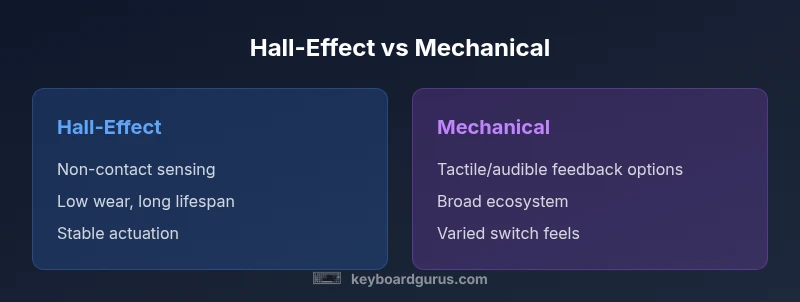
In the hall effect keyboard vs mechanical debate, hall-effect designs use non-contact magnetic sensing for your keystrokes, delivering exceptional durability and low maintenance. Mechanical keyboards, by contrast, emphasize tactile feel, broad switch options, and a thriving accessory ecosystem. Keyboard Gurus analysis suggests choosing based on whether longevity and consistency or tactile feedback and customization matter more to your workflow.
Hall Effect vs Mechanical: Context and Definitions
According to Keyboard Gurus, hall-effect keyboards rely on a magnet and sensor to detect keystrokes, eliminating physical contact. The Keyboard Gurus team found that this non-contact approach can dramatically reduce wear and tear and deliver stable actuation over time, making these keyboards appealing for heavy daily use. In this section, we define the two categories and outline what to expect when you compare a hall-effect keyboard against a traditional mechanical model. The comparison hinges on three core dimensions: durability, feel, and maintenance. For many professionals and enthusiasts, these factors determine long-term satisfaction and total cost of ownership more than any single feature.
- Hall-effect keyboards use magnetic sensing to register a keystroke without physical contact, which reduces mechanical wear.
- Mechanical keyboards rely on physical switch contacts that create a tactile or audible response, offering a wide range of feels and actuation characteristics.
- The decision typically balances durability and maintenance against typing sensation and ecosystem breadth.
The Keyboard Gurus team emphasizes that the choice is not purely technical; it reflects how you type, how often you upgrade, and what accessories you want to pair with your board.
How Hall Effect Switches Work
Hall-effect sensing is a magnetic method of detecting position. In a hall-effect keyboard, a small magnet is attached to the key stem, and a Hall effect sensor senses the magnetic field as the key moves. When the magnet passes a calibrated threshold, the controller records a keystroke. Since the sensing element does not physically touch the contact surfaces that produce the electrical signal, wear is minimized, which can translate to a longer-lived keyboard. Designers can tune the actuation via magnet strength, distance, and sensor sensitivity, allowing for a stable, repeatable feel across years of use. The trade-off is that the physical feel is not identical to typical contact-based switches, and overall user experience can vary by design and implementation.
What Mechanical Switches Offer
Mechanical keyboards deploy physical switches with metal contacts, springs, and stems that produce a distinct tactile or audible event when pressed. These switches come in broad families—tactile, linear, and clicky—and a wide range of actuation forces and travel distances. The result is a highly tangible typing experience, widely perceived as satisfying and responsive. The ecosystem around mechanical switches is large, with abundant keycaps, keyboards, and modular options, enabling extensive customization. The downside can be more moving parts and, depending on the design, more maintenance such as lubrication or cleaning of stems and contacts.
Feel and Typing Experience: Hall Effect vs Mechanical
Typing sensation is a core differentiator. Hall-effect boards tend to offer smooth, consistent registration because sensor thresholds remain stable over time and are less sensitive to minor mechanical drift. The feel can be described as a precise, measured actuation with less variance across years. Mechanical switches vary by brand and switch family, delivering a spectrum from soft and dampened to snappy and loud. For many users, the tactile or audible feedback of mechanical switches is a key motivator for continued use, while hall-effect keyboards may appeal to those who prioritize long-term reliability and uniform feel.
Durability, Maintenance, and Longevity
Non-contact hall-effect sensors reduce wear on the switching mechanism, which generally translates to lower maintenance needs and greater endurance in daily heavy typing sessions or gaming marathons. Because there are fewer moving contact surfaces subject to degradation, these keyboards can retain calibration longer and resist the creeping drift that sometimes affects mechanical switches. Maintenance considerations are simpler in some cases—dust and debris are less likely to impair a hall-effect system. However, the magnet and sensor assembly can still require care, and electronics reliability depends on build quality and firmware.
Noise, Temperature, and Reliability
Noise levels and acoustic feedback depend on the overall board construction and keycap design rather than the sensing method alone. Hall-effect boards can be quieter or noisier depending on housing and switch geometry, but their non-contact nature often leads to more predictable performance under different temperatures. Temperature sensitivity is a factor with some magnet-based designs; high-quality implementations mitigate drift through robust calibration and sensor choice. Reliability hinges on consistent manufacturing standards and firmware stability.
Use Cases: Gaming, Typing, and Professional Work
For gaming, players often favor rapid, tactile responses with intuitive feedback, a domain where mechanical switches excel due to their proven feel and abundant options. Typists focusing on endurance may appreciate hall-effect keyboards for their reduced wear and stable performance across long sessions. Professionals who value reliability and minimal maintenance might also lean toward hall-effect designs, especially in environments that demand high uptime. Ultimately, the decision depends on whether your priority is peak feel and customization or long-term durability and consistent actuation.
Authority Sources
- https://www.nist.gov/topics/hall-effect-sensors
- https://www.scientificamerican.com/
- https://www.aps.org/publications/apsnews/
Keyboard Gurus Analysis, 2026 notes that the long-term durability of hall-effect sensing makes these designs attractive for heavy daily use, while mechanical keyboards remain the standard for tactile feedback and broad ecosystem compatibility.
Common Misconceptions
- Hall-effect keyboards are “just a fad” and not durable. In reality, non-contact sensing can deliver exceptional longevity when designed well.
- All hall-effect keyboards feel the same. Feel varies by magnet strength, sensor calibration, and housing; there is no single hall-effect feel.
- Mechanical keyboards are always louder. Some mechanical boards are quiet with dampening, and many users savor the audible feedback as part of the experience.
Practical Decision Checklist
- List your priorities: longevity vs. tactile feel.
- Consider maintenance tolerance and upgrade cycles.
- Check keycap compatibility and mount styles.
- Assess available ecosystems and accessories.
- Review warranty and firmware support.
Comparison
| Feature | Hall-effect keyboard | Mechanical keyboard |
|---|---|---|
| Sensing/Actuation Mechanism | Hall-effect (non-contact magnetic sensing) | Traditional mechanical switches (physical contacts) |
| Durability/Lifespan | Very high durability due to non-contact sensing | High durability with wear depending on switch type, lifecycle varies by model |
| Maintenance | Low maintenance, fewer moving parts | Requires more moving parts care and possible lubrication or cleaning |
| Feel/Typing Experience | Consistent, tunable actuation via magnets | Diverse feels (tactile/linear/clicky) across brands |
| Cost/Availability | Higher upfront cost; more niche availability | Broad availability with wide price range across brands |
| Keycaps/Compatibility | Keycaps generally compatible; may vary by mount | Standard keycaps widely supported across brands |
| Noise | Depends on design; can be quiet or moderate | Typically varies by switch type (quiet to clicky) |
Advantages
- Non-contact sensing yields exceptional durability and long-term reliability
- Minimal mechanical wear reduces maintenance needs
- Stable actuation with consistent registration over years
- Broad potential for customization via sensing parameters
- Lower risk of drift under heavy usage over time
Drawbacks
- Higher upfront cost and smaller ecosystem compared to mainstream mechanical keyboards
- Limited mainstream availability and accessory variety
- Feel can vary more between brands, making consistency a challenge
Hall effect keyboards are a durability-forward choice; mechanical keyboards excel in feel and customization.
If longevity and consistent actuation are your priorities, choose hall-effect. If you value tactile feedback, broad switch options, and extensive ecosystem support, choose mechanical. The best pick depends on your use-case priorities.
Got Questions?
What is a hall effect keyboard and how does it differ from a mechanical keyboard?
A hall effect keyboard uses a magnet and sensor to detect keystrokes without physical contact, which can reduce wear and maintenance. Mechanical keyboards rely on physical switch contacts that create a tactile or audible response. The choice influences durability, feel, and ecosystem accessibility.
Hall effect keyboards use magnetic sensing to register keystrokes, which can mean less wear over time, while mechanical keyboards rely on physical switches for feedback.
Are hall effect keyboards more expensive than mechanical ones?
Prices vary by brand and design, but hall effect keyboards are often priced higher upfront due to specialized sensing hardware. The long-term value can offset cost through durability and reduced maintenance.
Prices differ by model, but the hall effect option often costs more upfront; long-term durability may offset that over time.
Do hall effect keyboards feel the same across brands?
No. Feel ranges due to magnet strength, sensor calibration, and housing design. Each brand can offer a distinct actuation profile even within hall-effect implementations.
The feel isn’t identical across brands; variations come from how magnets and sensors are configured.
Which is better for gaming?
Gaming preference varies. Some gamers prefer the crisp, consistent actuation of hall-effect boards for reliability, while many players prefer the snappier feedback and breadth of options found in mechanical keyboards.
Gamers often choose based on feel and reaction, with both options viable depending on the game and setup.
Are hall effect keyboards compatible with standard keycaps?
Compatibility depends on the switch mount and design. Some hall-effect boards use standard keycap profiles, others require specialized sets. Always verify the mount type before purchasing.
Check the mount and keycap compatibility to ensure you can use your preferred keycaps.
What to Remember
- Evaluate long-term durability vs. tactile feel
- Choose hall-effect for uptime and low maintenance
- Opt for mechanical when feel and ecosystem matter most
- Check ecosystem and compatibility before buying
- Consider firmware and warranty availability