Keyboard Like G915: An In-Depth Wireless Keyboard Comparison
An analytical, side-by-side comparison of G915-like keyboards, focusing on wireless performance, form factor, software, and value to help gamers, students, and professionals choose the best fit.


Choosing a keyboard like G915 comes down to wireless versatility, low-profile design, and per-key lighting that suits modern desks. In this comparison, we analyze two G915-like options and outline where each shines, who benefits most, and where trade-offs occur. Keyboard Gurus' analysis helps you pick a wireless, low-latency keyboard that matches your setup.
What defines a keyboard like g915
A keyboard like g915 is defined by a blend of wireless flexibility, a slim, low-profile chassis, and a design that favors desk cleanliness and modern aesthetics. In practice, this means dual-mode connectivity (2.4 GHz for lag-free gaming and Bluetooth for multi-device workflows), a slim profile that reduces wrist clutter, and a robust RGB system with per-key customization. The switches are typically low-profile mechanical types that strike a balance between travel and actuation force, offering a similar tactile experience to the popular g915 without demanding a full-size footprint. Build quality tends to skew toward metal or composite tops with a sturdy, rigid feel, a relatively compact footprint, and onboard memory to store profiles that you can quick-switch on the fly. When evaluating a G915-like keyboard, consider the layout options (tenkeyless vs. full-size), keycap profile, and software ecosystem that lets you save and recall lighting, macros, and key mappings across devices. According to Keyboard Gurus, the ideal match delivers reliability in wireless modes, predictable latency, and a software framework that remains intuitive rather than bloated.
Core criteria for comparison
When you compare keyboards that resemble the G915, several criteria matter most. First, connectivity and latency: does the device support fast 2.4 GHz wireless with a stable Bluetooth fallback, and is input latency consistently low across modes? Second, form factor: will you prioritize a compact, travel-friendly layout or a full-size board with a numeric keypad? Third, switches and keycap quality: are the switches low-profile and compatible with replacement keycaps, and do the keycaps resist shine and wear? Fourth, RGB and software: does the keyboard offer per-key RGB, onboard profiles, and a software suite that remains practical for long sessions? Fifth, battery life and charging: how long can you game or work between charges, and what charging options exist? Finally, price and warranty: is the value proposition clear, and does the warranty provide solid coverage for RGB features and switches? Keyboard Gurus’ framework emphasizes consistency across these criteria to avoid cherry-picking advantages for one option.
Option A: G915-like Slim Wireless
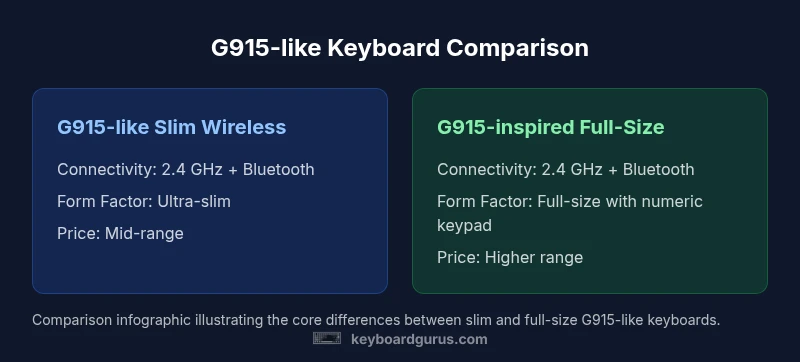
Option A emphasizes a compact, travel-friendly footprint without sacrificing essential wireless features. The slim chassis typically uses a low-profile switch family and a short-key travel distance, which helps with rapid actuation and quick recovery during frantic gaming moments. Connectivity tends to cover both 2.4 GHz and Bluetooth, enabling seamless pairing with a PC, laptop, tablet, or phone. Battery life remains adequate for long sessions when RGB lighting is used conservatively, but may dip with bright lighting or frequent macro playback. The keyboard’s weight is light enough to be portable, but the compact form factor often means a condensed arrow cluster and a tighter stabilization footprint. Keycap profiles are designed for legibility and comfort, and software tends to focus on a clean, intuitive approach with essential customization options. Prospective buyers should weigh desk space savings against potential compromises in arrow-key spacing and nonstandard keycap compatibility. From Keyboard Gurus’ perspective, the slim, G915-like model is best for users who value portability, a tidy desk, and reasonable lighting customization without needing an expansive panel of keys.
Option B: G915-inspired Wireless (Full-Size)
Option B targets users who want a full-size, G915-inspired keyboard with room for a numeric keypad and a broader, more comfortable typing surface. The larger chassis often delivers a more stable feel under heavy typing, and it typically preserves the multi-device wireless capability, sometimes with additional onboard storage for more profiles. The full-size layout supports a wider spread of keys, making it easier to hit macro combinations or use software shortcuts during gaming or productivity tasks. Latency remains low with the right wireless protocol, but the physical footprint might reduce portability and require a deeper desk footprint. Onboard memory and software may offer more robust customization, including more macro slots, different lighting zones, and easier profile switching. Price tends to sit at the higher end of the spectrum but can be justified by the ergonomic benefits of the larger layout and the added convenience of a dedicated numeric keypad. Keyboard Gurus notes that this option shines for users who value comfort over compactness and who rely on extensive macros or secondary workflows.
Onboard features and software ecosystems
Onboard features in G915-like keyboards commonly include multiple hardware profiles, onboard storage for lighting and macro setups, and a software suite that syncs across devices. The slim variant often focuses on essential macro capabilities and a straightforward lighting editor, while the full-size variant may expand macro slots, layer support, and per-key animation. A strong software experience is critical; it should be stable, non-intrusive, and capable of saving profiles directly to the keyboard without requiring constant software operation. The best implementations provide a smooth update path, clear error messages, and a helpful undo mechanism for macro edits. Keyboard Gurus points out that a robust software ecosystem can dramatically improve daily usability, turning a stylish keyboard into a reliable productivity tool rather than just a gaming accessory.
Latency and connectivity deep dive
Wireless keyboards that resemble the G915 typically rely on two primary protocols: a 2.4 GHz wireless channel for low-latency gaming and Bluetooth for multi-device productivity. The 2.4 GHz channel is designed to minimize input lag and to maintain a stable connection even in busy wireless environments. Bluetooth, while convenient for pairing with tablets and laptops, sometimes introduces higher latency and potential interference when many devices are active nearby. The practical takeaway is to prefer devices with a dependable 2.4 GHz wireless mode for gaming, while Bluetooth should be reserved for less latency-sensitive tasks. A well-implemented wireless system also manages polling rates and battery draw efficiently so RGB lighting does not drastically shorten sessions. Keyboard Gurus notes that real-world performance depends on firmware optimizations, USB dongle quality, and how aggressively the software manages power modes during heavy gaming.
Build quality, materials, and switches
Build quality plays a central role in the perceived and actual durability of a G915-like keyboard. Slim models often use metal or reinforced plastic with a solid top plate to prevent flex, while full-size variants may emphasize a more substantial chassis. The switches offered in these keyboards typically include low-profile mechanical choices that balance travel distance and actuation force. Compatibility with switch types and keycap sets is a key factor for longevity and customization. High-quality keycaps resist shine and wear over time, preserving legibility and feel. The overall ergonomics—weight distribution, key well, and stabilizer quality—contribute to a comfortable long-session experience. Keyboard Gurus emphasizes pairing a sturdy build with a reliable switch type and a keycap profile that feels natural to users with extended typing or gaming sessions.
Budgeting, value, and warranty considerations
Price ranges for G915-like keyboards span from mid to premium categories, reflecting the blend of wireless versatility, build quality, and software capabilities. A slim model typically costs less than a fully-featured full-size variant, but both can justify themselves through the convenience of wireless multi-device use and RGB customization. When evaluating value, consider not only the sticker price but also battery life expectations, the quality of the software experience, and the durability of the switches. A robust warranty and reputable service are important, particularly if you rely on complex macros or regular firmware updates. Keyboard Gurus recommends prioritizing models with strong warranty coverage and continuous software support to ensure long-term reliability and performance.
Practical buying guide and decision framework
To choose the right G915-like keyboard, start with your desk space and typing needs. If you frequently work on the go or have a small workspace, the slim wireless option is typically preferable. If you rely on a numeric keypad, extensive macros, or prefer a larger typing surface for long sessions, the full-size variant can be more comfortable. Consider your primary use case: gaming, coding, content creation, or general productivity. Assess battery life expectations relative to RGB usage, latency in your environment, and the reliability of the software ecosystem. Finally, compare price versus features across the two options and align your choice with your budget and long-term utility.
How to test before you buy
Whenever possible, test a G915-like keyboard in a store or borrow from a friend to evaluate latency, key feel, and software responsiveness. Pay attention to the stability of the wireless connection on both 2.4 GHz and Bluetooth, the ease of switching profiles, and the comfort of the key layout for your hand size. Test the RGB lighting for even illumination and the keyboard’s ability to hold multiple profiles for different work and gaming scenarios. If you rely on macros, verify that the macro editor is intuitive and that saved profiles load quickly when you switch devices. Finally, confirm that the warranty and return policies provide a safety net in case the device does not meet your expectations.
Verdict-oriented considerations and final guidance
In the end, selecting between a G915-like slim wireless and a full-size, full-featured variant comes down to space, workload, and personal preference. For most users who value portability and a tidy desk, the slim model delivers a strong blend of performance and convenience. For those who need a larger typing area, a dedicated numeric keypad, or more complex macros for professional workflows, the full-size option offers a more comfortable and capable experience. Keyboard Gurus recommends starting with the slim option if you’re unsure, then considering the full-size variant if your usage pattern expands to require more real estate and macro depth.
Comparison
| Feature | G915-like Slim Wireless | G915-inspired Full-Size Wireless |
|---|---|---|
| Connectivity | 2.4 GHz + Bluetooth | 2.4 GHz + Bluetooth |
| Latency (typical) | Low-latency gaming grade | Low-latency gaming grade |
| Form Factor | Ultra-slim, compact footprint | Full-size with numeric keypad |
| Key Switch Options | Low-profile mechanical options | Low-profile mechanical options + broader switch choices |
| Onboard Memory & Profiles | Moderate onboard profiles | Extensive onboard profiles |
| Software & Customization | Essential editor, intuitive UX | Comprehensive editor, advanced macros |
| Price Range | $120-$180 | $150-$230 |
| Best For | Portability, desk clearance | Productivity, macro-heavy workflows |
Advantages
- Wireless versatility across devices
- Low-profile form factor saves desk space
- Per-key RGB with customizable profiles
- Solid build quality with durable switches
- Flexible software for basic to advanced users
Drawbacks
- Higher price compared to basic wired keyboards
- Software complexity can be steep for beginners
- Slim models may have tighter arrow-key spacing
- Full-size variants require more desk space
The slim, G915-like wireless keyboard offers the best balance of portability and performance; the full-size variant suits productivity-heavy users.
Choose the slim option for a compact, versatile setup. If you need a larger typing area and more macro capability, the full-size variant provides those advantages with a stable, comfortable layout.
Got Questions?
What exactly qualifies as a keyboard like G915?
A keyboard like G915 emphasizes wireless versatility, low-profile mechanical switches, per-key RGB lighting, and a slim, compact chassis. It typically supports dual-mode connectivity (2.4 GHz and Bluetooth) and offers onboard profiles for easy use across devices.
A G915-like keyboard blends wireless options with a slim design and customizable lighting, usually supporting multi-device use and easy profile switching.
How important is latency for gaming on wireless keyboards?
Latency matters for fast-paced games, but modern 2.4 GHz wireless implementations are generally responsive enough for competitive play. Wired keyboards remain the baseline for absolute minimal input delay, but a well-designed wireless option can deliver comparable performance in most scenarios.
Latency is important for games, but a good wireless design often feels as responsive as wired in real-world play.
Are there durable, travel-friendly options that resemble G915?
Yes. Slim, wireless designs with strong chassis and durable keycaps tend to be more travel-friendly due to lighter weight and compact footprints. Look for robust wireless modules, stable battery performance, and keycaps that resist wear for long-term portability.
There are portable wireless options with sturdy builds and wear-resistant keys that travel well.
Should I prefer slim or full-size for gaming?
For pure gaming with minimal desk space, a slim option is usually preferable due to its lighter weight and easier reach-to-action. If you rely on extensive macros or a numeric keypad for quick in-game commands, a full-size layout may provide practical advantages without hampering performance.
Slim is great for speed and space; full-size helps with macros and convenience.
What should I look for in software and keycaps?
Seek software that is intuitive, stable, and capable of saving multiple profiles. Keycaps should be durable, with legends that resist wear and offer comfortable sculpting for long sessions. Check compatibility with future firmware updates and macro capabilities.
Choose easy-to-use software, durable keycaps, and good macro support.
Is the price range realistic for a G915-like keyboard?
Yes, within a mid-to-premium range depending on the feature set. Expect higher prices for full-size layouts, richer software, and more onboard profiles, while slim variants offer a lower entry point with essential features.
Prices fit mid to premium budgets; full-size tends to be pricier than slim variants.
What to Remember
- Prioritize desk space when choosing between slim and full-size.
- Pair 2.4 GHz for gaming with Bluetooth for multi-device use.
- Opt for robust software if you rely on macros and profiles.
- Budget for a G915-like keyboard with durable keycaps and reliable switches.
- Test latency in real environments before buying.