Keyboard vs Controller for Battlefront 2: An Analytical Comparison
An analytical guide comparing keyboard/mouse and controller setups for Star Wars Battlefront 2, with actionable tips, a side-by-side table, and setup recommendations for PC and consoles.


Keyboard and mouse offer superior precision and flexibility for Battlefront 2 on PC, while controllers excel in comfort and analog control, especially on consoles. The better choice depends on your platform, play style, and willingness to learn new bindings. Keyboard Gurus analyzes trade-offs to help you decide between rapid hotkeys and ergonomic control.
Context: is keyboard or controller better for battlefront 2
The question is is keyboard or controller better for battlefront 2? The answer depends on your platform, play style, and comfort with different input methods. Keyboard and mouse offer granular control over aiming and rapid hotkeys, which can tilt objectives that reward precision, map knowledge, and reaction speed. Controllers, by contrast, give smoother camera rotation, comfortable long sessions, and reliable performance without the need for a dedicated desk or mouse pad. Keyboard Gurus's framework for evaluating input devices considers cross-platform realities, game design features, and user ergonomics, ensuring the analysis applies to players who compete in ranked modes or who simply enjoy casual skirmishes. For players on PC, the keyboard/mouse combo is usually favored for precision and customization; on consoles, the controller remains the standard due to ergonomics and built-in aim assist. In Battlefront 2, your choice will influence how you manage cooldowns, weapon swaps, and situational awareness in firefights across space battles and ground battles. Throughout this guide, we examine strengths, weaknesses, and practical tips so you can decide which setup best supports your goals in the 2026 landscape.
Precision and responsiveness: Keyboard vs Controller
Precision and responsiveness are the core battlegrounds when choosing input devices for Battlefront 2. A keyboard and mouse on PC enables pixel-precise aiming, rapid weapon swapping, and a wider repertoire of mappings for cooldowns and specials. You can set DPI profiles to suit different character classes and roles, which translates into tighter control during peak moments in space battles or infantry skirmishes. Conversely, a controller emphasizes consistent, smooth input with analog sticks that feel natural during long sessions, especially when you’re navigating sprawling maps. The analog input can reduce abrupt jitter and help maintain steady tracking, which is particularly beneficial for players who favor a relaxed, methodical approach. The trade-off is that turning speed and fine-tuned aiming can feel less instantaneous than a mouse, particularly when you’re tracking fast targets. The decision hinges on your comfort with precision, your typical play pace, and whether your platform natively supports mouse input.
Aiming: Mouse precision and controller aim assist
Aiming quality often determines who wins gunfights in Battlefront 2. With a mouse, players enjoy fine-grained cursor control, allowing tiny adjustments that can be decisive in close quarters or when sniping at distance. In contrast, controller aim is assisted by built-in aim assist mechanisms on most consoles, which can stabilize targeting and reduce fatigue during longer fights. This means controller players might experience more forgiving tracking and easier long-range hits, but at the cost of absolute precision. On PC, if you disable aim assist in a competitive mode (where available) and rely on mouse input, you typically gain a precision edge. On consoles, aim assist can level the playing field for controller users yet may slightly blur micro-adjustments. Teams and tournaments that allow cross-platform play often need to establish norms around input fairness, which affects how you approach matchmaking and practice.
Movement and camera control: WASD vs joystick
In Battlefront 2, movement and camera control shape spatial awareness and reaction times. Keyboard users can execute rapid strafing, sprint toggles, and clambering maneuvers through dedicated keys, which can accelerate response times in tight engagements. The camera turns with precision using the right analog stick on controllers, but the underlying responsiveness depends on the controller model and latency. Some players prefer the tactile dead zones of controllers for consistency, while others enjoy the immediacy of keyboard-based movement. For space battles and ground battles alike, the choice affects how quickly you navigate cover, flank enemies, and orient yourself for aim while managing cooldowns. The key is to adopt a control scheme that minimizes hand fatigue and maximizes your situational awareness during extended play sessions.
Platform considerations: PC vs console experiences
Platform matters for input expectations. On PC, keyboard/mouse is often the default for Battlefront 2 because it leverages precision aiming, faster cooldown cycling, and deeper keybind customization. On consoles, controllers are the standard due to ergonomic comfort and the absence of native mouse support. That said, some consoles and games permit limited keyboard input via USB or Bluetooth adapters, but performance can be uneven and not officially supported. If you play predominantly on PC and enjoy tweaking bindings, you’ll likely feel more at home with a keyboard/mouse setup. If you’re more comfortable lounging on a couch with a controller, you’ll benefit from the smoother movement and ergonomic posture. Keyboard Gurus’s assessment emphasizes platform context, as the same game can feel dramatically different when played on a desktop versus a living room setup.
Ergonomics, setup, and long sessions
A practical concern is how comfortable you are after hours of play. Keyboard/mouse setups demand a desk, space for a keyboard, a mouse, and cable management, which can be ideal for a dedicated gaming room but less convenient for casual living-room play. Ergonomics also matter: wrist and shoulder strain from long sessions can be mitigated by ergonomic mice, split keyboards, and proper desk height. Controllers reduce postural strain by nature of their compact form and couch-friendly placement, but repetitive thumb movements and gripping can still cause fatigue. Think about your typical play sessions, the space you have, and whether you’re playing in short bursts or marathon sessions. The right setup minimizes fatigue and maximizes focus, especially in prolonged campaigns or competitive modes where consistency matters.
Customization, accessibility, and bindings
One major advantage of keyboard/mouse is the vast customization it enables. You can remap every key, set up complex macros, and fine-tune sensitivity to your preference, giving you tailored access to every ability, cooldown, and gadget. Accessibility features, such as large-key layouts or alternative bindings, help players with different needs participate at high levels. Controllers offer fewer keys but feature ergonomic layouts designed for long sessions, with customizable thumbstick grips and button mappings on many models. In both cases, accessibility matters: a comfortable, well-mapped interface reduces cognitive load and frees mental bandwidth for tactical decisions. Keyboard Gurus recommends starting with a core set of bindings, then gradually expanding to specialized macros or control schemes as you gain confidence.
Competitive play and real-world scenarios
In ranked modes and tournament settings, the input method can influence your performance trajectory. Keyboard/mouse players often excel in precise aiming and rapid cooldown management, which translates into competitive edge on PC. Controller players might leverage consistent aiming curves and smoother camera control to maintain steady performance during long sessions or in relaxed queues. Real-world practice, not theoretical capability, separates good from great players. Practicing with your preferred input method, studying map patterns, and refining your loadout strategy are crucial steps. Consider cross-training: try both methods for a few weeks to identify where your strengths lie and how you can adapt to different game modes or map types.
Practical setup tips: building your ideal kit
To maximize gains with whichever input method you choose, align your kit with your discipline and environment. If you opt for keyboard/mouse, invest in a responsive mouse with adjustable DPI, a comfortable mechanical keyboard, and a supportive chair. For controllers, select a model with reliable sticks, comfortable grips, and responsive buttons. Cable management matters for desk setups, while wireless options can improve living-room comfort but may introduce latency if not properly paired to the console or PC. Calibration steps—such as adjusting mouse sensitivity, calibrating aim assist (where applicable), and customizing hotkeys for critical abilities—are essential. In the end, your kit should reduce friction, not add complexity, so you can focus on map awareness, positioning, and teamwork during battles across space and ground maps.
When to choose keyboard versus controller for Battlefront 2
The best input choice aligns with platform, play environment, and personal preference. If you play primarily on PC and value precision, customization, and rapid input, keyboard/mouse is typically the stronger option. If you play on a couch, in a shared living space, or on a console, a controller offers ergonomic benefits and consistent performance. The transition between devices can be challenging, but gradual practice and a consistent setup will yield better results. Keyboard Gurus suggests a pragmatic approach: pick one setup for the majority of your sessions and occasionally practice the alternate method to stay adaptable in mixed-match scenarios.
Comparison
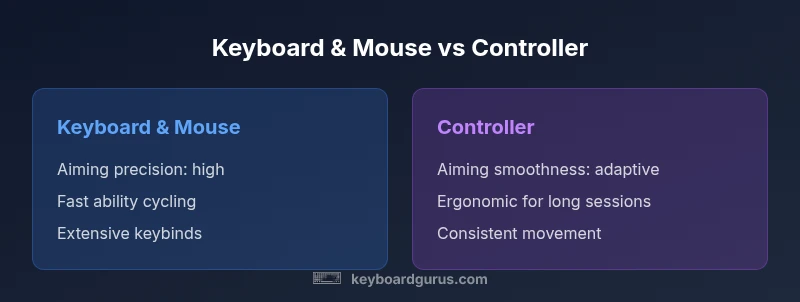
| Feature | Keyboard & Mouse | Controller |
|---|---|---|
| Aiming precision | High accuracy on PC with mouse | Steadier aiming with analog sticks; easing of tracking on consoles |
| Movement control | Rapid keyboard-based movement and hotkeys | Smooth analog movement with sticks; ergonomic control |
| Learning curve | Steep at first; many bindings to master | Gentle start; familiar layout for many players |
| Comfort & ergonomics | Desk setup; potential fatigue without breaks | Couch-friendly; lower desk dependence |
| Setup and space | Requires desk and peripherals | Requires minimal space; portable |
| Platform compatibility | Best on PC; broad customization | Best on consoles; native support for gamepad |
Advantages
- High aiming precision and customization with keyboard/mouse
- Extensive keybinds and macro potential for complex loadouts
- Fast cooldowns and weapon swaps via keyboard shortcuts
- Strong performance on PC with broad game support
- Better for players who enjoy deep config control
Drawbacks
- Requires desk setup and can dominate space
- Steeper learning curve for newcomers
- Potential for wrist/hand fatigue during long sessions
- Less ergonomic for couch-based play on console
Keyboard and mouse generally outperform controllers on PC for Battlefront 2 when precision and customization matter; controllers excel on consoles for comfort and ease of use.
Choose keyboard/mouse for PC workhorse accuracy and rapid macro-driven play. Choose a controller for couch gaming, comfort, and steady analog control. The right choice depends on platform, environment, and willingness to practice.
Got Questions?
Which input method provides higher aiming accuracy in Battlefront 2?
On PC, keyboard/mouse generally offers higher aiming precision due to pixel-level control and DPI customization. Controllers rely on analog sticks and aim assist on many consoles, which provides smoother tracking but less micro-precision. The best choice depends on your platform and comfort with bindings.
On PC, keyboard and mouse usually give you the sharpest aiming. Controllers are smoother but trade some precision for comfort and ease.
Is Battlefront 2 better played with keyboard/mouse on PC or a controller?
If you play mostly on PC, keyboard/mouse is typically favored for accuracy and customization. If you’re on a couch with a console, a controller offers ergonomics and stable control. The decision should match your primary platform and playing style.
On PC, go keyboard and mouse for precision; on consoles, use a controller for comfort and steady control.
Do keyboard remapping and macros help in Battlefront 2?
Yes, remapping buttons and using macros where allowed can streamline cooldowns and weapon swaps, reducing cognitive load during intense moments. Start with essential bindings and gradually expand as you grow more comfortable.
Remapping can speed up key actions, but start small to avoid confusion.
What’s a good starting setup for beginners?
Beginners benefit from a straightforward layout: avoid excessive bindings, keep critical actions accessible, and practice in familiar modes. Whether you choose keyboard/mouse or a controller, focus on core mechanics first before expanding bindings.
Start simple, master the basics, then expand bindings as you gain confidence.
How do I transition from controller to keyboard for Battlefront 2?
Transition gradually: begin with a dedicated practice session, remap a few key actions to familiar shortcuts, and adjust sensitivity to your preference. Give yourself time to adapt to the more precise input, especially for aiming.
Take it slow—practice a bit each day and adjust your bindings until it feels natural.
What to Remember
- Define your platform first to guide the choice
- Keyboard/mouse excels in precision and keybinds
- Controllers excel in comfort and smooth movement
- Invest in ergonomic gear to reduce fatigue
- Practice with both methods to stay adaptable