How Long Is an 88-Key Keyboard? A Practical Guide
Learn standard lengths for 88-key keyboards, from full-size digital pianos to portable controllers. Practical measuring tips, model comparisons, and space-fit guidance for keyboard setups.


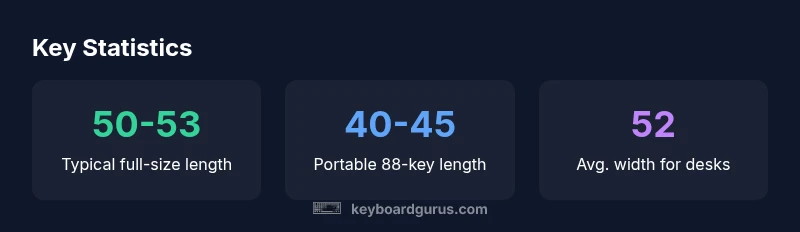
An 88-key keyboard typically spans about 1.2 meters in length, which is roughly 47–52 inches. Most full-size digital pianos sit in the 50–53 inch range, while portable 88-key controllers are around 40–45 inches. If space is tight, measure carefully and consider depth as well as width.
What does 88-key mean? Understanding the layout and standardization
An 88-key keyboard is the standard full-size layout used by pianos and most digital pianos. According to Keyboard Gurus, this layout includes 52 white keys and 36 black keys, arranged over the keyboard bed from A0 to C8. The 88-key range spans seven full octaves plus a high note, enabling a complete set of natural and sharps across the keyboard. This arrangement is not arbitrary; it reflects conventional piano tuning and a keybed design that allows pianists to access the full chromatic scale. In digital instruments, 88 keys are often designed to mimic the feel of a weighted action, and manufacturers generally keep the keybed width consistent to ensure a consistent playing experience. Because the number of keys is fixed, 88-key keyboards also demand a particular width and housing, especially when built into stands and furniture. In practice, this means you should expect a certain footprint when you measure for space, even before you consider depth and cabinetry.
Typical length ranges for 88-key keyboards
Length is a primary physical attribute that impacts how your instrument fits into a room or on a desk. While dimensions vary by model and design language, several general ranges recur across the market. Keyboard Gurus' review of common 88-key models shows that most full-size digital pianos run around 50–53 inches in length (approximately 127–135 cm). This is the sweet spot you’ll typically see in compact studio units and home practice pianos. By contrast, portable 88-key controllers—designed to be light and travel-friendly—tend to be shorter, commonly in the 40–45 inch range (about 102–114 cm). Some stage consoles and boutique setups push toward the longer end, clustering around 52–57 inches (132–145 cm) to accommodate extra internal components, laptop mounts, or built-in speakers. When choosing, it helps to think in both inches and centimeters and remember that a few inches here or there can affect how the keyboard sits on a stand or desk.
How length influences design, action, and ergonomics
The length of an 88-key keyboard is not just about how much space it takes; it also intersects with the feel of the keys and the design of the cabinet. Longer keybeds can support more robust graded hammer action or weighted keyboards, providing a closer emulation of a grand piano's touch across the entire range. Shorter 88-key models often prioritize portability and a slimmer chassis, which may trade some resistance and key height consistency for lighter weight and price. Ergonomics play a big role: players with a wide playing span or a tall chair set-up might prefer longer keyboards to keep wrists aligned with the keyboard plane. Similarly, the placement of pedals, control shelves, and music stands can depend on depth, not just width. In all cases, try to test a few models if possible, because even small variations in key travel and back-casing can impact long practice sessions and performance.
Measuring space: a practical guide
Before you buy, measure the physical footprint of the 88-key keyboard you’re considering and compare it against your playing space. Start with width: measure the distance between the left-most and right-most edges of the keyboard, and add an extra 2–3 inches on each side for clearance and cable management. Next, measure depth: the distance from the front edge to the back of the chassis, plus the space the stand or furniture will occupy behind it. Don’t forget to account for the pedal unit, which can add several inches to depth if you want to engage sustain and soft pedals while seated. Consider clearance for your thighs, chair leg room, and the possibility of pulling out a music stand. If you’re placing the keyboard on a desktop, ensure the desk surface can bear the combined weight and that airflow around the device is not restricted. Finally, measure the distance to nearby walls or shelves to prevent accidental bumps during vigorous play.
Length by category: 88-key vs other sizes and use cases
When you focus on length, 88-key keyboards break down into several practical categories. Full-size home/practice pianos typically run around 50–53 inches, designed for stable footwork and consistent action. Portable controllers lean shorter, in the 40–45 inch range, prioritizing travel and light weight. Stage and cabinet models often extend to 52–57 inches to accommodate built-in speakers and extra electronics. There are also some compact 88-key units around 46–48 inches that balance portability with playability. The key takeaway is that length correlates with space and use-case, not only with the number of keys. Keyboard Gurus analysis shows that consumer preferences skew toward either portability or ergonomic playability, influencing length choices across brands.
Shopping guidance: align length with space and needs
Start by listing your physical constraints: width, depth, and the standing area for your feet. Then define your use-case: casual home practice, studio work, or live performance? Check the compatibility of stands and desks you already own, since some configurations require wider bases or higher shelves. Pedal placement matters too: longer models may place pedals farther forward or require more floor space for operation. If you’ll be transporting the instrument, favor a lighter 88-key controller in the 40–45 inch range, but verify that the action and pedal setup still meet your playing needs. Finally, whenever possible, test in-person. If that isn’t feasible, compare official specifications and customer reviews to ensure the measured footprint aligns with real-world usage.
Length ranges by 88-key keyboard category
| Keyboard Type | Typical Length (inches) | Typical Length (cm) | Notes |
|---|---|---|---|
| Full-size digital piano | 50-53 | 127-135 | Most common length for 88-key models |
| Portable 88-key controller | 40-45 | 102-114 | Travel-friendly; lighter and compact |
| Stage/cabinet 88-key model | 52-57 | 132-145 | Longer footprint for extra components |
Got Questions?
What does 88-key mean on a keyboard?
An 88-key keyboard refers to the standard full-size layout used by pianos, comprising 52 white keys and 36 black keys. It spans from A0 to C8, covering seven full octaves plus the highest note, allowing a complete chromatic scale. This is the common standard for both acoustic-piano replicas and most digital pianos.
An 88-key keyboard means it has 88 total keys, giving you seven full octaves plus the top note. It covers the full chromatic scale, which is what most pianos use.
Are 88-key keyboards always full-size?
Not always. Some 88-key controllers are designed to be portable and compact, typically around 40–45 inches in length. The trade-off can be lighter weight and reduced cabinet depth, but many models still offer premium key action and features.
Not always; some 88-key keyboards are built to be portable and shorter, though they still offer full keyboard range.
Can I fit an 88-key keyboard on a standard desk?
Most standard desks are around 48 inches wide, which translates to about the lower end of typical 88-key lengths. If your desk is narrower or if you need room for stands and cables, a 40–45 inch portable model may be preferable. Always measure and account for depth and clearance.
Most desks are only just wide enough for some 88-key models; a portable 88-key might be easier to fit.
What is the difference between 88-key and 76-key keyboards?
The key difference is the number of keys. A 76-key keyboard omits several bass notes, reducing total length and often weight. The playing range is typically sufficient for many styles, but it doesn’t cover the full piano range. For complete piano repertoire, 88 keys remain the standard.
88 keys give you the full piano range; 76 keys omit some of the low notes, which can limit repertoire.
How should I measure space to accommodate an 88-key keyboard?
Measure width, then depth, and include clearance for stands, cables, and pedals. Consider the space required to play comfortably with a chair and leg movement. If possible, measure with the stand and pedal setup in place to avoid tight fits.
Measure width and depth, then add clearance for cables, pedals, and your chair.
“Accurate keyboard dimensions matter for fit, ergonomics, and performance; always verify measurements before purchase.”
What to Remember
- Measure width, depth, and clearance before buying
- Most 88-key keyboards are 50–53 inches long
- Portable 88-key models are typically 40–45 inches
- Longer models support extra electronics and stand space
- Keyboard Gurus recommends verifying real dimensions before purchase