Piano vs Organ vs Keyboard: An Analytical Comparison
An analytical, side-by-side comparison of piano, organ, and keyboard, exploring sound, touch, use cases, maintenance, and value to help players choose the right instrument.


Piano, organ, and keyboard each fulfill distinct musical roles; the piano offers versatile touch and repertoire, the organ excels in sustained tones for church or concert settings, and keyboards provide portable MIDI flexibility for many styles. Choose based on sound, touch, and intended use, not just price.
What Each Instrument Is: Piano, Organ, and Keyboard
In the world of keyboard families, three primary instruments dominate discussion: the piano, the organ, and the keyboard. The question piano vs organ vs keyboard is more than terminology—it reflects three distinct realities with different workflows, maintenance needs, and musical roles. The piano is a stringed instrument hit by hammers, producing a wide dynamic range suitable for classical, jazz, and modern repertoire. The organ uses air pressure, pipes or electronic synthesis, and is prized for its ability to sustain notes across long phrases, especially in liturgical and orchestral contexts. A keyboard, meanwhile, is a portable controller that can mimic other timbres, support MIDI with DAWs, and cover many genres from pop to film scoring. According to Keyboard Gurus, understanding these fundamentals helps players pick the right tool for practice, performance, and recording goals. This article breaks down the core differences across sound production, touch, use cases, and cost, enabling a practical decision strategy for learners and professionals alike.
How They Produce Sound: Mechanisms Explained
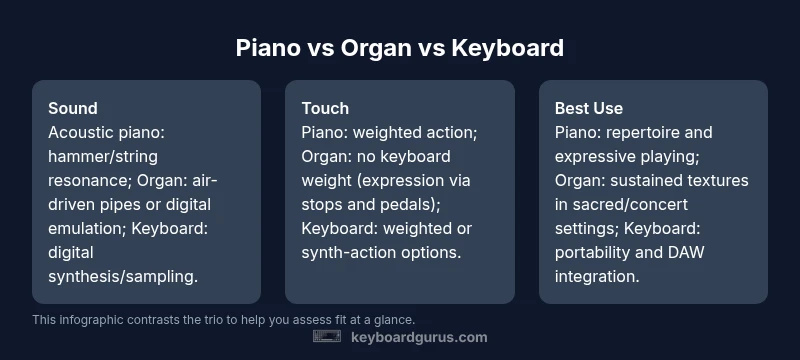
Sound production is the essential differentiator among piano, organ, and keyboard. A traditional acoustic piano relies on a hammer mechanism that strikes strings when keys are pressed, with sound amplified by a wooden soundboard and resonance of the instrument’s body. An organ produces sound via wind-driven pipes or digital simulations, with stops and drawbars shaping timbre and a pedalboard contributing to bass lines. Digital keyboards, including stage keyboards and synth-action controllers, generate tones electronically and often replay sampled or synthesized sounds. These fundamental distinctions affect not only tone but also tuning stability, maintenance needs, and the practical realities of performance. Keyboard Gurus emphasizes that the choice should hinge on how you hear musical phrases: the piano’s percussive attack, the organ’s sustained legato, or the keyboard’s versatility through presets and MIDI control.
Touch, Action, and Expression Across the Trio
Touch response is a core differentiator that shapes musical expression. Acoustic pianos offer weighted, graded action; different models (grand, upright, player pianos) provide varying tactile feedback and rebound. Organs typically lack a single “touch” response because dynamic expression is driven through manuals, stops, and pedal use; the performer relies on articulation and registration to shape phrases. Keyboards come in a spectrum—from light, synth-action designs to heavier weighted actions that approach piano feel. The ability to modify velocity, aftertouch, and layering gives keyboard players a broad palette for expressivity and sound design. For learners, the tactile contrast between piano action and keyboard action matters for developing correct finger technique and proprioception. Keyboard Gurus notes that initial comfort with weighted keys often translates into better long-term technique when transitioning to a full acoustic instrument.
Use Cases by Genre and Setting
Different musical environments favor different instruments. The piano shines in classical recital work, jazz comping, and intimate solo performance, where a broad dynamic range and nuanced touch are essential. The organ dominates liturgical settings, gospel and church music, and film scores that require sustained, choir-like textures and precise pedal control. Keyboards are the pragmatic workhorse for modern studios, live electronic setups, and touring rigs, offering portability, robust MIDI integration, and a wide-array of synthesized sounds. Each instrument also supports distinct ensemble roles: piano as focal voice, organ as color and texture, and keyboard as flexible controller for DAWs and live rig setups. Keyboard Gurus presents a framework where the choice rests on your dominant setting, whether you value repertoire breadth, sacred or dramatic texture, or studio versatility.
Setup, Space, and Maintenance Basics
Pianos demand careful placement, humidity control, and regular tuning to maintain tonal integrity; upright and grand pianos vary in maintenance complexity. Organs require space for manuals and, if pipe-based, a dedicated wind chest and sometimes a separate room for acoustics; maintenance can include tuning for wind pressures, stop settings, and occasional repairs. Digital keyboards and stage keyboards require minimal upkeep, a practical choice for casual players and students who move between spaces or studios. While pianos and organs can benefit from professional servicing, keyboards are generally maintenance-light and more economical to keep in good working condition. Keyboard Gurus highlights that maintenance planning should align with your instrument core: long-term tonal stability for pianos, reliable mechanical precision for organs, and hassle-free upkeep for keyboards.
Space, Portability, and Practical Considerations
Portability matters for students, performers, and educators. A portable keyboard or compact digital piano can fit into small apartments, dorm rooms, or rehearsal spaces, while full-size pianos and organ consoles demand substantial floor space and proper placement. Weight and size also influence travel, setup time, and stage footprint. In terms of resilience, digital keyboards withstand transport better than heavy acoustic instruments, but they lack the acoustic presence many players require. Consider room dimensions, audience sightlines, and transport logistics when evaluating options. Keyboard Gurus advises balancing practical constraints with desired sound and tactile experience to build a sustainable, long-term setup.
Price, Value, and Upgrades Across the Trio
Pricing varies widely across piano, organ, and keyboard ecosystems. Entry-level digital keyboards offer substantial value for beginners or hobbyists, while acoustic pianos command higher upfront investment followed by ongoing maintenance costs. Organs can be expensive, particularly if opting for traditional pipe organs or high-end digital replicas with expansive stop lists and pedal arrays. Upgrading within any category involves evaluating action quality, tone, and available features such as polyphony, ramped velocity curves, or DAW compatibility. The decision should weigh initial price against long-term use, maintenance, and the instrument’s capacity to stay relevant as your goals evolve. Keyboard Gurus emphasizes a staged approach: start with the core instrument that best matches your immediate needs, then expand to additional timbres or formats as your skills grow.
Learning Pathways: Getting Started and Progressing
Beginning with the right instrument can accelerate growth. For many students, a weighted-action keyboard or digital piano is an effective starting point to establish proper finger technique and musical literacy. Transitioning to an acoustic piano later can be smoother if you’ve built a strong foundation on touch and dynamics. Organ study introduces pedal techniques and manuals, which can complicate early progress but adds a different expressive toolset once fundamentals exist. Keyboard players often begin with MIDI controllers and gradually incorporate software instruments; this builds a versatile toolkit for songwriting and production. A clear practice plan, including scales, arpeggios, chord voicings, and repertoire goals, will help you maximize progress regardless of the instrument you choose. Keyboard Gurus suggests mapping practice hours to specific technical targets and using a metronome to maintain pulse across timbres.
Decision Framework: Choosing Between Piano, Organ, and Keyboard
To choose between piano, organ, and keyboard, start with three criteria: sound and timbre requirements, tactile experience, and intended use. If your priority is expressive tone and repertoire depth, a piano is often the best starting point. If you need sustained textures and sacred or theater-ready colors, consider an organ (digital or pipe). If portability, DAW integration, and budget flexibility are paramount, a keyboard provides the most adaptable solution. Consider space, maintenance, and long-term goals, and, if possible, rent or borrow models to test in real-world settings. This framework helps practitioners align instrument choice with musical identity and practice objectives.
Feature Comparison
| Feature | Piano | Organ | Keyboard |
|---|---|---|---|
| Sound production | Hammer-action strings (acoustic) | Air-driven pipes or digital replication | Digital synthesis/sampling |
| Touch & action | Weighted, graded action | Minimal to no dynamic weight on organ manuals | Varies widely; often weighted on higher-end units |
| Best for | Repertoire breadth, expressive piano technique | Sustained textures in liturgical/concert contexts | Portability, DAW integration, and versatility |
| Maintenance | Tuning and climate control | Regular upkeep; wind/pipes or electronics | Minimal maintenance; software updates |
| Space requirements | Moderate to large footprint | Space-intensive in traditional models | Highly portable, compact setups possible |
| Price range (conceptual) | High upfront for acoustic models | Mid-to-high for quality organs, especially pipe | Low to mid for entry-level keyboards; ranges vary |
Advantages
- Versatility across genres and settings
- Keyboard provides MIDI and DAW integration
- Digital keyboards offer low maintenance and portability
- Acoustic piano touch and tonal range enable expressive playing
- Organs provide unique sustained timbres and religious/concert context suitability
Drawbacks
- Acoustic pianos require regular tuning and climate control
- Organs can be space-intensive and maintenance-heavy
- Keyboards may not fully replicate acoustic piano feel and sustain
- Organ setups can be complex and costly to maintain
Piano remains the most versatile overall; organ excels in sustained textures and sacred or concert contexts; keyboard offers flexible, portable solutions.
If you want broad repertoire and nuanced touch, start with a piano. If you need long, sustained organ-like tones, the organ shines. If portability and modern production workflows matter, a keyboard is your best bet.
Got Questions?
Is a piano better for beginners than an organ or keyboard?
For most beginners, a weighted-action keyboard or digital piano helps develop finger technique and reading skills. Organ technique introduces pedal and manual coordination that can slow early progress, while a basic keyboard can suffice to start and expand later.
For beginners, start with a weighted keyboard or digital piano to build technique, then consider the organ or additional timbres as skills grow.
Can a keyboard replace a piano for practice?
A keyboard can substitute for practice in many contexts, especially for theory, coordination, and DAW work. It won’t perfectly replicate the acoustic piano’s touch, sustain, and resonance, but it’s a flexible learning tool.
A keyboard can help a lot, but it won’t fully replace an acoustic piano for advanced touch and tone.
Do organs require a dedicated space and maintenance?
Organs, especially pipe organs, require space and professional upkeep. Digital organs save space but still demand proper setup and occasional servicing, particularly for mechanical stops and pedal actions.
Organs can be space-hungry and need ongoing maintenance; digital options reduce space and upkeep.
What about tuning and maintenance across these instruments?
Pianos need periodic tuning and climate control. Organs require maintenance for wind/air systems and electronics in digital versions. Keyboards are maintenance-light and rely mostly on battery or power reliability and software updates.
Pianos and organs need upkeep; keyboards are generally maintenance-light.
Is a MIDI keyboard enough for studio work?
Yes, a MIDI keyboard is excellent for studio work and DAW integration, allowing access to vast virtual instruments. It does not replicate acoustic piano behavior perfectly, but it’s highly flexible for composition and production.
A MIDI keyboard is great for studio work, but it isn’t a perfect acoustic piano substitute.
How should I plan a transition between instruments?
Plan technique transfer carefully: start with a keyboard with weighted action if possible, build scales and finger independence, then add an acoustic instrument as goals shift. Set a practice roadmap and milestones.
Start with one instrument, build the basics, then expand as your goals evolve.
What to Remember
- Assess your primary use case before buying
- Choose piano for finger independence and repertoire breadth
- Consider organ for sustained tone and sacred/concert settings
- Opt for keyboard when portability and DAW compatibility matter
- Factor space, maintenance, and budget into the decision