Portable Keyboard vs Digital Piano: Choosing the Right Tool in 2026
An analytical comparison of portable keyboards and digital pianos, covering key action, sound, portability, price range, and ideal use cases for learners, hobbyists, and professionals.


According to Keyboard Gurus, the portable keyboard vs digital piano decision hinges on mobility, touch, and budget. In short, choose a portable keyboard for travel-friendly practice, quick setup, and versatile tones. Opt for a digital piano when you need authentic hammer-action, full 88 keys, and piano-like touch for serious study or performance. Your choice should align with your primary use case and space constraints.
What portable keyboard vs digital piano really are
In the world of keyboard instruments, a portable keyboard is designed for ease of transport, lightweight construction, and a broad library of built-in tones. A digital piano emphasizes piano feel and tone, often featuring weighted keys and speaker systems that mimic an acoustic piano. The distinction matters for players who travel, study in small spaces, or need different voices for music genres. According to Keyboard Gurus, the difference largely comes down to actions and keys, not just sounds. This practical distinction guides many buyers toward an instrument that matches their daily environment and musical goals rather than chasing the most realistic piano tone alone.
Core differences: action, keys, and sound
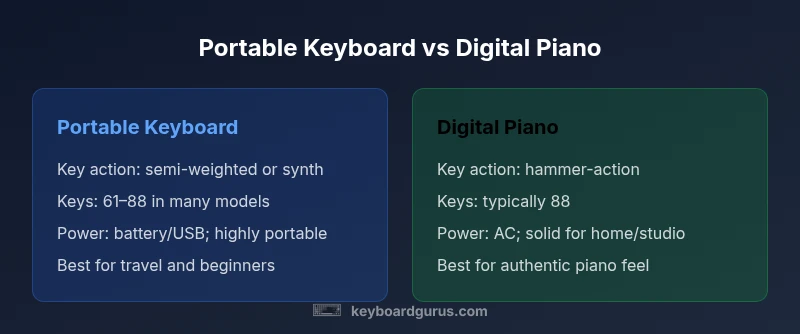
The most visible mismatch between portable keyboards and digital pianos lies in the keyboard action and the number of natural keys. Portable keyboards typically use synth or semi-weighted actions, offering lighter touch and faster repetition for beginners and casual players. Digital pianos generally adopt hammer-action or graded hammer-action keys that replicate the resistance of an acoustic piano across the keyboard. The sound engines differ as well: portable models rely on sample-based engines with broad timbral options, while digital pianos emphasize high-fidelity piano voices with elaborate sustain and dynamic responses. The result is a spectrum from light, agile playing experiences to deeply expressive piano performances, with action fidelity as the main differentiator.
Sound quality and piano feel
Sound quality is not universal across all models, but digital pianos commonly provide richer, more authentic piano tones and subtler dynamics, especially on higher-end units. Portable keyboards excel at variety: synth bass, electric piano emulation, strings, and drums enable genre versatility on the go. Keyboard Gurus analysis shows that for many players, especially beginners and hobbyists, the immediate usability and diverse voices of portable keyboards outweigh the premium piano realism of a digital piano—until a learner reaches a point where touch accuracy matters most. The best choice depends on whether you crave a broader sonic palette or a more convincing piano touch.
Portability, power, and practical setup
Portability is the defining advantage of portable keyboards: they’re lighter, easier to pack, and often operate on batteries or USB power, making them suited for small rooms, dorms, or travel. Digital pianos tend to be heavier, rely on AC power, and require stands and sometimes dedicated furniture. If you travel frequently or have limited space, a portable keyboard minimizes setup friction and storage concerns. For studio setups or living rooms where a stable piano-like experience is desired, a digital piano’s weight and power requirements are a reasonable trade-off for performance fidelity.
Voices, samples, and polyphony
A portable keyboard’s voices are typically broad but sometimes lean on smaller sample sets. Polyphony—that is, how many notes can be played simultaneously without dropping tones—varies widely. Digital pianos tend to deliver robust piano voices with strong note separation and sustain, benefiting from deeper sampling. The trade-off is that some portable keyboards may cap polyphony lower, which can affect complex chords or dense arrangements. When shopping, compare the polyphony count and sustain behavior across models to ensure your typical playing style remains uninterrupted.
Connectivity and expandability
Both types offer MIDI/USB connections and audio outputs, but the level of expansion differs. Digital pianos often provide reliable pedal functionality and cleaner line-level outputs for recording, along with stable Bluetooth or USB audio options on newer models. Portable keyboards frequently include built-in speakers and versatile, transport-friendly I/O but may rely more on external amps or headphones for best tone in practice. If you plan to connect to a computer or audio interface, verify that the model supports class-compliant MIDI and stable driver performance.
Use-case scenarios by user type
For beginners and students, portability, price, and simplicity can make portable keyboards appealing. Keyboard Gurus analysis shows that this audience often prioritizes quick setup, variety of built-in lessons, and easy on-the-go practice. For hobbyists and performers, a digital piano may be preferable when the aim is home studio reliability, authentic touch, and nuanced performance control. Touring players may opt for hybrid setups that toggle between a compact stage keyboard and a digital piano for live shows. Your scenario—space, budget, and goals—will determine the best fit.
Budget, value, and longer-term costs
Price and value are central to the portable keyboard vs digital piano decision. Portable keyboards offer a broad spectrum—from entry-level models to mid-range boards—at lower upfront costs, with ongoing savings on space and power. Digital pianos, while costlier upfront, can offer better long-term value for serious pianists due to higher touch fidelity and durability. When planning, consider total cost of ownership: maintenance, required accessories, stand, bench, and potential upgrade cycles. Keyboard Gurus recommends mapping your anticipated growth: if you expect frequent instrument upgrades, a portable model may be the most cost-effective starting point; if you anticipate long-term piano study, investing in a digital piano can pay off over time.
How to audition: what to check in-store
When testing in-store, focus on action feel, key stability, pedal responsiveness, and voice quality across several presets. Play scales and arpeggios to feel the weight difference, check for aftertouch if present, and simulate common practice scenarios. Listen for keyboard noise, speaker clarity, and how cleanly the instrument responds to velocity and dynamic changes. If possible, compare a portable keyboard to a digital piano side-by-side and evaluate whether the purchase supports your current repertoire and future goals.
Hybrids and alternative approaches
Hybrid arrangements—using a weighted keyboard controller with a digital piano module—offer a middle ground: you can get hammer-action feel while loading additional sounds or MIDI control for studio work. Some players prefer extra keyboards for stage rig flexibility, using one for practice and another for performance. This approach requires careful cable management and a reliable audio interface. Hybrids aren’t universally better; they’re best for players who want specific tonal palettes alongside piano feel without bulk.
Quick decision framework
Create a simple decision tree: (1) Do you travel often or have limited space? If yes, start with a portable keyboard. (2) Do you need authentic hammer-action and 88 keys? If yes, lean digital piano. (3) Will you record or perform professionally? Favor digital piano or a hybrid. (4) What is your budget? Use price tiers to determine feasibility. (5) How important is voice variety? If high, portable keyboards offer a broader palette; if low, focus on piano fidelity. This framework helps you narrow to the right class before evaluating individual models.
Comparison
| Feature | Portable keyboard | Digital piano |
|---|---|---|
| Key action | Semi-weighted/synth action typical | Hammer-action or graded hammer-action |
| Number of keys | 61–88 keys | 88 keys |
| Portability | Very portable; light; battery/USB powered | Heavier; needs stand and AC power |
| Power options | Battery/USB power | AC power (typical) |
| Pedals | Often 1–3, depending on model | Usually 3 standard pedals |
| Sound/voices | Broad synthesis and voices; versatile | High-fidelity piano voices; strong emulation |
| Polyphony | 16–128+ (varies by model) | 128–256+ (higher-end models common) |
| Connectivity | MIDI/USB, audio outputs, headphones | MIDI/USB, audio outputs; sometimes line inputs |
| Best for | Travel, practice, beginner versatility | Home studio, performance, mature players |
| Price range | $100–$600 | $800–$3000 |
Advantages
- Low upfront cost and high portability for quick setup
- Broad voice library enables experimentation across genres
- Space-efficient footprints fit small rooms and dorms
- Easier to share music files and record ideas
- Good entry point for beginners on a budget
Drawbacks
- Action and feel may lack authentic piano weight
- Some models compromise on key size or aftertouch in budget tiers
- Audio quality and sustain can be less convincing on inexpensive portable boards
- Long-term musicians may outgrow features sooner and upgrade more often
Choose based on your primary use-case: go portable for mobility and budget, go digital for authentic piano feel and serious practice.
If you prioritize travel, space, and cost, portable keyboards excel. If you seek hammer-action, full 88 keys, and stable piano tone for long-term study, a digital piano is the stronger long-term investment. Keyboard Gurus’s framework guides this choice.
Got Questions?
What is the main difference between a portable keyboard and a digital piano?
The main difference is action, keys, and how authentic the piano touch feels. Portable keyboards are lighter with synth actions and varied voices, while digital pianos emphasize hammer-action keys and piano-focused tones.
The big difference is feel and piano authenticity.
Can I learn piano on a portable keyboard?
Yes, you can start with a portable keyboard, especially for fundamentals and rhythm. However, plan for a transition to a digital piano if you want hammer-action and greater realism for advanced pieces.
You can start learning on portable, but plan to move to a digital piano for serious piano work.
Do portable keyboards have weighted keys?
Some portable keyboards offer weighted or semi-weighted keys, but most are lighter action. True weighted keys are more common on higher-end portable models or digital pianos.
Most portable keyboards aren’t fully weighted, but some models imitate weight.
Is a digital piano better for beginners?
Digital pianos can be better for beginners who want a proper piano feel early on. That said, a well-chosen portable keyboard can start learners effectively and be more affordable.
Digital pianos can help beginners with touch, but a good portable can work too.
Should I buy used or new?
Used instruments can save money but require careful checks of action, keys, pedals, and internal electronics. If buying used, test extensively or seek a warranty where possible.
Used can save money if you check action and pedals well.
What to Remember
- Prioritize use-case and space first
- Portable keyboards favor versatility and portability
- Digital pianos favor authentic touch and piano fidelity
- Budget guides should include accessories and stand
- Test action, polyphony, and voice quality in-store