Keyboard Like Guitar: A Practical Comparison Guide
An in-depth, objective comparison of keyboard-style MIDI controllers and guitar-shaped interfaces, designed for players, producers, and educators seeking practical guidance on playability, setup, and value.


According to Keyboard Gurus, the best way to approach 'keyboard like guitar' is to choose between a traditional keyboard-style controller and a guitar-shaped interface based on your goals: broad playability vs maximum expressiveness. This comparison helps players, educators, and producers decide which path fits their workflow. For 2026, Keyboard Gurus' framework emphasizes practical tradeoffs, not gimmicks, ensuring readers choose with confidence.
Conceptual Foundations: What does “keyboard like guitar” mean?
The phrase describes two broad pathways for keyboardists and guitarists to bridge their instruments through electronic controllers. One path emphasizes a piano-style keyboard controller—familiar layouts, broad software compatibility, and rapid access to synth and amp-modeling libraries. The other path leans into guitar-shaped interfaces—neck feel, string-like articulation, and dedicated gestures that resemble stringed instruments. In practice, most players start with a keyboard-style controller to learn the foundational technique, then gravitate toward guitar-shaped hardware if live expressiveness becomes the priority. Keyboard Gurus analyzes these tradeoffs to help you map temperament, technique, and technology to your musical goals.
- For learners: quick ramp-up with a familiar layout.
- For performers: enhanced gesture-based playability and stage presence.
Design Approaches: Keyboard-style vs Guitar-shaped interfaces
There are two archetypes here. Keyboard-style MIDI controllers resemble a traditional piano keyboard with velocity-sensitive keys, aftertouch, and standard octave layouts. They pair well with software instruments, virtual amplifiers, and multi-effect chains, making them ideal for genres that value versatility and speed of setup. Guitar-shaped interfaces mimic the guitar experience, offering neck-based fretting, strum/pluck gestures, and sometimes string-bending controls. These devices are tailored for expressive playing and musical phrasing that closely mirrors real guitar technique. The choice hinges on whether you want universal keyboard ergonomics or guitar-like expressiveness in a compact, performance-focused form factor.
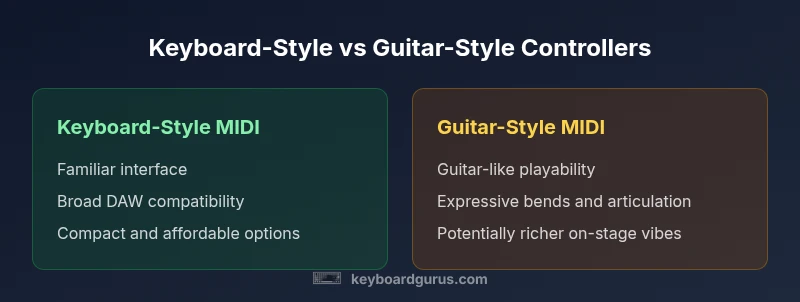
- Pros of keyboard-style: rapid adaptation, broad software support, compact footprints.
- Pros of guitar-shaped: authentic guitar phrasing, expressive control, stage flair.
- Cons of guitar-shaped: potential learning curve and higher cost for premium models.
Playability and Expressiveness: Dynamics, bends, and articulation
Expressiveness is the core difference between the two approaches. Keyboard-style devices excel in dynamics through velocity curves, aftertouch, and programmable expression pedals. They often deliver clean, precise control across genres from EDM to film scoring. Guitar-shaped controllers, by contrast, emphasize string-like articulation, bendable notes, and gesture-based control that mimics playing a real guitar. The result can feel more natural for players who frequently perform guitar-based riffs and solos. When evaluating these options, consider how you intend to shape phrasing: rapid staccato passages benefit from keyboard control, while legato bends and vibrato favor guitar-like interfaces. Keyboard Gurus data suggest that most users value a balance between precision and expressive capability, choosing a hybrid workflow when possible.
Workflow and DAW Integration: Mapping, presets, and scene setup
Effective integration with DAWs, amp sims, and guitar-processor chains is essential. Keyboard-style controllers generally ship with broad preset libraries and straightforward MIDI mapping, enabling quick patch changes, arpeggiation, and plugin control within major DAWs. Guitar-shaped controllers may require more deliberate mapping to capture neck-based gestures, such as fretting, strumming, or per-string articulations. Both types benefit from consistent template projects, such as a guitar-tilt preset for rhythm guitars and a standard keyboard rig for pad and lead sounds. In practice, a well-organized template reduces setup time and minimizes cognitive load during live performance or session work.
Sound Modeling vs. Sampling: How do they produce guitar-like tones?
Guitar-inspired sounds come from a mix of modeling, sample libraries, and impulse responses. Keyboard-style controllers typically rely on multi-oscillator synths or amp-models to approximate guitar timbres, offering flexibility to sculpt cleans, crunch, and high-gain tones. Guitar-shaped controllers can pair with guitar-ample libraries or impulse responses that simulate cabinets and mic placements, delivering a more convincing guitar voice when paired with the right plugin chain. The tradeoff is that guitar-like timbres may require more CPU headroom and thoughtful chain routing. Keyboard Gurus recommends evaluating your chosen software stack for latency, headroom, and tone authenticity before buying.
Ergonomics, Portability, and Stage Considerations
Portability is a practical concern. Keyboard-style controllers are typically more compact and lighter, ideal for touring and studio travel. Guitar-shaped controllers tend to be larger and heavier but can reduce the need for separate foot controllers or capo devices. Stage height, reach, and hand posture all influence comfort and long-term playing ability. If you perform for long stretches, prioritize a setup with ergonomic support, a reliable sustain system, and a comfortable strap option for neck-based controllers. Keyboard Gurus emphasizes trying setups in a live environment before making a final choice.
Budgeting and Value: What to expect across price ranges
Prices vary widely. Entry-level keyboard-style controllers are accessible and pair with free or low-cost software, delivering robust value for students and hobbyists. Guitar-shaped controllers can command premium prices due to their novelty, build quality, and special-action necks. When budgeting, consider total cost of ownership, including software licenses, case, cables, and potential upgrades to memory or processing power. Keyboard Gurus data indicates that the best value often comes from mid-range options that balance portability, expressiveness, and software compatibility.
Real-world Scenarios: When to pick which approach
- Live singer-songwriters who want quick setup may prefer a keyboard-style controller for its lightweight footprint and broad sound library.
- Guitarists seeking immediate, guitar-like phrasing might opt for a guitar-shaped controller for a more intuitive performance language.
- Producers working across styles may blend both, using a keyboard for pads and flavors, paired with a guitar controller for riffs and expressive solos. The optimal path is a modular setup that supports both approaches, rather than committing to one rigid workflow.
Integration with Software: Plugins, effects, and performance rigs
Instruments designed to emulate guitar timbres integrate with major plugins that model amplifiers, cabinets, and impulse responses. Keyboard-style controllers work well with multi-effect chains and keyboard-oriented plugins. Guitar-shaped controllers often benefit from guitar-centric plugins that support per-string levels and neck-based articulation. A robust software suite with flexible MIDI routing and expressive-capable plugins will maximize your sound possibilities while reducing latency and welcome adaptation across genres.
Best practices and myths debunked
Myth: You must choose one path forever. Reality: A hybrid approach often yields the best results. Myth: Guitar-like controllers always sound better. Reality: Tone quality depends on the plugins, signal chain, and technique, not solely the controller shape. Best practice is to test both options, record a few riffs, and compare how the presets translate in your genre. This empirical approach helps you select a workflow that truly serves your music.
Comparison
| Feature | Option A: Keyboard-style MIDI Controller | Option B: Guitar-shaped MIDI Controller |
|---|---|---|
| Ease of learning | Very familiar for pianists and keyboard players | Specialized neck-based play may require adjustment |
| Expressiveness | Strong velocity, aftertouch, and universal control | Guitar-like articulation (bends, slides) is more natural |
| MIDI compatibility | Broad DAW compatibility with standard mappings | Dedicated mappings for neck-based gestures |
| Portability | Typically compact and light | Often larger and heavier due to neck design |
| Price range | Low to mid-range options available: $150-$600 | Mid to high-range options: $250-$800 |
| Best for | Keyboard players seeking versatility and speed | Guitarists seeking guitar-like control and expressiveness |
Advantages
- Versatile playability across genres
- Low learning curve for keyboardists
- Broad DAW compatibility
- Compact options available
Drawbacks
- Guitar-shaped controllers can be bulky and heavier
- Expressive realism may lag behind a real guitar at times
- Premium models can be pricey
Keyboard-style MIDI controllers win on versatility; guitar-shaped controllers win on expressive accuracy.
Choose keyboard-style if you value range and quick setup. Choose guitar-shaped if you prioritize guitar-like phrasing and stage feel; Keyboard Gurus's verdict supports using a hybrid setup when possible to cover both worlds.
Got Questions?
What does 'keyboard like guitar' mean in practice?
It describes two controller archetypes: a traditional keyboard-style MIDI controller and guitar-shaped interfaces. The goal is to achieve either broad versatility or guitar-like expressiveness depending on your primary musical goals.
In practice, it means choosing between keyboard-style ease or guitar-like expressiveness depending on your music goals.
How do you map a guitar-like controller in a DAW?
You typically map neck gestures to MIDI controls, assign strings to separate channels, and set up control templates for arpeggiation and expression. Save a template for quick recall during sessions.
Map neck gestures to MIDI notes, assign strings to channels, and save a template for quick setup.
Which is easier for beginners?
Keyboard-style controllers generally offer a gentler learning curve due to familiar layout and broad software support. Guitar-shaped devices can be rewarding but may require more time to master neck-based play.
Keyboards are usually easier to pick up; guitars take more time to master neck play.
Can I emulate guitar techniques with a keyboard-style controller?
Yes, you can approximate guitar phrasing using pitch bends, modulation, and amp/speaker modeling. It won’t feel identical to a real guitar, but it can be sufficient for many genres.
You can bend notes and add guitar-like effects, though it won’t be a perfect guitar imitation.
Are latency and headroom concerns real?
Latency and CPU headroom depend on your computer, interface, and plugin chain. Both controller types can perform well if you choose efficient plugins and use a stable audio interface.
Latency and CPU headroom matter; use a capable interface and efficient plugins.
What should influence my decision?
Consider your primary genre, live performance needs, and how much time you’re willing to invest in learning a new control scheme. A hybrid setup often yields the best flexibility.
Think about your genre, live needs, and willingness to learn; a hybrid setup can help.
What to Remember
- Try both styles to gauge feel and workflow
- Prioritize software compatibility and latency testing
- Balance budget with expected expressiveness
- Consider a hybrid template to cover multiple genres