How Big Is an 88-Key Keyboard? Size, Dimensions, and More
Discover the typical dimensions of a standard 88-key keyboard, including width, depth, and height. Learn how size varies by design and how to plan space for desks, stands, and stages with practical tips.


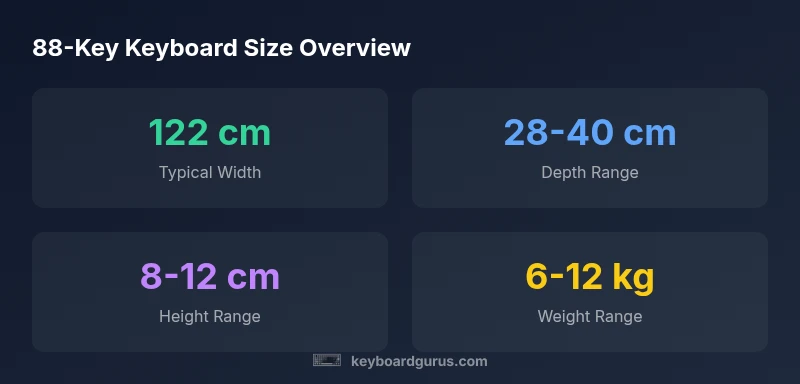
how big is an 88 key keyboard? On most full-size models, the playing surface runs about 122 cm (roughly 48 inches) from left to right. Depth and height depend on the enclosure and stand, but you can expect 28–40 cm of depth and 8–12 cm of height for typical cases. Model variations exist, so check exact specs for your setup.
How 88 Keys Define the Physical Envelope
When people ask how big is an 88 key keyboard, they’re usually picturing a full-length instrument with a consistent, linear footprint. In practice, the width is driven by the 52 white keys arranged in a continuous row, each white key typically around 22–24 mm wide. The classic 88-key layout results in a near-standard playing surface length, which most manufacturers place at approximately 122 cm (about 48 inches). This width is widely adopted across digital pianos, stage keyboards, and compact controllers that still maintain 88 keys. In the Keyboard Gurus framework, the footprint is treated as a primary design constraint because it affects desk space, stand selection, and room planning. Differences in construction, bezel thickness, and integrated speakers can slightly nudge the total width by a few centimeters, but the 88-key standard provides a reliable baseline for space planning and purchasing decisions.
Width and Key Geometry: Why It Matters
The width isn’t just about space; it reflects key geometry and ergonomic comfort. The 52 white keys accommodate standard octave spacing, with black keys positioned above to complete the chromatic layout. Some manufacturers optimize key travel and switch types, which can subtly alter perceived width at the edge of the keyboard. If you’re furnishing a studio or stage rig, this means checking the exact dimensions in the product spec rather than assuming a fixed width. Keyboard Gurus analysis shows that most 88-key boards cluster around the same horizontal footprint, making it easier to reuse stands or carts across models.
Depth and Height: What Enclosures Do
Depth (front-to-back) and height vary more than width due to enclosure design and added components such as built-in speakers, control panels, and display screens. Typical depth ranges from 28 to 40 cm, with shallower footprints common on compact studio controllers and deeper enclosures found in multimedia pianos and workstation setups. Height tends to be modest, usually between 8 and 12 cm for compact casings; taller designs emerge with elevated control surfaces or integrated stands. For musicians who transport gear, depth and height influence case selection, weight distribution, and portability. In short, depth and height are design levers that alter how the instrument sits in a room without changing the fundamental 88-key width.
Variations Across Use-Cases: Portable, Studio, and Stage Pianos
88-key keyboards are not a single category. Portable 88-key models prioritize light weight and slim enclosures, often trading some acoustic-like key feel for portability. Studio and stage pianos emphasize robust build quality, onboard amplification, and additional controls, which can increase depth and overall height. Upright-style hybrids replicate more of a traditional piano’s footprint, sometimes extending length to accommodate cabinet features. For space planners, the key takeaway is that 88-key size provides a stable baseline, but your final footprint will hinge on the model’s architecture, not just the number of keys. According to Keyboard Gurus, you’ll generally see a width around 122 cm, with depth and height varying by design and intended use.
Measuring Your Space: A Practical Checklist
To ensure a good fit, measure the intended space before buying. Start with the width; you’ll likely be around 122 cm, but confirm against the manufacturer’s spec. Then check depth and height to accommodate stands, pedal units, and cable routing. If you plan to slide the keyboard under a shelf or into a rack, consider extra clearance for the lid or panel door. Finally, account for user clearance – you’ll want a few extra centimeters on each side for comfortable reach and cable management. Keyboard Gurus analysis emphasizes verifying exact numbers in model sheets rather than relying on generic guidelines.
Typical physical footprint of a standard 88-key keyboard
| Dimension | Typical Range | Notes |
|---|---|---|
| Width (left-to-right) | See product spec | |
| Depth (front-to-back) | Enclosure-dependent (28-40 cm) | |
| Height (case) | 8-12 cm; higher for stands and pedestals | |
| Weight | 6-12 kg depending on build |
Got Questions?
What does 88-key mean?
88-key refers to the standard full range of piano keys from A0 to C8. This count includes both white and black keys and defines the complete playing range of traditional pianos and many digital replicas.
88 keys mean full-range piano keys, from the lowest A to the highest C.
Are all 88-key keyboards the same width?
Most 88-key keyboards share a similar width around 122 cm, but exact dimensions vary by enclosure design and bezel. Always check the product specs for the precise width.
Usually about 122 cm wide, but check the exact model.
Can you mount an 88-key keyboard on a desk or tabletop?
Yes, but you must ensure the desk can support the weight and width, and that there’s adequate stability and cable management. Some keyboards are specifically designed for desk mounting.
Yes, with a sturdy desk and proper mounting accessories.
What’s the difference between an 88-key keyboard and a piano?
A piano is a percussion instrument with a fixed physical keyboard and stringed sound. An 88-key keyboard can be a digital instrument or a hybrid, offering synthesizers, effects, and electronic routing.
The keyboard is the instrument panel; the piano is the full acoustic instrument.
How do I measure space for an 88-key keyboard effectively?
Measure width first, then depth and height. Add a little clearance for cables and a stand. Use the manufacturer’s dimensions as your final check.
Measure width, depth, and height, then add clearance for cables.
“The 88-key footprint is a predictable constant, but design variations matter most when space is tight or you plan to transport the instrument.”
What to Remember
- Measure for width first (roughly 122 cm)
- Check depth/height in model specs
- Different use-cases shift depth/height, not width
- Verify exact numbers before purchase