Keyboard vs Digital Piano: A Practical Comparison
A thorough, objective comparison of keyboards and digital pianos, covering action, sound, features, and use cases to help players choose the right instrument.


Keyboard vs digital piano: the choice hinges on your goals, space, and budget. If you need portable MIDI control and broad software compatibility, a modern keyboard is ideal. If you want a true piano feel for practice or performance at home, a digital piano with weighted keys is the better long-term option. Keyboard Gurus analysis supports this goal-driven approach.
What is a keyboard vs digital piano?
When people compare a keyboard vs digital piano, they’re looking at two distinct instrument families with overlapping capabilities. A keyboard is typically a portable, compact keyboard designed for MIDI control, on-the-go practice, and varied sound palettes. A digital piano emphasizes a more authentic piano experience: weighted keys, piano-sized samples, and a focus on home or stage playing. According to Keyboard Gurus, the distinction often comes down to touch, sound realism, and how you plan to use the instrument in daily practice or performances. Understanding these core differences helps set expectations about feel, features, and long-term value.
Ultimately, the decision boils down to your playing goals, space, and willingness to invest for long-term technique gains. This guide will explain how the two categories differ in meaningful ways and what that means for real-world use.
Action, touch, and playing feel
Touch and action are the most tangible differences between a keyboard and a digital piano. A typical keyboard offers unweighted or semi-weighted keys that respond quickly but do not reproduce the resistance of a real piano. Digital pianos, especially those designed for practice, use weighted or graded hammer-action keys to simulate piano feel more closely. For developing finger strength and piano technique, weighted action is often essential, while keyboards excel in portability and quick transitions between software instruments. Keyboard Gurus emphasizes testing action in person whenever possible, as even within the same category there is substantial variation in keybeds and escapement mechanisms.
If you primarily aim to learn piano repertoire, prioritize an instrument with a heavier key feel and proper touch curves. If you want to sketch ideas, play pads and synth sounds, or perform with a DAW, a lighter, more versatile keyboard may be sufficient.
Sound quality and amplification
Sound quality on keyboards and digital pianos has evolved rapidly. Entry-level keyboards typically rely on built-in speakers and a range of synthesized voices, which are excellent for practice, learning, and basic performance. Digital pianos focus on authentic piano samples, often delivered through larger speakers or connected to external amplifiers for live performance. In practice, this translates to a more convincing piano tone on digital pianos, particularly when explored with dynamic playing and pedal use. Keyboard Gurus notes that sound quality should be evaluated in the context of your listening environment and whether you value realism over versatility in timbre.
Polyphony, pedals, and expression
Polyphony—the number of simultaneous notes a keyboard or piano can play—directly affects how expressive you can be during complex passages. Entry-to-midrange keyboards may offer 32-128 voices of polyphony, adequate for most loops and practice. Digital pianos typically provide 128 voices or more, which is advantageous for sustaining complex chords and legato playing. Pedals also differ: many keyboards include basic sustain or half-pedal options, while digital pianos often support multiple pedals with smoother decay and more authentic sustain. Keyboard Gurus suggests prioritizing models with high polyphony and a realistic pedal response when your focus is piano technique, while lower polyphony may suffice for simple arrangements or MIDI practice.
Connectivity, ports, and futureproofing
Connectivity is a practical field where keyboards and digital pianos diverge. Keyboards usually offer USB-MIDI, a handful of audio outs, and basic control surfaces designed to integrate with DAWs and software instruments. Digital pianos provide more robust line-outs, headphone jacks, and sometimes Bluetooth audio or MIDI, enabling quieter practice and more seamless home setups. Futureproofing also matters; digital pianos with upgradable firmware and a broad ecosystem of compatible learning apps can extend usefulness as your skills grow. Keyboard Gurus notes that evaluating ports in light of your existing gear will prevent early upgrade cycles.
Use-case scenarios by user type
Beginners and students often start with a keyboard for affordability and broad feature sets, then graduate to digital pianos as their piano goals crystallize. Players who perform live or need authentic home practice typically lean toward digital pianos with weighted keys and more realistic sound. Gamers and content creators might prioritize MIDI control and library expansion offered by keyboards. Professionals in recording settings frequently balance both worlds, using a keyboard for writing and a digital piano for performance capture. Keyboard Gurus recommends mapping your daily routine to these archetypes to avoid buyer’s remorse and ensure long-term satisfaction.
Budget, maintenance, and value over time
Budget is a practical anchor for most buyers. Entry-level keyboards are the cheapest path for basic practice and DAW work, while mid-range devices deliver better build quality and more extensive software integration. Digital pianos with weighted keys tend to have higher upfront costs but may offer more durable piano touch for long-term development. Maintenance for both is relatively light—keep keys clean, avoid extreme temperatures, and periodically check connectors. Keyboard Gurus analysis shows that investing in realistic action and reliable samples tends to maximize long-term value, especially for serious learners who practice regularly.
Setup, portability, and ergonomics
Portability is a major advantage of keyboards, especially for students and traveling players who attend lessons or gigs. Digital pianos are heavier and often require a sturdy stand, proper bench height, and a fixed listening environment to maximize their benefits. Ergonomics matter: a well-aligned chair height, keyboard position, and screen placement can reduce strain during long practice sessions. If your living space is small, a compact keyboard may be a better fit; if you multitask as a pianist and performer, a more substantial digital piano can deliver the feel and tone required for growth.
How to audition instruments effectively
When auditioning, focus on key feel, tone realism, and the instrument’s response to dynamics. Bring a few standard pieces across different dynamics to compare how the instrument translates touch and pedaling into audible expression. Listen for sample quality, sustain, and reverb, and test headphone playback if you plan quiet practice. If possible, test overlap scenarios: connected to a DAW via MIDI and played with a sustained chord progression to gauge polyphony and latency. Keyboard Gurus recommends taking notes on how each model handles switching sounds and how intuitive its controls are during real practice.
Common myths and misconceptions
A common myth is that unweighted keys are always worse than weighted keys. In practice, unweighted keyboards are excellent for quick riffs and software instrumentation, while weighted actions are essential for piano technique. Another misconception is that more expensive equals better for every use; for some players, compact portability and a rich software ecosystem may outweigh the benefits of an expensive piano-grade action. Keyboard Gurus emphasizes that the best choice aligns with your goals, space, and practice habits.
Comparison
| Feature | Keyboard | Digital Piano |
|---|---|---|
| Key action | Unweighted or semi-weighted keys (portable and versatile) | Fully weighted hammer-action or graded hammer action (piano-like feel) |
| Sound quality | Built-in voices and basic samples; strong for practice | Premium piano-grade samples; optimized for home or stage use |
| Polyphony | 32–128 voices, depending on model | 128 voices or more for complex passages |
| Connectivity | USB-MIDI, audio outs, basic controls | USB-MIDI, line out, headphone, sometimes Bluetooth |
| Portability | Very portable; often battery or light power needs | Heavier; requires stand and stable setup |
| Price range | $100-$600 (entry-level) | $500-$2,000+ (digital pianos) |
| Best for | Learning software, DAW work, portability | Home practice, performance, piano realism |
Advantages
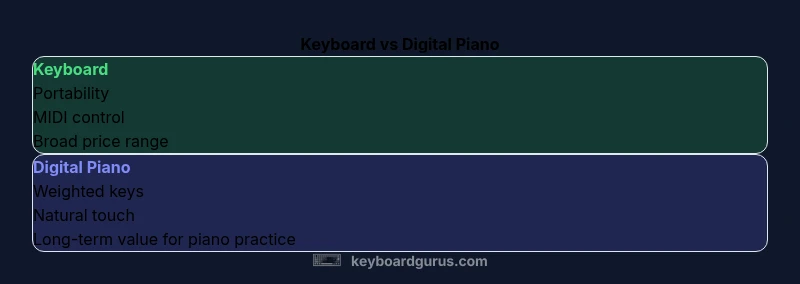
- Excellent portability and lower price point
- Great MIDI and DAW integration for creators
- Broad range of features and learning tools
- Easier to upgrade or customize over time
Drawbacks
- Unweighted or semi-weighted keyboards lack piano touch
- Digital pianos with weighted keys can be expensive
- Speaker quality on budget models is limited
- Less suited for large-venue stage use without external amplification
Digital piano with weighted keys is typically the stronger choice for serious piano practice; keyboards excel in portability and MIDI control.
If your priority is authentic piano touch and reliable home practice, the digital piano wins. If you need portability, broad software integration, and budget flexibility, a keyboard is the better fit. The Keyboard Gurus team emphasizes aligning your gear with your goals and space.
Got Questions?
What is the key difference between a keyboard and a digital piano?
Both are keyboards, but digital pianos emphasize piano feel and sound quality. Keyboards focus on portability, MIDI control, and a broad range of built-in voices.
Key difference: digital pianos aim for piano feel; keyboards prioritize portability and MIDI versatility.
Do I need weighted keys to learn piano?
Weighted keys help develop piano technique and touch sensitivity. For beginners focused on general music making or DAW work, a non-weighted keyboard can still be useful, but weighted keys become important as you progress.
Weighted keys are important if you’re aiming to learn piano technique; for casual play, keyboards can work too.
Can a keyboard be used for home piano practice?
Yes, you can practice with a keyboard, especially if it has velocity sensitivity and good software support. For a more authentic piano experience, a digital piano with weighted keys is preferable.
You can use a keyboard at home, but a weighted digital piano feels more like the real instrument.
Are there digital pianos that are easy to move?
Some digital pianos are designed to be more portable, with lighter stands and compact footprints. Look for models marketed as portable or with compact designs and lighter action.
There are portable digital pianos, but they still tend to be heavier than most keyboards.
Which is better for beginners?
For beginners, a keyboard offers affordability and practice versatility. If the goal is to develop piano technique quickly, a digital piano with weighted keys provides a more accurate feel from the start.
If you plan to learn piano seriously, start with a weighted digital piano; otherwise, a keyboard is fine for learning and exploring sounds.
How should I test one before buying?
Test key action, sound realism, polyphony, pedal response, and ease of connecting to your computer or DAW. If possible, compare multiple models side-by-side in a store or at a demo event.
Try several models side by side to feel the touch and hear how the piano samples respond to different playing styles.
What to Remember
- Assess primary use: practice vs portability
- Prioritize weighted keys if piano skills are the goal
- Check polyphony and sample realism for genuine feel
- Factor space and budget before buying
- Test instruments in person before committing to a model