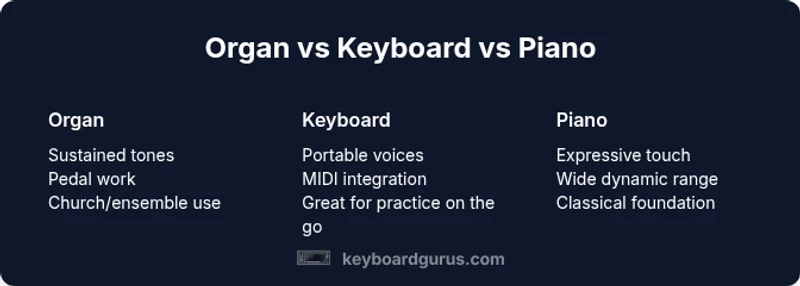
Organ vs Keyboard vs Piano: A Comprehensive Comparison
A thorough, data-driven comparison of organ, keyboard, and piano to help players choose based on sound, touch, portability, and performance goals.


Organ vs keyboard vs piano: which instrument fits your needs? The organ emphasizes sustained tones and pedal action, the keyboard prioritizes portability and programmable features, and the piano delivers expressive touch and dynamic range. Your choice should consider genre, space, and practice goals, not just brand or trend. All three paths have their own strengths, and hybrid rigs often blend elements for practical setups.
What organ, keyboard, and piano really offer (and where they shine)
According to Keyboard Gurus, the organ, keyboard, and piano occupy overlapping but distinct roles in modern music contexts. The phrase organ vs keyboard vs piano is not about chasing a single best instrument; it's about mapping sound goals to mechanisms. Each instrument embodies a different philosophy of touch, sustain, and expressivity, and understanding these differences helps players pick wisely rather than chase trends. The organ is built around sustained tone and pedal control; its keys are tuned to produce generous legato and shimmering chords, often in ensemble settings or sacred spaces. A keyboard, by contrast, emphasizes versatility: portability, programmable voices, MIDI integration, and immediate accessibility for practice, composition, and live performances where space or budget is limited. Finally, the piano provides the most directly expressive keyboard action and a wide dynamic range that responds to touch, nuance, and technique. The organ vs keyboard vs piano trio thus presents a spectrum rather than a single winner, with each instrument serving different musical futures.
In practice, many students start with a keyboard to learn core musical concepts before committing to a piano or organ setup. Keyboard feel, voice presets, and MIDI compatibility can accelerate learning and experimentation, especially for genres like pop, film scoring, and electronic music. Yet for classical training, the piano remains the benchmark for touch and tone development, while the organ offers a gateway into liturgical performance and cathedral timbres. The central question remains: what are your primary goals, and what environment do you have to support growth? The Keyboard Gurus approach emphasizes intent first, then tool selection, ensuring organ vs keyboard vs piano aligns with authentic practice and performance needs.
This framework helps avoid overinvestment in trendy gear. Instead, you assess the instrument’s relationship to technique, repertoire, and venue, and then choose tools that reinforce long-term progress. The organ’s pedal discipline, the keyboard’s versatility, and the piano’s expressive certainty each facilitate different learning curves and musical ambitions. If your aim is versatility and mobility, a modern keyboard or digital piano can bridge gaps; if you seek sacred music or ensemble textures, the organ offers unique capabilities; and if you want a robust path to classical technique, the piano is often the most dependable foundation.
- Note: this block lightly references organ vs keyboard vs piano across contexts to establish scope.
Feature Comparison
| Feature | Organ | Keyboard | Piano |
|---|---|---|---|
| Sound signature | Sustained, choir-like tones with pedal support | Versatile, digitally sourced voices; strong options for synth textures | Acoustic or highly responsive digital action with broad dynamic range |
| Touch/Action | Multiple manuals; pedalboard; heavy action in many setups | Lightweight to medium-weight action; velocity-sensitive; programmable | Weighted or graded hammer action; nuanced touch sensitivity |
| Portability | Typically heavy; often requires dedicated space or stage rig | Highly portable; fits small studios or travel setups | Heavy if acoustic (upright/grand); digital pianos vary in portability |
| Typical use case | Sacred services, pipe-organ timbres, ensemble church music | Practice spaces, studios, live gigs with space constraints | Classical repertoire, contemporary performance, general-purpose keyboard |
| Cost range | Mid-to-high for traditional pipe-organ installations; digital emulations vary | Low to mid for portable keyboards; wide range of models | Mid-to-high for acoustic grands; digital pianos offer affordable options |
| Best for | Worship contexts and pedal-focused texture | Practice, composition, and on-the-go performances | Developing technique, repertoire breadth, and expressive control |
Advantages
- Clarifies learning path by instrument role, reducing buyer confusion
- Wide model variety and price points enable gradual progression
- Digital keyboards offer MIDI, voice options, and portability for practice
- Pianos offer the strongest foundational touch for technique and repertoire
Drawbacks
- Organ setups require space and a dedicated rig, which can limit room for growth
- Pianos are heavy and maintenance-intensive compared to portable keyboards
- Digital keyboards may not perfectly replicate true acoustic piano touch or organ pipe response
- Hybrid rigs can complicate maintenance and resale value
Piano is the most versatile and foundational choice for long-term musical development; organ and keyboard fill essential niches when their unique capabilities are needed.
Choose the piano to build technique and repertoire across genres. Opt for organ when sustained textures and pedal control are priorities, and use a keyboard for portability, modern sounds, and MIDI-driven workflows.
Got Questions?
What is the fundamental difference between organ, keyboard, and piano?
The organ relies on sustained tones and pedal work to create its characteristic textures, the piano emphasizes touch sensitivity and expressive dynamics without sustaining pedals in the same ways, and the keyboard provides portable, programmable sounds with flexible routing. Each serves different musical goals and environments.
Organ emphasizes sustain and pedals; piano focuses on expressive touch; keyboard offers portable versatility.
Can a keyboard imitate organ or piano adequately for beginners?
A good digital keyboard can reasonably emulate piano sounds and some organ textures, especially for practice and basic ensemble work. However, authentic organ or piano response depends on specialized action and sound engines, so consider future upgrades if you intend to study organ or classical piano deeply.
A keyboard works for practice now, but you’ll outgrow it if you pursue advanced organ or piano technique.
Is organ playing easier than piano?
Organ technique often demands strong coordination and sustained pedal work, which can be challenging for beginners. Piano generally offers a clearer path to developing finger independence and tonal control. The difficulty also depends on the particular organ or piano model and the repertoire.
Organ is not necessarily easier; it depends on goals and the instrument's setup.
Which instrument is best for beginners?
For pure technique development, the piano is typically the best starting point due to its universal keyboard layout and strong pedagogy. Beginners who expect to work in worship, or who need compact gear, may start with a keyboard or an organ with simplified needs.
Piano is usually the best starting point for beginners, with keyboards being a good stepping stone for portability.
What should I consider if I have limited space?
In tight spaces, a compact digital keyboard or a portable digital piano can meet practice needs without the footprint of an acoustic piano or pipe organ. For organ-style work, you can investigate digital organs with compact pedal setups. Plan for future growth while staying within space constraints.
If space is tight, start with a compact keyboard or digital piano and scale up later if needed.
Are there hybrid instruments that combine elements?
Yes. Hybrid instruments blend elements of organ, keyboard, and piano, often through MIDI, layered voices, and hybrid action. They are popular for studio work and live performance paths that require flexible sound design without committing to a single traditional instrument.
Hybrid instruments mix features from all three, offering flexibility for many gigs.
What to Remember
- Define your primary use case before shopping
- Pianos provide the best overall technique foundation
- Organ excels in sustain, texture, and ensemble roles
- Keyboards shine for portability and versatility
- Hybrid setups are common and practical for flexible learning